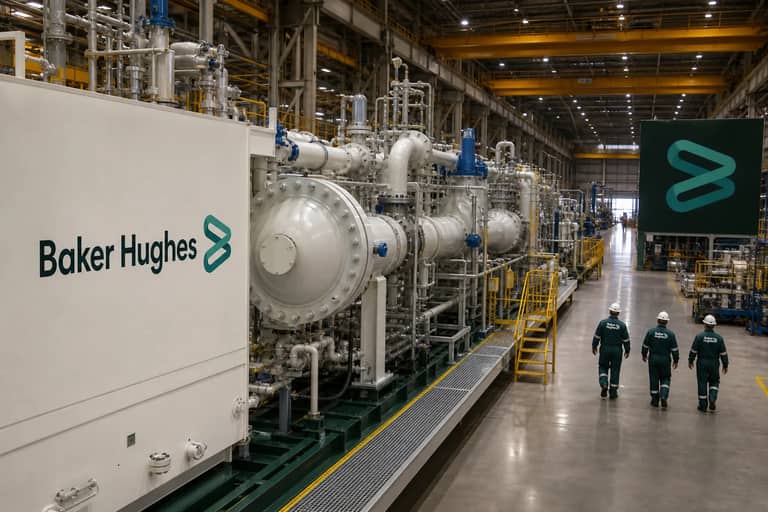
Baker Hughes has $37.1 billion of contracted industrial and energy work still to deliver. Its oilfield unit has $3.0 billion. That divide is large enough to change how investors should judge the company, which has long been known mainly for drilling and oilfield equipment.
The immediate issue is execution. Industrial & Energy Technology, or IET, is winning major gas, power, and LNG work, but its revenue was flat in the latest quarter. Baker Hughes also took on new borrowing to help fund the Chart Industries acquisition. The company now has a larger opportunity, along with less room for delays.
The next quarterly report needs to show that orders are becoming revenue without weakening margins or cash flow.
IET now holds nearly all future work
Baker Hughes reported $40.1 billion in remaining performance obligations at the end of the period. That is the company's measure of signed work that has not yet been completed. IET held almost 93% of that total, while Oilfield Services & Equipment, or OFSE, held the rest.
This is a different future mix from the company's public image. IET sells equipment and services for gas infrastructure, power generation, and LNG projects. The oilfield segment supports drilling and production. Both units still matter to current profit, but the contract base places most future delivery work in industrial energy systems rather than oilfield activity.
That creates a useful distinction for investors. A large order book gives Baker Hughes more visibility than a business dependent only on near-term drilling budgets. But it also makes results more dependent on manufacturing capacity, project timing, installation work, and service execution. These long-cycle businesses can create durable revenue, yet signed orders rarely become sales overnight.
The contract mix now points to industrial energy systems as the main source of future delivery work.
The company booked $10.501 billion of total orders during the period, up 49% from a year earlier. IET accounted for $7.088 billion, more than double its prior-year level. The result shows Baker Hughes is gaining exposure to a new round of spending on gas-fired power, LNG infrastructure, and related equipment.
Contracted work, however, is not the same as reported sales. The investment case now turns on the distance between those measures.
Orders surged while sales stayed flat
IET revenue was $3.291 billion during that period, unchanged from a year earlier. At the same time, segment EBITDA, a measure of operating profit before interest, taxes, depreciation, and amortization, rose 16% to $678 million. The profit improvement is encouraging, but flat revenue shows that recent orders have not yet reached the income statement in a meaningful way.
That timing gap is normal in large equipment projects. A turbine, compressor, or LNG system may require design work, manufacturing, delivery, and installation before the seller recognizes much revenue. Service contracts can then create recurring work after the original equipment is installed. The order book matters because it can support future sales, not because it has already produced them.
Baker Hughes' IET obligation balance gives clues about the future mix. Gas Technology Equipment held $15.0 billion of work still to complete. Gas Technology Services held another $16.7 billion. Equipment creates the initial delivery opportunity, while service work can extend the relationship after a project enters operation.
Management also pointed to demand tied to North American data centers and energy infrastructure. Baker Hughes received a 76-turbine award representing about 1.3 gigawatts of capacity. Its agreement with Kodiak Gas Services began with a 1-gigawatt award and could reach as much as 1.8 gigawatts.
Those awards explain part of the order growth, but they do not establish the pace of revenue conversion.
That is where the next few quarters matter. IET needs to show sales growth while protecting operating profit. Rising revenue with falling margins would suggest that delivery costs or capacity expansion are consuming too much of the benefit. Stronger sales and stable or better profitability would show that the order base has value beyond a headline total.
Chart expands the opportunity and adds pressure
Baker Hughes completed its acquisition of Chart Industries on July 16. Chart adds thermal management, gas handling, compression, and aftermarket capabilities. Those products fit with Baker Hughes' push into gas equipment and LNG projects, where customers often need complex systems and support over many years.
The strategic logic is straightforward. Baker Hughes can offer more equipment around a large industrial project, then pursue service work after installation. That fits the composition of IET's contracted work, which already leans heavily toward gas equipment and gas services.
Management raised its 2026 through 2028 outlook for IET orders to more than $45 billion and said it would expand capacity. The acquisition broadens the product range available for that growth plan. It may also give Baker Hughes more chances to win work across a project rather than supplying a single component.
But the deal changes the financial test as well.
Baker Hughes generated $1.109 billion of free cash flow in the quarter, compared with $239 million a year earlier. Free cash flow is cash left after operating needs and capital spending. It can support capacity additions, integration costs, and debt service, but one strong period does not prove that cash generation will remain at that level through an acquisition integration.
To finance part of the deal, Baker Hughes borrowed $2.0 billion under new term loans. The loans mature two years after funding. That maturity does not mean the company faces an immediate cash crunch, but it makes cash conversion more important. Management must show that the acquired business and the IET order book can produce cash before the financing window closes.
The debt is manageable only if the operating plan works. Delayed projects, weaker margins, or integration costs that run ahead of revenue would make the new borrowing more burdensome than the period's cash flow suggests.
The oilfield business remains the near-term drag
The shift toward IET does not make OFSE irrelevant. The oilfield unit produced $3.451 billion of revenue in the latest results, down 5% from a year earlier. Its EBITDA fell 11% to $605 million. Management cited Middle East disruptions among the pressures on the business.
The oilfield unit therefore remains the strongest countercase to the industrial growth story. It still contributes meaningful revenue and profit today, while IET waits for recent orders to move through its delivery cycle. Baker Hughes could have a strong long-term industrial order book while consolidated earnings remain under pressure in the near term.
The mismatch is visible in the latest results. IET improved operating profit despite flat sales, while the oilfield business saw both revenue and profit decline. If that pattern persists, investors will have to decide how much credit to give Baker Hughes for future work that has yet to become current earnings.
A weaker oilfield cycle would not invalidate the IET strategy. It would raise the standard for execution. The industrial segment would need to convert enough work into higher-margin revenue to offset pressure from the legacy business and the cost of expanding capacity.
That is a demanding but measurable test.
The next report must prove conversion
Baker Hughes has established demand for its industrial energy products. The more important question is whether that demand can move through factories and projects fast enough to improve reported results. Investors should focus first on IET revenue growth, then on whether segment profit holds up as the company expands capacity and integrates Chart.
Cash flow is the other key measure. The company needs enough internally generated cash to support investment and integration while carrying the new term loans. New acquisition-related orders and evidence of recurring aftermarket service revenue would strengthen the case that the deal is adding to IET's growth path rather than simply increasing costs.
The next results will show whether Baker Hughes can turn a large contract book into sales, cash, and a more durable earnings base.