What Happened at Cape Canaveral
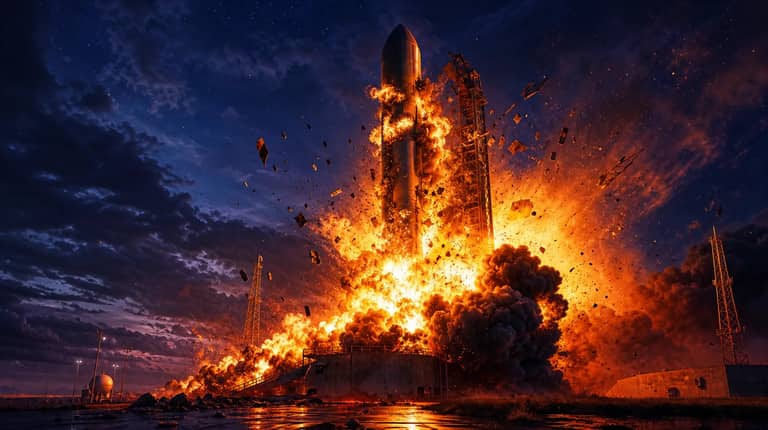
Blue Origin's New Glenn rocket exploded during a static fire test at Launch Complex 36 at Cape Canaveral Space Force Station around 9 PM ET on Thursday. All seven BE-4 methane-fueled engines were being tested when the 320-foot vehicle erupted into a fireball visible for miles.
The 188-foot first stage was engulfed in flames. The 86-foot upper stage tilted and began to collapse. Seconds later, the full fuel load of liquid methane and liquid oxygen detonated. Jeff Bezos confirmed all personnel were safe. No injuries were reported.
This is the worst failure in Blue Origin's 26-year history. New Glenn had completed three flights: a successful debut in January 2025, a second mission in November 2025 that achieved the first booster landing, and an April 2026 flight where the booster landed but the upper stage failed to deliver AST SpaceMobile's BlueBird 7 satellite to orbit.
The Pad Problem
Blue Origin has only one New Glenn launch pad. It was damaged in the explosion. Until that pad is rebuilt and a new rocket is assembled, New Glenn cannot fly. There is no backup facility and no timeline for return to service.
That single point of failure now affects Amazon's entire satellite strategy. Amazon contracted Blue Origin for 24 New Glenn launches to deploy its Project Kuiper internet constellation. The entire 24-mission manifest is suspended with no resumption date.
Amazon confirmed no operational Kuiper satellites were on the rocket during the test. But the delay puts Kuiper further behind SpaceX's Starlink network, which already has thousands of satellites in orbit and is generating billions in annual revenue.
What This Means for SpaceX
SpaceX is now the only company with an operational U.S. heavy-lift rocket. Its Falcon Heavy has been flying since 2018 with a near-perfect record. The Starship superheavy vehicle is in active testing, though it faces its own FAA investigation after a booster mishap on Flight 12.
The timing matters. SpaceX's IPO roadshow begins June 4. Pricing is set for June 11, with trading under ticker SPCX on June 12 at a reported valuation of roughly $1.8 trillion. Blue Origin's failure removes the strongest competitive narrative against SpaceX. The company Bezos founded to rival Musk's dominance in space just lost its rocket and its only pad.
For investors evaluating the SpaceX IPO, the competitive moat just got wider. VonTrend covered the full IPO timeline and how retail investors can buy it earlier this month.
How Space Stocks Reacted
The premarket reaction was severe. AST SpaceMobile fell roughly 14% before the opening bell on fears about future satellite launches. Rocket Lab dropped around 5%. Intuitive Machines fell about 7%. Planet Labs slid nearly 5%.
The selling reversed almost entirely during the regular session. AST SpaceMobile is trading higher on the day. Rocket Lab is down modestly. Intuitive Machines is up sharply. Virgin Galactic is up sharply in early trading, with traders positioning it as the "only space tourism pure play" unaffected by launch vehicle failures.
The quick recovery suggests the market sees this as a Blue Origin problem, not a sector problem. The companies that launch on SpaceX rockets were never at risk. The ones exposed to New Glenn, primarily AST SpaceMobile through its BlueBird program, face the most uncertainty.
What Investors Should Watch
Two questions will determine how this plays out. First, how long does it take Blue Origin to rebuild Launch Complex 36 and return New Glenn to flight? The company has not provided a timeline, and reconstructing a launch pad after an explosion of this scale is not a quick fix.
Second, does Amazon shift Kuiper launches to alternative vehicles? SpaceX's Falcon 9 and United Launch Alliance's Vulcan Centaur are both capable of launching Kuiper satellites. Amazon previously contracted with both providers as backups. If Amazon accelerates those contracts, it further validates SpaceX's monopoly position in commercial launch.
The FAA now has two simultaneous rocket investigations open: SpaceX's Starship Flight 12 booster mishap and Blue Origin's New Glenn pad explosion. Regulatory attention on the commercial space sector is rising at the same moment SpaceX is trying to go public.