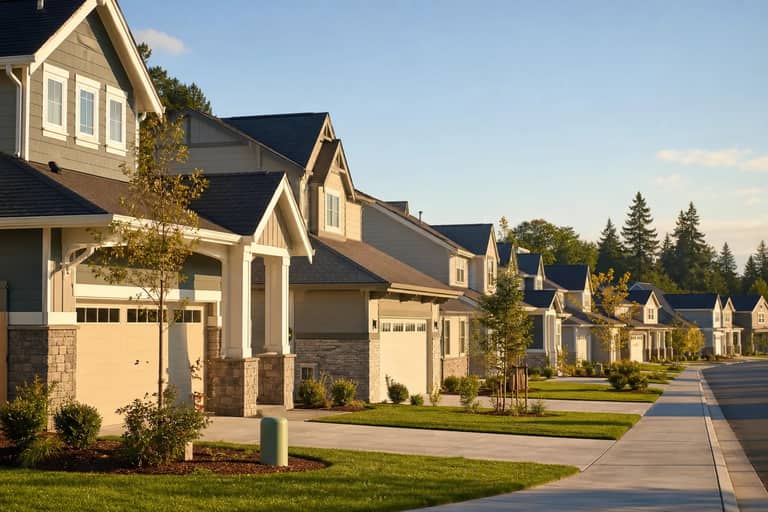
Owner-occupiers are not buying enough new homes to clear the lot. Existing sales sit near three-decade lows, unsold new inventory has climbed for two years, and builders answered the only way a volume business can: they changed the customer mix.
The structural shift is build-to-rent. In 2025, Harvard's Joint Center for Housing Studies counted 106,000 completed single-family homes built for rent — 11% of single-family completions, nearly three times the historical average. That is not a one-month starts print. It is a multi-year rewrite of who absorbs new supply.
- Harvard JCHS reports build-to-rent reached 11% of single-family completions in 2025 (106,000 units), versus roughly 4% averaged through the 2000s and 2010s.
- The same report shows single-family starts fell 7% in 2025, unsold new inventory rose 54% over two years to 127,000 units by January 2026, and builders pivoted to smaller floor plans, townhomes, and rate buydowns.
- NAHB's September 2026 Housing Market Index found 38% of builders cutting prices (average 6%) and 66% using sales incentives — still the dominant playbook even as the institutional rental channel grows.
The second customer is institutional and local landlords
When a retail buyer needs roughly $120,000 of income to clear the median new single-family home near $417,400, the for-sale funnel thins. JCHS notes builders still cut prices and buy down rates, but they also sell finished product into single-family rental portfolios. That second customer does not need a 30-year fixed at a payment the median renter can stretch to own. They need yield, scale, and a house that rents in a still-tight vacancy regime.
Vacancy is not the 2009 glut story. Nationwide homeowner and renter vacancy rates remain below 1990s averages at 1.1% and 7.3% in early 2026. The shortage of units is easing from pandemic lows, but it has not flipped into surplus. That backdrop keeps single-family rentals economically relevant even while for-sale demand stalls.
Product mix is the tell. Homes under 1,800 square feet rose from 23% of single-family completions in 2022 to 31% in 2024. Townhomes climbed to 18% of completions in 2025 from 13% in 2022. Lots under 7,000 square feet hit a record 39% share. Smaller, denser, cheaper-to-build stock is what both stretched retail buyers and rental operators can underwrite.
Incentives are a margin tax; BTR is a volume valve
Price cuts and mortgage buydowns protect absorption, but they tax builder margins and do not restore pre-pandemic traffic. NAHB's September reading put confidence at 32, with two-thirds of builders still leaning on incentives. That is a defensive tool, not a growth engine.
Build-to-rent is the volume valve. It lets community builders and larger publics keep crews busy, rotate finished inventory, and match a household formation pattern that favors renting while ownership stays out of reach for many under-35 households. JCHS also flags that higher-income renters drove most recent renter growth — exactly the demographic that can support institutional single-family rental rents even when they cannot clear a down payment.
This is distinct from the commercial maturity-wall credit story. The cash flows here sit in residential builders, land banks, and single-family rental operators — not office or retail refinance risk. The risk is different too: if immigration and household formation keep slowing, rental demand softens; if mortgage rates ease enough to revive retail buyers, BTR's share of completions can compress. Neither outcome is a same-week headline. Both are multi-quarter paths.
What investors should watch
Do not treat every homebuilder as a pure rate-cut call. The durable question is mix: how much of new single-family supply keeps flowing to rental counterparties, and whether smaller floor plans become the permanent center of gravity.
Watch three markers across the next several quarters. First, BTR's share of single-family completions — whether it holds near double digits or fades if retail demand returns. Second, the persistence of price cuts and incentives in NAHB surveys versus improvement in buyer traffic. Third, how public builders guide community mix, average selling price, and land spend toward entry-level and rental-ready product.
For a 50-plus investor, the asymmetrical frame is simple. Ownership demand is still capped by price-to-income and payment math. Builders that already rebuilt their machine around a second customer — the landlord — are not waiting for the old buyer to come back. Build-to-rent is not a side channel anymore. It is part of the playbook.