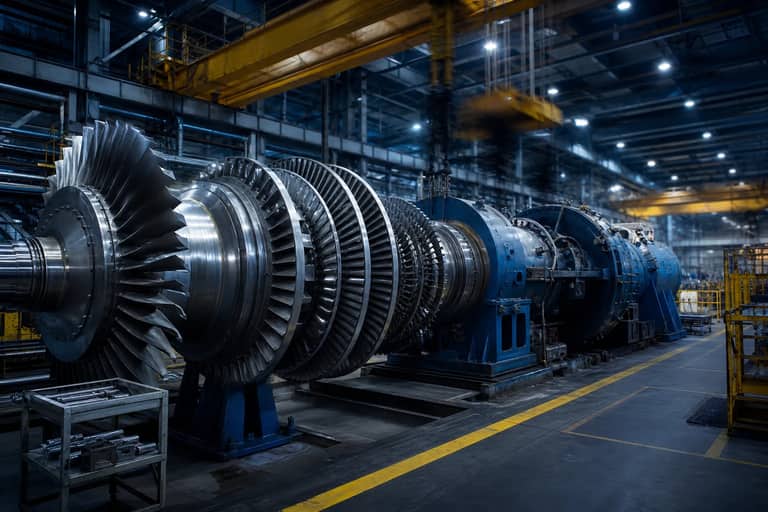
Morning markets still treat artificial intelligence as a chip and software story. The multi-year constraint sitting underneath those earnings is more industrial: high-efficiency combined-cycle gas turbines are effectively sold out, order books stretch into the next decade, and prices have nearly tripled since the last cycle. That is a scarcity trade with pricing power, not a one-session tape story.
For investors who own power-equipment makers, independent power producers, utilities, and the EPC firms that turn steel into megawatts, the asymmetrical setup is simple. Data-center load wants firm, dispatchable power. The preferred machines take years to get, so developers are paying up, locking slots early, or pivoting to substitutes that can ship sooner.
- J.P. Morgan Private Bank notes that demand for high-efficiency combined-cycle gas turbines has run so far ahead of supply that the largest manufacturers are effectively sold out, with some order books extending to 2030–31 and prices up about 195% since 2019.
- The same note cites GE Vernova, Siemens Energy, and Mitsubishi Power as the three main suppliers, with an estimated 77% market share in the second quarter of 2026.
- Wood Mackenzie’s April 2026 research puts global turbine orders at about 110 GW at end-2025 against manufacturing capacity of only 60–70 GW, and sees prices approaching $600/kW by end-2027, a 195% rise since 2019.
Sold out is the durable fact
J.P. Morgan Private Bank’s scarcity research frames the U.S. power build-out for data centers as a textbook bottleneck: control what is scarce, or build around it. High-efficiency combined-cycle units sit in the first bucket. When the preferred equipment is unavailable, reciprocating engines and aeroderivative turbines move into the second.
Wood Mackenzie’s April 1, 2026 press release on the U.S. gas turbine market makes the imbalance concrete. Global orders sat near 110 GW at the end of 2025 while worldwide manufacturing capacity was only 60–70 GW. Analyst Aurora Tenorio noted that turbines can account for roughly 20–30% of combined-cycle project costs (and more for simple-cycle), with six-year lead times and order books sold through 2027 shifting decisions from fuel economics to procurement strategy.
OEM disclosures line up with that backlog story. GE Vernova has told investors it is taking reservations for 2031 deliveries as combined gas equipment backlog and slot reservations climb well into the triple-digit gigawatts. Siemens Energy and Mitsubishi Power have similarly long books into the late decade. The precise gigawatt figures differ by accounting (firm equipment versus paid slot reservations), but the investor takeaway does not: near-term large-frame slots are scarce, and the calendar, not the spark spread alone, now sets project timing.
Capacity additions will not clear the queue overnight
Manufacturers are spending to catch up. Wood Mackenzie notes GE Vernova investing more than $160 million to lift large-frame output from roughly 50 units a year toward 70–80 by late 2026, Siemens Energy moving key facilities to 24/7 operations with a $1 billion U.S. investment program, and Mitsubishi Heavy Industries planning to roughly double manufacturing capacity through 2028.
Those are real programs. They are also not a quick fix. WoodMac’s research flags specialized labor shortages and hot-section component manufacturing, especially single-crystal blade production, as the stubborn chokepoint, because only a handful of global suppliers can do that work at scale. For a multi-quarter investor, that means pricing power and backlog visibility can persist even while OEMs announce bigger factories.
The workaround: engines and aeroderivatives
J.P. Morgan’s note is clear that the durable response to scarcity is not only paying up forever. Developers chasing fast behind-the-meter power for data centers have turned to substitutes industrial suppliers can deliver now: reciprocating engines and aeroderivative turbines. Neither is a perfect replacement for a large frame combined-cycle machine. Both are available, dispatchable, and suited to modular on-site generation when grid interconnection timelines stretch.
That pivot matters for portfolio construction. The AI power story is not only “own the three turbine OEMs.” It also includes the suppliers and developers who can put firm megawatts next to a campus while the large-frame queue stays full. Watch whether engine and aero order books keep filling as a leading indicator that the large-turbine bottleneck is still binding.
What this means for portfolios
This is a scarcity and pricing-power thesis, not a call to chase every power-theme ticker. Execution risk, EPC labor, interconnection queues, and commodity gas prices still matter. Speculative developer stories can re-rate hard when a turbine slot slips a year. Franchises with backlog, aftermarket services, manufacturing scale, and named data-center or utility customers sit closer to cash-flow visibility.
Watch three multi-quarter markers. First, whether large-frame order books and slot reservations keep extending into 2031 rather than shortening. Second, whether WoodMac-style price and lead-time pressure stays elevated even as OEMs expand capacity. Third, whether reciprocating-engine and aeroderivative orders keep rising as the explicit workaround for behind-the-meter AI load.
Chips train the models. Turbines, engines, and interconnection keep them running. For patient capital, the near-term AI power trade is less about another software narrative and more about who controls the scarce machines that turn gas into firm megawatts.