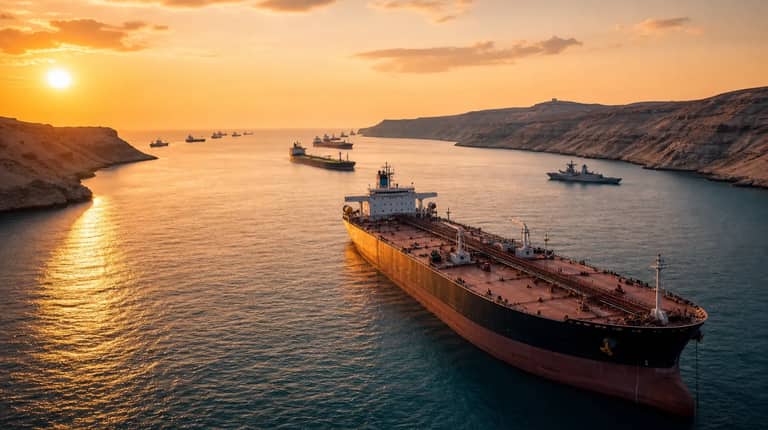
Iran's top joint military command declared the Strait of Hormuz closed overnight, to oil tankers and commercial ships alike, and warned that any vessel attempting passage will be fired on. The declaration came hours after a fresh round of U.S. strikes on Iranian air defense and communications sites.
Brent rose about 2.5% to around $95 a barrel by midday. WTI is up a touch more, near $92. That is the entire reaction to the formal shutdown of a waterway that carried about a quarter of the world's seaborne oil before the war.
A $2 move on a closure announcement is not complacency. It is the market telling you the closure already happened months ago, and pointing you toward the trades that are actually working.
A Declaration of Something That Already Existed
The strait has been largely blocked since late February, when the air war began and Iran started boarding ships, laying mines, and warning off tankers. Crude spiked as high as roughly $126 a barrel earlier in the crisis, against a pre-war price near $65. The announcement formalizes a blockade the physical market has been living with for more than three months.
The U.S. military pushed back within hours, saying commercial ships continue to transit in and out of the strait, and limited volumes are still leaving the Gulf. Three supertankers carrying a reported 6 million barrels exited the strait this week.
Supply has found other routes around the chokepoint. The Strategic Petroleum Reserve has dropped below 360 million barrels, its lowest since April 2024, after roughly 50 million barrels of releases since the conflict began. OPEC+ has approved four output increases since the closure, the latest adding 188,000 barrels per day from July. And Chinese crude imports are running at an eight-year low, draining demand from the same market the war is squeezing.
That is why traders are pricing a long grind instead of a spike. The question for crude is no longer whether the strait closes. It is how long the buffers holding the price under $100 can keep absorbing the loss.
The Money Is Going to the Toll Takers, Not the Producers
Look at what is moving today and a pattern emerges. The market is not paying the companies that pump oil. It is paying the companies that profit from the war itself.
Defense primes are having their cleanest session of the conflict. General Dynamics is up almost 5% to around $358, within about 3% of its 52-week high. Lockheed Martin is up more than 3% to around $544, Northrop Grumman is up about 2.6%, and RTX is up more than 2%. The iShares U.S. Aerospace & Defense ETF is up about 2.5%.
That move matters because it is a break in character. On Wednesday, a second straight day of U.S. strikes could not lift these names, and Lockheed fell 1% with the post-CPI tape. For three sessions the group traded on beta, not headlines. Today, with the index drifting, the war trade is finally decoupling.
The group is not expensive relative to its backlog visibility. General Dynamics trades around 23 times trailing earnings with 28 consecutive years of dividend increases and a yield near 1.8%. Lockheed yields around 2.25% and still sits more than 20% below its 52-week high of $692, even after today's move.
Tankers Are the Purest Expression of a Closed Strait
Every barrel that still moves through a war zone pays for the privilege. War-risk insurance premiums, rerouted voyages, and scarce willing vessels have pushed spot tanker rates to levels the industry has never seen. The benchmark Middle East-to-China VLCC rate reportedly hit a record above $420,000 per day during the crisis.
Frontline, one of the largest publicly traded tanker owners, posted a record adjusted profit in the first quarter and pays a variable dividend tied to spot earnings, most recently $1.55 per share. The stock is up more than 4% today near its 52-week high, and has more than doubled off its 52-week low.
The risk context cuts both ways. Spot rates are among the most volatile prices in any market, and a genuine reopening of the strait would deflate them quickly. Tanker stocks are a trade on disruption persisting, not a long-term holding thesis.
What Is Not Moving Tells You Just as Much
The producers are flat. Occidental Petroleum is up about half a percent and EOG Resources is unchanged on the day the strait formally closed. With crude capped under $100 by reserve releases and OPEC+ supply, the earnings upside for exploration and production names is also capped. The market is treating $90 oil as the ceiling of a range, not the start of a breakout.
Gold is pinned near $4,100, around a seven-month low, during a live shooting war. We covered the mechanics earlier this week: the metal is losing to interest rate math, because every dollar the war adds to oil feeds the inflation prints that keep the Fed hawkish. Wednesday's CPI showed energy driving more than 60% of the monthly increase, and this morning's wholesale inflation data ran at the fastest annual pace since 2022.
This is the same regime we flagged when nine of 11 S&P sectors closed higher on a strike day. The market treats the conflict as contained. What has changed since is that the containment trade now has clear winners inside it, and they are not the obvious ones.
What to Watch From Here
The next escalation rung is specific: a tanker actually fired on or struck while attempting passage. That converts the declaration from words into enforcement, and it is the event that pushes Brent through $100. Until then, the smuggled barrels, reserve releases, and OPEC+ additions keep a lid on price.
The second thing to watch is the Fed. The FOMC meets Tuesday and Wednesday, the new chair's first meeting, with wholesale inflation at a three-and-a-half-year high and a live energy shock on the table. A hawkish surprise would hit the producers and the primes alike, because June has already shown that in a rate-driven selloff, everything gets sold.
Watch the defense group's close today. If General Dynamics and Lockheed hold these gains into the bell while the index stays flat, the decoupling is real, and the war trade has finally separated from the tape after three failed attempts.