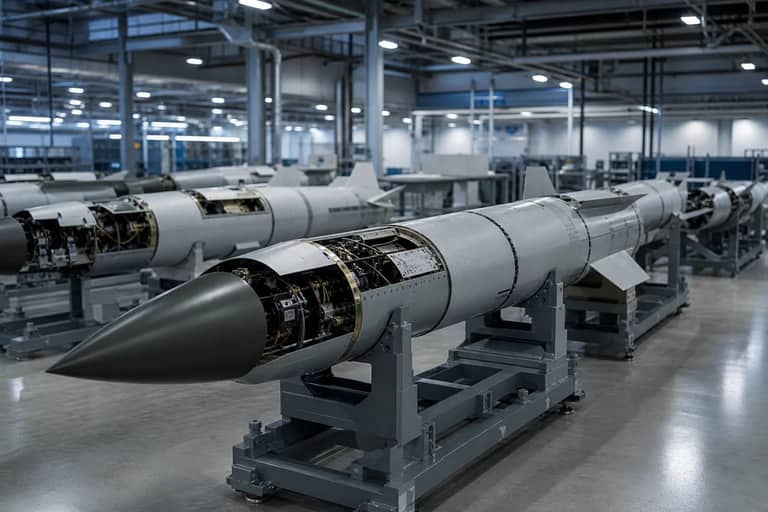
The durable defense story is not one missile announcement. It is Congress and the Pentagon shifting critical munitions from year-to-year spot buys to multiyear production authority, while prime contractors raise factory capacity against a multi-year demand signal.
For investors who own missile-defense and tactical-munition primes, suppliers, and defense ETFs, the cash-flow question is whether those multiyear frameworks keep filling backlog even when a single fiscal year gets noisy.
- CRS reports the Defense Department requested $35.7 billion in FY2026 procurement and RDT&E for missile and munitions programs, with $30.2 billion tied to the selected programs Congress tracked in detail.
- The FY2026 defense appropriations agreement granted multiyear procurement authority for eight Munitions Acceleration Council programs—including PAC-3 MSE, THAAD, Tomahawk, AMRAAM, SM-6, SM-3 IB, JASSM-ER, and LRASM—and funded more than $6.3 billion across the 13 critical munitions on that list.
- Lockheed Martin said a seven-year PAC-3 MSE framework targets annual capacity of about 2,000 interceptors, up from roughly 600, after delivering 620 in 2025; by mid-2026 its Missiles and Fire Control backlog had climbed to about $87.9 billion from $46.7 billion at year-end 2025.
Multiyear authority is the structural change
Annual appropriations still set the cash. Multiyear authority changes how factories and suppliers plan. The House-Senate FY2026 defense appropriations explanatory text said the Munitions Acceleration Council is meant to fix production challenges, cut unit costs with scale, and give the industrial base a clearer surge path. Controllers still required documentation under section 8010, so Congress approved multiyear authority for eight of the thirteen munitions DoD asked for, not a blank check.
That is still a regime shift from the Ukraine-era scramble for one-year buys. PAC-3 MSE, THAAD, Tomahawk, AMRAAM, Standard Missile variants, JASSM-ER, and LRASM sit in the approved set. Those lines feed homeland and theater missile defense, strike, and air-to-air inventories that allies also pull from.
CRS’s FY2026 weapons funding review also shows Congress topping up selected missile-defense lines above the request in the NDAA and appropriations process. The durable point for portfolios is not the exact delta in one bill. It is that missile defense and munitions keep winning bipartisan dollars while the Pentagon tries to buy them on longer contracts.
Factory capacity is catching the order book
Lockheed Martin’s January 2026 PAC-3 framework announcement put numbers on the industrial story: capacity aimed near 2,000 a year over seven years, after 620 deliveries in 2025 and more than a 60% production increase over the prior two years. Its mid-2026 results then showed Missiles and Fire Control backlog nearly doubling as multiyear THAAD work and PAC-3 ramps hit the books, lifting company backlog to about $230 billion.
DoD’s own FY2026 budget overview asked for about $2.5 billion specifically for munitions industrial-base work (organic and hypersonic) alongside larger submarine-industrial and IBAS/DPA investments. That is the supplier-layer spend investors should track next to prime backlog: energetics, seekers, solid rocket motors, and machine-shop capacity do not appear as ticker headlines, but they decide whether multiyear contracts ship on time.
What investors should watch
This is not a green light to buy every defense name because munitions are popular. Execution risk sits in supplier tooling, workforce, and whether FY2027 discretionary and mandatory dollars keep funding the frameworks Congress authorized. Reconciliation-heavy years can inflate a headline total that later needs to migrate into the base budget.
Watch three multi-quarter markers. First, whether PAC-3, THAAD, Tomahawk, and peer programs keep converting multiyear authority into definitized contracts and rising deliveries, not just press releases. Second, whether Missiles and Fire Control–style backlog and segment sales at the primes stay elevated for several quarters after the first wave of framework deals. Third, whether DoD and Congress keep funding the industrial-base line items that feed motors, seekers, and energetics—not only the finished missiles.
For a 50-plus investor, the portfolio question is simple. Who gets paid when the United States and allies restock interceptors and strike munitions on multiyear schedules, and who is stuck if capacity stalls? The munitions story moved from emergency restocking to industrial planning. That is a multi-year cash-flow cycle, not a one-week defense headline.