Orders are strong. Profitability is the dispute.
Northrop Grumman fell as much as 7.8% in Tuesday morning trading after a quarter that looked strong at first glance. Second-quarter diluted EPS was $7.68, versus analyst consensus of $6.82. Sales rose 5% to $10.9 billion.
Demand was even firmer than those results suggest. Northrop received $20 billion in net awards during the quarter, lifting backlog to a record $105 billion, up 17% from a year earlier. That is a large store of contracted work and a source of unusual revenue visibility across long-running defense programs.
The share reaction suggests investors are focused on a less comfortable question: how much of that future revenue will turn into profit?
Backlog measures work a company has won. It does not measure the return it will earn while doing that work. On complex, multiyear programs, a revised cost estimate can turn a welcome contract into years of weaker margins. Northrop’s quarter showed that risk in plain view.
The EPS result was better than expected by $0.86 a share, but operating income moved the other way. Company-wide operating income fell 23%, or $329 million, from the prior-year quarter. Operating margin dropped to 10.1% from 13.8%.
Sales growth paired with a steep profit decline is rarely a clean setup. It means the market has to judge whether cost pressure is limited to a few programs or reflects a wider problem in the portfolio.
The margin line carries the warning
Segment operating margin fell to 10.6% from 11.8%, led by Defense Systems and Space Systems. The most visible item was a $68 million unfavorable estimate-at-completion adjustment on the SiAW missile program. In practical terms, Northrop now expects a less favorable financial result from that work than it had assumed earlier.
Space Systems added to the pressure. Its operating income fell 16% from a year earlier to $236 million, while its operating margin declined to 8.6% from 10.6%.
Those figures do not erase the strength of the order book. They do change its meaning. A $105 billion backlog can support years of sales growth, yet still produce disappointing earnings if program costs keep rising or if more work carries lower returns than expected.
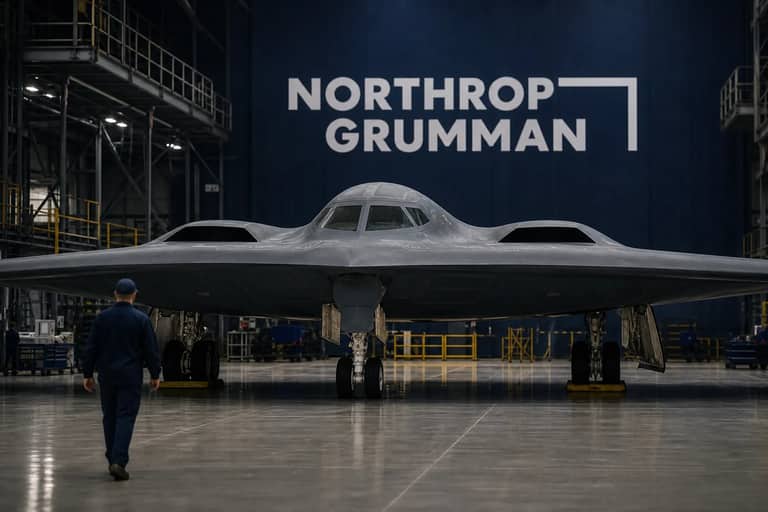
There is also a meaningful split inside Northrop. Aeronautics sales rose 13%, helped by B-21, TACAMO, and mature production programs. That business is showing the benefit of programs moving into production. The trouble is that investors cannot value every dollar of defense backlog as if it carries the same execution risk.
The current concern is concentrated in the weaker parts of the portfolio, especially Defense Systems and Space Systems. If that remains true, the margin decline may prove to be a costly but contained repair job. If more programs require estimate revisions, the record backlog could become a source of concern rather than comfort.
A higher outlook does not settle the margin question
Northrop did not signal a weaker demand outlook. It raised 2026 sales guidance by $250 million, to a range of $43.75 billion to $44.25 billion, from $43.50 billion to $44.00 billion. It also raised MTM-adjusted EPS guidance by $1.20, to $28.60 to $29.10, from $27.40 to $27.90.
Management expects stronger government outlays in the second half. That could help convert the expanding backlog into reported sales. The updated guidance gives the market a reason to believe the demand side remains intact.
But a higher sales forecast is not proof that the margin issue has passed. The market appears to be distinguishing between revenue visibility and earnings quality. Northrop has plenty of the first. The second now needs evidence.
The strongest countercase is straightforward. The SiAW adjustment could be program-specific, while Space Systems may be working through temporary pressure. Aeronautics is already growing at a 13% rate, and stronger government spending could improve overhead absorption as production rises. Under that view, the selloff may be treating a concentrated issue as a companywide trend.
That case weakens if the next results show another estimate-at-completion adjustment, further pressure in Space Systems, or another drop in segment margins. A single charge is manageable. Repeated revisions would suggest Northrop’s original cost assumptions are proving too optimistic across a broader set of programs.
The next proof point is operational
Northrop expects to begin delivering redesigned GEM 63XL motors by the end of 2026 after a successful static-fire test. Those deliveries would mark a shift from redesign work toward execution. They would not solve every margin issue, but they would give investors a concrete signal on whether one important program is progressing as planned.
Until then, the next quarterly margin figures carry more weight than another large award total. Investors will be watching whether Defense Systems and Space Systems contain costs while Aeronautics keeps growing. If those conditions hold, the record backlog can regain its value as an earnings asset. If charges spread, the market will keep treating that backlog as a long list of obligations with uncertain returns.