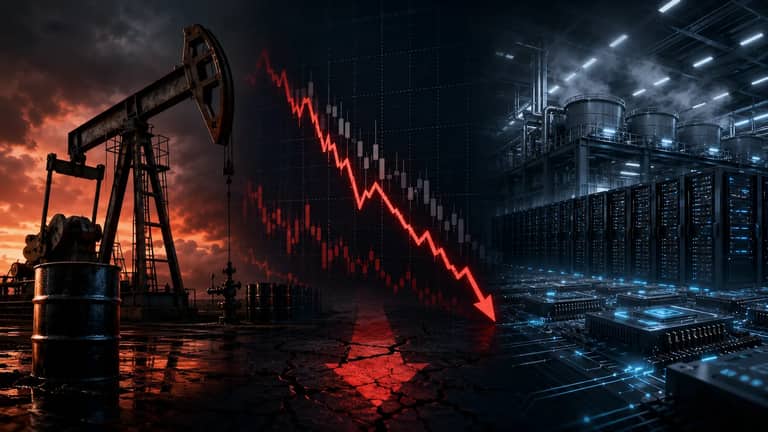
Stocks opened lower Thursday morning as oil rose to a multiweek high and fresh concern returned over the cost of the AI buildout. New U.S. strikes on Iran and Houthi targets raised threats to tanker traffic, while Alphabet and Tesla's second-quarter reports put technology spending back under a harsh light.
The question by late morning is whether those two pressures can last long enough to squeeze the wider market. Higher energy costs can revive inflation fears. Bigger AI budgets require companies to show that new data centers and computing equipment will produce enough revenue and cash flow to earn their keep.
Either concern can unsettle stocks on its own. Together, they create a tougher test for richly valued technology companies and for businesses that cannot easily pass higher fuel and input costs to customers.
Oil raises the cost of capital
Oil is not just an energy-sector issue when it stays elevated. Fuel costs reach airlines and freight operators first, but they also affect chemical makers, manufacturers, retailers, and households. A durable increase can leave consumers with less money to spend elsewhere and raise operating costs across much of the economy.
Integrated oil producers sit on the favorable side of the split. Higher crude prices can support the value of the oil they produce, though the benefit depends on how long prices hold and how their refining and other operations perform.
The broader risk runs through inflation and bond yields.
When oil rises sharply, investors must consider whether inflation will cool more slowly. If that concern pushes bond yields higher, borrowing becomes more expensive and investors may place a lower value on profits expected years from now. That is a direct challenge for companies whose stock valuations depend heavily on future growth.
High-valuation technology shares can be exposed even when their own sales remain strong. Their businesses may not use much oil directly. But a higher return on safer bonds raises the hurdle rate investors use for uncertain future profits. The result can be a lower valuation multiple, meaning investors pay less for each dollar of expected earnings.
This is why a shipping disruption can reach far beyond tanker companies.
The effect will not be equal across industries. Airlines and transport firms may have fuel hedges or contracts that delay the impact. Consumer-facing companies with strong brands may raise prices without losing many customers. Others may have to absorb higher costs in their margins because price-sensitive customers will not accept another increase.
That makes duration more important than Thursday morning's first move. A brief threat to shipping can lift oil without changing corporate profit forecasts. A prolonged disruption is different. It can alter inflation expectations, raise bond yields, and force investors to sort companies by their ability to protect margins.
AI spending now needs a clearer payoff
Alphabet and Tesla reported after the July 22 close, bringing a second concern into the same market session. The issue is no longer whether cloud and AI demand exist. The harder question is whether the spending needed to serve that demand will produce an acceptable return.
Capital spending is money a company puts into long-lived assets such as data centers, servers, and computing equipment. It can create a major advantage if demand fills that capacity. It can also weigh on cash flow for years if revenue does not grow fast enough to cover the investment and ongoing operating costs.
The public AI story has often treated demand as the answer. It is only the first step.
A company can have strong demand and still make a poor investment if it spends too much to meet it. New cloud capacity must bring in added sales, not simply shift existing customers into different products. Those sales must also be profitable enough to cover the power, equipment, maintenance, and staffing needed to run the infrastructure.
That creates a practical way to read the next technology reports. Cloud growth supports the demand case, but it does not settle the investment case. Investors need evidence that AI services are increasing customer spending, improving revenue per customer, supporting margins, or adding to cash generation as capacity expands.
The difference is material. Revenue can rise while free cash flow, the cash left after operating costs and capital spending, stays under pressure. In that case, a company may be growing but still asking investors to wait longer for the economic benefit of its AI investment.
Thursday's weakness does not prove investors have reached a shared verdict on AI spending. A stock move alone cannot establish the crowd's reasoning. It does show why the next round of results will face a higher standard: management teams must explain the return on new capacity, not simply the size of the capacity being built.
Two pressures can reinforce each other
The oil problem and the AI problem are linked by the cost of money. If energy prices keep inflation concerns alive, higher bond yields can reduce tolerance for companies spending heavily today for returns that may arrive later.
That does not mean a higher oil price directly weakens cloud demand. The connection is financial. A market that faces higher inflation risk tends to become less patient with long-duration investments, where much of the expected value sits in profits several years ahead.
AI infrastructure also uses significant computing power and energy. The available evidence does not establish how much Thursday's oil move changes those costs for any one company. Still, the direction of travel is unhelpful. Rising energy costs make the economic case for giant computing investments harder to assess, especially before the revenue payoff is clear.
The market is now judging two separate forms of spending at once. Households and businesses may face higher energy costs in the near term. Technology leaders may keep putting large sums into capacity that has to prove its value over a longer period.
That combination narrows the room for disappointment.
Companies with durable demand, strong pricing power, and proven cash generation may handle the pressure better. Companies that rely on distant profit expectations, thin margins, or easy access to cheap capital face a more demanding backdrop. The distinction is less about whether a business mentions AI and more about whether its investment can produce visible economic returns.
The strongest countercase is still real demand
The negative case requires both concerns to persist. That is far from certain. Oil spikes tied to shipping risk can fade if tanker traffic concerns ease and supply disruption does not broaden. A short-lived jump in crude may never have time to reshape inflation expectations or corporate spending plans.
AI demand can also remain durable while investors question the timing of its payoff. Customers may still want cloud capacity and AI tools. Companies building the infrastructure may still be right to invest. The missing piece is proof that the added capacity is filling quickly enough, at attractive enough economics, to justify the larger capital base.
That countercase is stronger than a simple claim that technology spending is harmless. It rests on observable evidence. If future reports show sustained cloud demand, higher spending by customers on AI services, and improving cash generation from the expanded infrastructure, the current concern over capital outlays could ease.
There is also a limit to the oil read-through. Energy producers can benefit from firmer crude, while many companies can absorb a short increase through hedges, contracts, or pricing. The more damaging outcome requires oil to remain high long enough to change inflation expectations and spending behavior.
The bearish view breaks if either side fades.
If shipping risks ease, oil may retreat before it becomes a broader cost shock. If AI spending starts to show clearer revenue and cash-flow returns, investors may again treat capital outlays as a source of future advantage rather than an open-ended bill.
The next test is straightforward: watch whether tanker traffic risk broadens or eases, then watch the next technology reports for proof that AI infrastructure is producing added revenue and cash flow. Those two signals will show whether Thursday's opening weakness reflects a lasting change in market conditions or a collision between two concerns that can still fade.