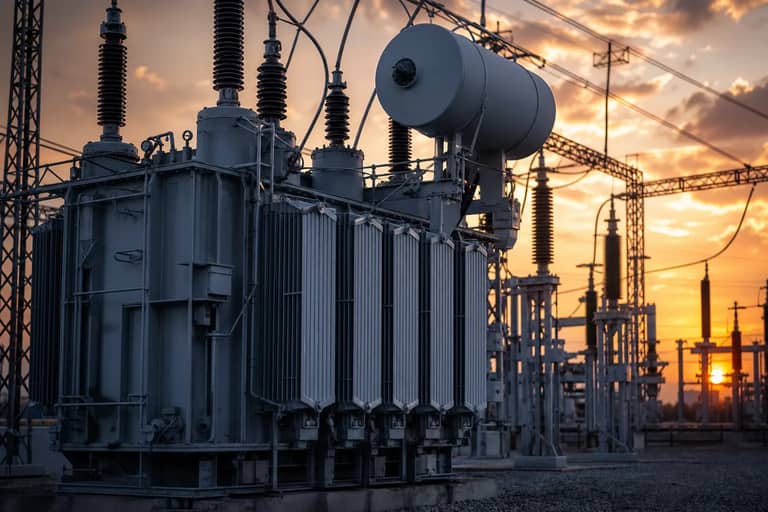
Turbines and copper get the investor airtime. The quieter multi-year choke on U.S. grid builds is still the large electrical gear that steps voltage up and down. Power transformers, switchgear, and related kit now sit on order books measured in years, not months, and new factory announcements mostly land capacity later this decade.
That is the asymmetrical setup for investors watching utilities, equipment makers, and data-center developers. Megawatts on a slide deck do not connect until the transformer slot arrives. The trend is durable: demand from data centers, electrification, and aging fleet replacement stacked on thin domestic manufacturing for years.
- In a March 2026 Department of Energy convening, Assistant Secretary for Electricity Katie Jereza said distribution transformer demand has jumped 41% since 2019, with order lead times rising from three to six months in 2019 to one to two years or longer by 2024, while large substation and generator units stretch three to as much as four years.
- Widely cited Wood Mackenzie survey work from the second quarter of 2025 put average power-transformer lead times near 128 weeks and generator step-up units near 144 weeks, with generator step-up demand up roughly 274% since 2019 and power-transformer demand up about 119% over the same span.
- Hitachi Energy’s September 15, 2026 announcement of a $528 million Gallman, Mississippi transformer plant, the cornerstone of an around $1.5 billion U.S. manufacturing expansion, still schedules production start in 2029, after a June groundbreaking on a $457 million large-power expansion in South Boston, Virginia.
Why transformers, not just turbines
A gas turbine or a restart reactor still needs a generator step-up transformer and a chain of substation and distribution units before customers see power. DOE’s Office of Electricity has been blunt that much of the grid still rests on 1960s and 1970s engineering, while AI campuses, factories, and load growth pull new capacity that shares the same scarce gear.
Jereza also flagged nearly 40,000 different distribution transformer configurations nationwide. That SKU sprawl slows factories, blocks mutual aid after storms, and makes inventory hard to share. DOE’s convening work with Oak Ridge National Laboratory, utilities, and manufacturers is trying to cut configurations and improve interchangeability. National Grid told the same webinar it had already cut 223 of roughly 700 distribution SKUs, about a 32% reduction, as one utility-side example of the same pressure.
Distribution eased. Large power did not
Some relief is real on the smaller end. At the same March 2026 DOE webinar, Prolec GE said lead times for distribution transformers had normalized over recent months, while special-purpose components such as certain arresters, breakers, and dual-voltage options still stretch schedules. That split matters for investors. Padmount and pole-top availability can improve without unlocking the multi-year bottleneck in large power and generator step-up classes that gate utility and data-center energization dates.
Federal work tracks the same story. The National Infrastructure Advisory Council’s June 2024 report to CISA described utilities waiting two to four years for transformers versus months as recently as 2020, and it set a goal of lifting domestic large-power transformer production toward 50% by 2029 from an estimated share near 20%. An April 23, 2026 Federal Register presidential determination under the Defense Production Act named transformers, high-voltage breakers, conductors, electrical core steel, and related grid gear as industrial resources essential to national defense, citing long lead times and limited domestic capacity.
Factories are coming. The calendar is slow
Hitachi Energy’s Gallman press release is a clear capital signal: more than double capacity versus Crystal Springs, over 700 jobs, and production not scheduled until 2029. The company also points to a $457 million South Boston, Virginia large-power expansion, a $106 million Alamo, Tennessee components project, and a $70 million Pennsylvania high-voltage equipment expansion, together framed as more than 1,600 jobs across the U.S. footprint.
Those are serious checks. They are not next-quarter relief. New transformer plants take years to staff, qualify, and fill slots already sold into backlogs. Grain-oriented electrical steel, copper, and specialized labor remain binding inputs. Capacity announcements can coexist with still-long quoted lead times for the largest units through the late 2020s.
What this means for portfolios
This is not a tip to chase every grid ticker on a headline. Equipment makers can miss on mix, execution, or a pause in utility CapEx. Utilities can absorb higher equipment prices in rate cases with lag. Data-center developers can redesign sites or slip in-service dates when transformer slots slip. Speculative names without backlog quality or manufacturing depth can re-rate hard when a single order book story fades.
For a 50-plus investor, watch multi-quarter markers instead of a single session’s tape. First, whether large-power and generator step-up lead times stay in the multi-year band even as distribution eases. Second, whether OEM factory start dates (Hitachi’s 2029 Gallman target, peer expansions) slip or fill earlier than guided. Third, whether DOE standardization and Defense Production Act tools show up as shorter quoted cycles and higher domestic share in utility and manufacturer disclosures, not just speeches.
Chips, copper, and turbines still dominate the AI-power narrative. The transformer is the dull steel box that decides when a megawatt becomes a billable load. Until factory ramps catch the demand stack, grid timelines stay hostage to lead times measured in years.