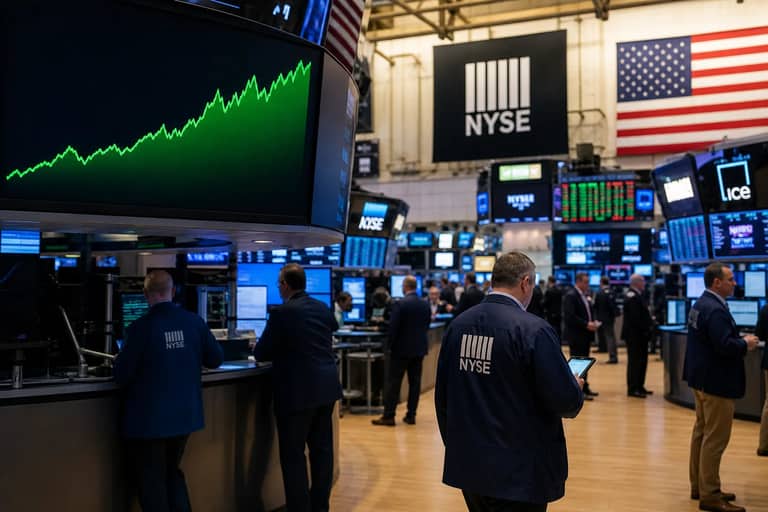
A record close, with a narrow question behind it
Tuesday ended with a broad rally and fresh records. The Dow Jones Industrial Average rose 1.7% to a record closing high. The Nasdaq Composite gained 2.6%, and the S&P 500 logged its 25th record close of 2026, its first since June 2.
Those are strong closing figures, especially after a long stretch without a new benchmark high. But the more useful question is whether the session marked a wider improvement in the market's foundations or a return to the familiar leaders that have carried much of this year's advance.
The answer matters because the two forces behind Tuesday's move work in different ways. Lower oil eases an immediate inflation risk. Stronger corporate profits give stock prices a firmer base. A rally that has both can last longer than one driven only by relief or enthusiasm.
Tuesday offered evidence of both. It did not yet prove that either will persist.
Lower oil eased a threat to stock valuations
Energy relief changed the near-term math for the market. The Iran conflict had raised the possibility that disrupted supply could push fuel costs higher and add to inflation pressure. Lower oil reduced that immediate concern during Tuesday's session.
That matters most for shares whose value depends heavily on earnings expected years from now. When inflation risk rises, interest-rate expectations can rise with it. Higher rates reduce the present value investors place on future cash flow, which can pressure growth stocks even when their current business results remain solid.
The link is mechanical, not emotional. A lower perceived inflation threat gives investors more room to value future profits at richer levels.
That helps explain why technology shares were such a large part of the advance. It does not mean energy risk has disappeared. Oil can reverse quickly if the conflict again threatens shipping or supply. The market has received a reprieve from one near-term risk, not a permanent settlement.
For investors, the key distinction is between a lower price and a lower risk. Tuesday delivered the first. The second depends on whether the conditions behind the energy move hold.
Profits gave the rally something more solid
Lower oil alone would have been an incomplete foundation for a record close. It removes a possible problem, but it does not create revenue, margins, or cash flow. The session also had fresh earnings support from Palantir and Caterpillar, both cited for stronger spring-quarter profits than expected.
Those companies matter because they touch very different parts of the economy. The software company is closely tied to corporate and government demand for AI-related tools. The equipment maker sells into industrial activity. Stronger profits from both point to continued spending in areas that go beyond consumer demand or falling energy costs.
The evidence is encouraging, but it remains selective.
The first report supports the case that AI spending is reaching company income statements. The second supports the view that industrial customers are still willing to spend. Neither can establish that earnings are improving across every technology company, manufacturer, retailer, or consumer business.
That limitation is central to how investors should read the record. An index can rise on strong results from a few large or influential companies while many other businesses face slower demand, weaker pricing, or higher costs. A durable bull market usually gets more support over time from a wider set of earnings reports.
Tuesday's rally had an earnings base. The remaining issue is how broad that base becomes.
AI hardware remained the session's fastest-moving trade
The Nasdaq's larger gain showed where the strongest appetite sat. NVIDIA rose 2.6% during Tuesday's session, while Broadcom gained 6.6%. Both moves outpaced the blue-chip average's advance, and the networking supplier's rise was especially sharp.
The chipmaker and Broadcom are important gauges for AI infrastructure spending. NVIDIA is a major supplier of AI computing chips. Its peer is tied to the networking hardware and other components needed to connect large computing systems. Their gains put the hardware buildout back near the center of the market's advance.
That is a strength and a vulnerability.
It is a strength because AI spending has produced some of the market's clearest growth stories. If customers keep funding data centers, chips, and networking gear, the companies supplying that buildout can continue to post strong results. Tuesday's move suggests the market still sees those businesses as central to the profit outlook.
It is a vulnerability because leadership concentrated in a small set of fast-moving names can make an index rally look broader than its underlying drivers. The three major averages all rose, but the biggest gains among the named technology leaders came from companies linked to the same broad AI investment cycle.
A positive session does not reveal what investors collectively believed. It does establish the question that the next reports must answer: Is AI infrastructure demand still strong enough to support the expectations attached to the chip and networking leaders?
That question is larger than any one company. It affects the hardware suppliers, the software provider, and the wider group of businesses whose valuations depend on sustained AI spending.
The record came after a long pause
The benchmark's new high ended a 42-day gap between record closes. That was its longest pause since a 53-day stretch ended on April 16.
A pause between records is not a bearish signal by itself. Markets often move sideways while earnings, rates, and economic data catch up with earlier gains. But the gap shows that Tuesday broke a stall rather than extending an uninterrupted climb.
One strong session can restart momentum. It cannot confirm breadth on its own.
The countercase is straightforward. If the next round of AI and chip-company results does not support continued demand, the same shares that lifted the tech-heavy index can become a source of pressure. If oil rises again and revives inflation concerns, rate-sensitive growth stocks could face a second challenge at the same time.
The risk is not that the software firm, industrial supplier, chipmaker, or networking company produced no useful evidence. They did. The risk is treating evidence from a handful of winners as proof that the whole market has regained a broad earnings runway.
That is also why the blue-chip average's record close carries more weight than a technology-only rally, but less weight than a period of sustained gains across many industries. Tuesday cleared the first hurdle. It did not settle the next one.
What would make this rally more durable
The best confirmation would come from two places. First, oil would need to stay contained enough that the immediate inflation threat remains reduced. Second, coming earnings reports would need to show that AI spending and business investment are reaching more than the usual technology leaders.
The market does not need every company to produce exceptional results. It needs enough companies outside a small group of AI-linked names to show that profit growth has a wider footing. Better results from industrial, software, and other cyclical businesses would make Tuesday's record look less dependent on a single investment theme.
There is a practical difference between a broad index move and broad earnings support. The first can happen in a day. The second takes several reporting cycles to establish.
Investors following the leading chip and networking suppliers should therefore watch the demand language in upcoming reports as closely as the headline numbers. A good result matters most when it confirms that customers are still spending at a pace that supports the wider hardware chain. A weaker demand signal would challenge the part of Tuesday's rally that moved fastest.
The next test is whether earnings keep widening beyond AI leaders while oil relief holds. That combination, rather than Tuesday's record alone, would determine whether the rally has a stronger foundation.