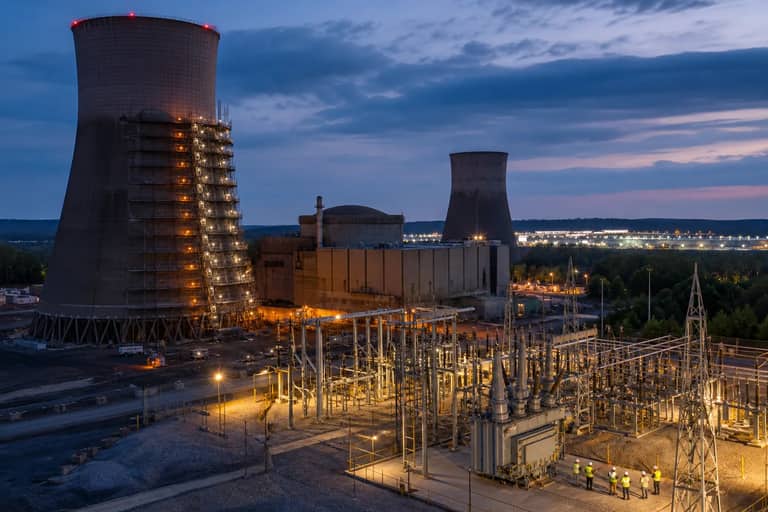
Wall Street still prices artificial intelligence as a chip and software story. The multi-year constraint sitting underneath those earnings is firmer: the United States needs more always-on electricity, and the fastest nuclear megawatts are not new reactor blueprints. They are uprates, life extensions, and restarts of plants that already have steel in the ground.
That is the asymmetrical setup for investors who own utilities, independent power producers, and the hyperscaler customers writing long-term power contracts. Theme-stock excitement around brand-new reactor designs can run far ahead of licensing and construction. Restart and uprate cash flows are closer to the meter.
- DOE’s UPRISE program targets about 2.5 GW of added nuclear capacity by 2027 and 5 GW by 2029 through uprates, life extensions, and restarts rather than greenfield builds.
- Industry surveys and NRC pipelines point to a multi-year wave of power-uprate applications, while historic uprates have already added roughly 8.5 GW of capacity at a fraction of new-build cost.
- Large offtake deals, including Constellation’s 20-year Microsoft agreement tied to the Crane Clean Energy Center restart, show how AI load is underwriting restart economics.
Why restarts beat new builds on the clock
In March 2026 the Department of Energy launched the Utility Power Reactor Incremental Scaling Effort, or UPRISE. World Nuclear News summarized the goal plainly: squeeze more output from the existing fleet, with interim milestones of roughly 2.5 GW by the end of next year and 5 GW by 2029. The White House has separately framed a much larger long-term nuclear expansion toward mid-century. UPRISE is the near-term delivery tool.
POWER magazine reported DOE officials describing uprates and restarts as the fastest path to gigawatts on the grid, with federal loan authority available to de-risk project costs and “matchmaking” workshops planned between plant owners and large end users. That is policy language for a commercial fact investors already see in filings: data-center buyers will pay for firm, carbon-light power on multi-year contracts.
The offtake template is already live
Constellation Energy’s Crane Clean Energy Center restart is the clearest public template. Constellation’s investor release describes a 20-year power purchase agreement with Microsoft that supports restarting Three Mile Island Unit 1, adding roughly 835 megawatts of carbon-free capacity to the PJM grid. Constellation has estimated about $1.6 billion of restart capital and an in-service window later this decade, subject to Nuclear Regulatory Commission and other approvals. DOE loan support has been part of the public financing narrative around Crane and other restart candidates.
Similar restart stories are backing the policy push. Holtec’s Palisades restart in Michigan and NextEra’s Duane Arnold discussions with a long-term technology offtaker sit in the same bucket: bring back or stretch known assets, then lock in a creditworthy buyer. That is a different underwriting problem than betting on first-of-a-kind small modular reactors that still need serial manufacturing proof.
Uprates are the quiet capacity adder
Restarts grab headlines. Uprates quietly add megawatts across dozens of operating units. The Nuclear Regulatory Commission has historically approved more than 170 uprates that, in aggregate, added about 8.5 GW of electric capacity. POWER’s reporting on UPRISE cited an NRC expected-applications list of roughly 30 planned uprates through 2030 across measurement-uncertainty, stretch, and extended power-uprate categories, representing on the order of 2.5 GWe if completed.
A September 2025 Nuclear Energy Institute survey, as cited in the same coverage, found most surveyed units expect to operate for decades more, with a large majority of sites showing interest or planning for some form of power uprate. For a 50-plus investor, that is the durable trend: rate base and merchant fleets sweating existing plants harder while AI load keeps the offtake bid firm.
What this means for portfolios
The AI power trade is not only “buy any nuclear ticker.” Execution risk, capital intensity, and regulatory calendars still matter. Speculative developer stories can re-rate violently when timelines slip. Owners with operating fleets, uprate pipelines, restart projects backed by named offtakers, and access to federal credit support sit closer to cash-flow visibility.
Watch three multi-quarter markers, not a single session’s tape. First, whether UPRISE workshops and loan activity convert into more announced offtake agreements. Second, whether NRC uprate and restart dockets stay on the published application cadence. Third, whether hyperscalers keep signing decade-plus contracts that make restart and uprate math work even when wholesale power prices wobble.
Chips make the models. Megawatts keep them running. For now, the near-term nuclear story for patient capital is less about blueprints and more about bringing known reactors back up, and turning the dial on ones already online.