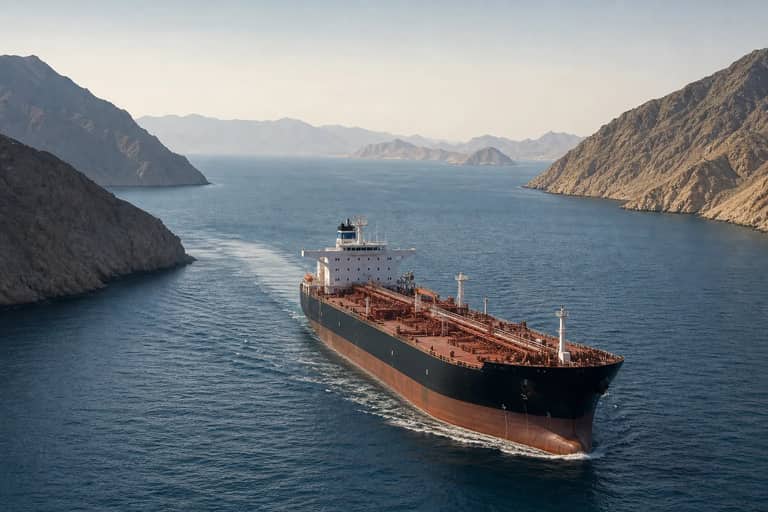
Oil was falling sharply in premarket trading Monday after President Trump said Sunday that U.S. forces would refrain from attacks against Iran and that an agreement to end the fighting was near. Nasdaq futures were modestly higher before the opening bell.
The immediate relief is clear. The investable question is harder: can a pause in attacks restore the shipping traffic that has been missing from the Strait of Hormuz?
That distinction will decide whether lower oil prices mark a lasting easing of supply pressure or simply a quick reversal of a geopolitical fear trade. The Energy Information Administration has already documented a large drop in physical oil flows through the waterway. A statement from Washington can reduce the chance of new strikes. It cannot, by itself, put tankers back on regular schedules.
For energy investors, that leaves two separate trades. A credible return of shipping would cut the scarcity value that has supported U.S. crude and fuel exports. If traffic stays weak, the physical shortage could reassert itself even after Monday's early price move.
Oil has swung before, but ships set the supply test
Oil's swings this year show how quickly a headline can move prices. Brent crude reached $118 per barrel on April 29, then fell to $72 on June 26, according to the EIA's review of the second quarter.
Those moves do not tell investors whether supply was available at the right place and time. Shipping does.
The EIA said disruptions to crude and petroleum-product traffic through Hormuz drove higher and more volatile crude prices through much of the second quarter. That makes physical flow data more useful than a single morning in futures trading. It tracks whether barrels can actually reach refiners and fuel buyers.
Trump's statement changes the near-term military risk. It may also make insurers, ship operators, port workers, and cargo buyers more willing to resume normal business. But each of those decisions has to happen before the oil market can treat the route as repaired.
The strongest relief case assumes that an agreement arrives quickly and convinces shippers that the risk has changed. In that case, tanker traffic could improve before official supply data fully captures it. Oil prices often move ahead of confirmed barrels because traders are trying to price the next supply balance, not the last one.
That is also why Monday's decline deserves caution. A lower price can reflect a lower chance of escalation. It does not yet prove that the supply problem has been solved.
Hormuz flows show the size of the disruption
Total oil flows through the Strait of Hormuz averaged 14.6 million barrels a day in the first quarter of 2026. That was down from 20.7 million barrels a day in the fourth quarter of 2025, a decline of about 29%.
That gap is large enough to change where buyers look for crude and fuel.
The missing volume matters because Hormuz is a shipping route, not a producer. Oil may still exist in producing countries, but it has less value to a buyer if it cannot arrive reliably. A production increase elsewhere can help the global balance, yet it cannot fully replace a route that connects major exporters with international customers.
This is where the market's next evidence will matter more than diplomatic language. A recovery would show up in tanker movement, export volumes, port activity, and the willingness of commercial parties to move cargoes through the strait. A slow return would leave the oil market exposed even if military action stays paused.
The EIA's second-quarter findings also show why volatility could remain high. When traffic through the route is disrupted, the market has to reroute cargoes and find replacement supply. Those changes can take time, and they can create sharp price moves in both directions as conditions change.
Investors do not need to assume a new supply crisis to see the risk. They only need to recognize that the physical market has not yet provided proof of a normal shipping recovery.
U.S. exports filled part of the gap
Disrupted Middle East traffic increased demand for U.S. supply, the EIA said. U.S. crude oil and petroleum-product net exports reached a record 5.8 million barrels a day in April, and May remained close to that level.
Net exports are exports minus imports. The record therefore shows a larger U.S. contribution to overseas supply, rather than just a rise in shipments leaving American ports.
That shift gave U.S. crude producers and refiners a better outlet for barrels when buyers needed replacement supply. Refineries make money from the difference between crude costs and the prices received for fuels such as gasoline and diesel. Strong demand for exported fuel can support that spread, though the export data alone does not measure refinery profits.
The Gulf Coast is central to this response. It had 9.88 million barrels per calendar day of refinery capacity at the start of 2026, according to the EIA. That concentration gives the region a large role in turning crude into products that can be shipped to overseas markets.
A fast return of Middle East shipping would change those economics. International buyers would regain access to more familiar cargoes, and U.S. exporters could face less scarcity-driven demand. The effect would likely be most important for businesses whose recent strength depended on unusually tight global fuel supplies.
Lower crude and fuel costs would create benefits elsewhere. Airlines, transportation operators, and manufacturers use large amounts of fuel or move goods through fuel-intensive networks. A sustained drop in energy costs could ease an expense that has been difficult to budget during periods of volatile oil prices.
The West Coast remains less flexible than the Gulf Coast. Limited pipeline links make its fuel supply more vulnerable to local refinery losses, according to the EIA. Broader relief in global oil markets would help, but it would not erase a local refinery outage or a regional supply bottleneck.
Producers can add supply, but cannot clear the route
Seven OPEC+ producers agreed in July to add 188,000 barrels a day in August. The group also said the increase could be paused or reversed as market conditions change.
The planned addition is small beside the drop in Hormuz traffic from late 2025 to the first quarter. More supply can improve the global balance, but its value depends on where those barrels are produced, where buyers need them, and whether shipping routes work normally.
The decision is also reversible. That gives the group flexibility, but it means investors should not treat the August increase as a permanent reset in supply policy. It left itself room to respond if the conflict, shipping conditions, or oil prices change again.
The countercase to a bullish energy view is straightforward. A credible ceasefire could rapidly lower shipping and insurance risk, restore transit through Hormuz, and reconnect buyers with Middle East cargoes. Returning traffic, combined with additional output, could unwind the supply premium faster than energy-focused investors expect.
That case needs visible confirmation. A pause in U.S. attacks is an opening step, not proof that commercial shipping has returned to normal.
Friday's jobs report comes after the shipping test
The first signal to watch is tanker movement and export volumes through Hormuz. A sustained recovery would show that the oil market is getting more than a diplomatic headline. Continued weak transit would suggest that Monday's lower prices are ahead of the physical supply picture.
The next broad market catalyst arrives Friday. The July Employment Situation report is scheduled for release at 8:30 AM ET.
Energy costs and labor data will shape different parts of the same rate debate. If shipping improves and energy prices stay lower, one recent source of inflation pressure would ease. If transit remains impaired, fuel costs could rise again even as investors assess whether hiring is cooling.
A weak labor report alongside lower energy costs would present a different market backdrop than strong hiring paired with renewed fuel inflation. Neither outcome is established today. The unresolved variable is whether ships begin moving through Hormuz in enough volume to make the early oil retreat durable.