Operating capacity is arriving faster than expected
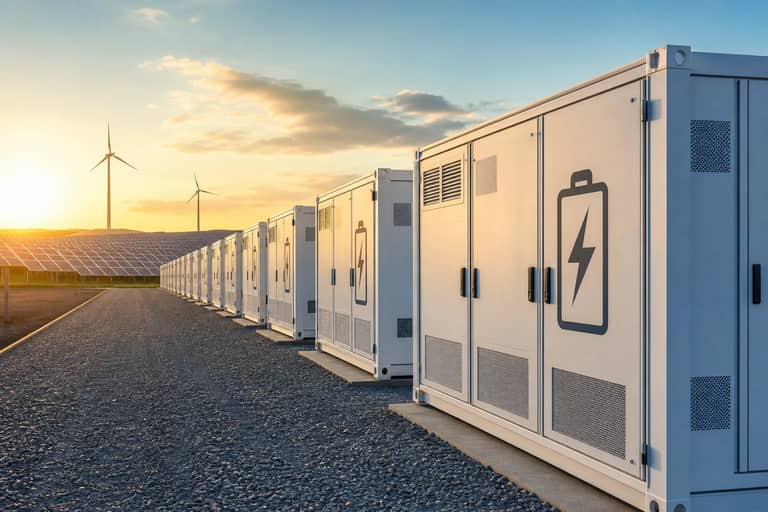
U.S. utility-scale battery storage reached nearly 52 gigawatts by June after operators added 8.3 GW in the first half of 2026. The key issue is no longer whether batteries will become a major part of the grid. It is whether this much new capacity can keep earning healthy power-price spreads.
The system ended 2025 with 43.6 GW of operating storage. Adding nearly one-fifth more capacity in six months changes the supply picture because these are working assets, not projects waiting for permits or financing.
Battery storage had already grown at an average annual rate of 70% over the prior three years. The first half of 2026 shows that growth continuing from a much larger base.
That creates a split outcome for power investors. More storage can make solar generation more valuable. Yet the same buildout can reduce the price gaps that battery projects need to make money.
Batteries move solar power into better hours
A battery's business model is simple. It charges when wholesale electricity prices are low and sends power back when prices are higher. Its revenue depends on the difference between those two prices, after operating costs and losses from storing energy.
Solar projects have a clear reason to add batteries. Solar output is strongest around midday, when abundant generation can push power prices down. Electricity demand can remain high after sunset, when solar panels no longer produce. A solar-only project must sell most of its output in the lower-priced hours.
Storage lets a developer hold some solar generation for later. That can improve the value of each unit of power a solar project produces, provided evening prices remain high enough.
AES's Bellefield Solar and Energy Storage Farm shows the model at scale. The project began operating in December 2025 with 500 megawatts of solar capacity and an equal amount of battery capacity.
Bellefield is scheduled to double both parts of the project by November 2026. If completed, it would become the largest U.S. power-storage facility. The project is a useful example of where new solar development is heading: generation and storage built together rather than treated as separate investments.
The pipeline could reshape project economics
Operators report plans to add 54 GW of storage over the next two and a half years. That is more capacity than is operating today, and it would more than double the current base if the projects enter service as planned.
The schedule is heavily weighted toward the near term. Operators plan 14 GW in the second half of 2026, 26 GW in 2027, and another 14 GW in 2028.
That pipeline supports companies developing solar-plus-storage projects. A project that can shift power into higher-priced hours may have an advantage over solar-only generation, especially in regions where midday supply is already plentiful.
Solar-only assets may face a tougher comparison.
Still, more batteries do not automatically mean better battery returns. Storage assets often charge during similar low-price periods and discharge during similar high-price periods. If a large number of projects follow the same pattern, they can compete for the same evening power prices.
That competition could narrow the spread between cheap and expensive hours. A smaller spread means less revenue from each charge-and-discharge cycle, even if the battery is operating as planned.
This is the central risk in the storage buildout. The capacity pipeline may be good for equipment demand, construction activity, and the value of paired solar projects, while reducing returns for storage assets once too many are chasing the same hours.
Completion is only the first proof point
The next near-term measure is whether planned projects become operating assets. The remaining additions scheduled for this year, including Bellefield's expansion, will show how much of the reported pipeline is moving from development into service.
A delay at one project would not prove the broader schedule is failing. But a steady flow of completed projects would make the coming supply increase more concrete, especially before the much larger 2027 buildout.
The more decisive measure comes after the batteries are online. Investors need to watch wholesale power-price spreads in the regions where storage is concentrated. Wide differences between low-price charging hours and high-price discharge hours support battery revenue. Narrower differences weaken the economics of new projects and can pressure existing assets.
The likely beneficiaries are developers that pair storage with solar and can capture more value from their generation. The casualty would be a storage project built on price spreads that shrink as competing batteries enter the same market.
Battery capacity is becoming a real part of the U.S. grid, not a distant construction plan. The next test is repeatable: project completions must be followed by power-price spreads wide enough to support healthy returns. enough to support the new fleet. If those spreads compress as capacity rises, the buildout will still change the grid, but it may not reward every battery owner equally.
Primary source: U.S. Energy Information Administration, Today in Energy