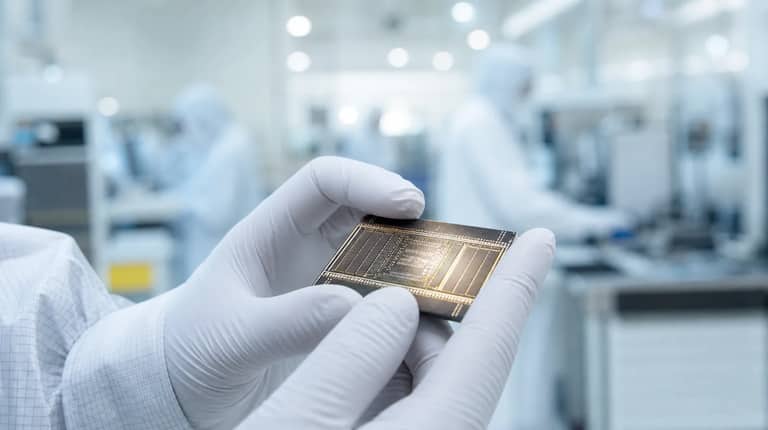
The Chip You Keep Hearing About
Every AI server that ships today contains stacks of a specialized memory chip called high bandwidth memory, or HBM. It is not the processor. It is not the GPU. It is the memory sitting next to the GPU that determines how fast the entire system can think.
Traditional DRAM sends data through a single layer. HBM stacks multiple DRAM chips vertically, one on top of the other, and connects them using microscopic copper pillars called through-silicon vias. The result is a chip that moves data at rates above 2 terabytes per second, roughly 10 times faster than standard server memory.
A single AI training server requires 8 to 10 times more memory than a conventional server. That gap is why Dell just posted $16.1 billion in AI server revenue in a single quarter, up 757% from a year ago. The servers are expensive because the memory inside them is expensive, scarce, and controlled by a small group of producers.
Three Companies, No Alternatives
The global HBM market is an oligopoly. SK Hynix holds over half of global production. Micron holds roughly 20%. Samsung controls most of the rest. Nobody else manufactures HBM at scale.
That concentration gives all three producers pricing power that most semiconductor companies can only dream about. Micron reported gross margins near 75% on its memory products in the most recent quarter, up from the low 40s just 18 months ago. Revenue hit $23.9 billion in Q2, a 196% increase from a year earlier, with non-GAAP earnings of $12.20 per share. UBS nearly tripled its price target on Micron to $1,625.
The stock is trading around $973 as of Friday morning, putting its market cap above $1 trillion. It has gained roughly 850% over the past 12 months. SK Hynix, which trades in Seoul, posted record first-quarter profit in April on the same HBM tailwind.
All three producers have confirmed that their entire 2026 HBM output is sold out. Every chip they can manufacture this year already has a buyer.
Why GPUs Cannot Work Without It
Nvidia reported $81.6 billion in revenue last quarter, up 85% from a year ago, almost entirely driven by data center GPU sales. But those processors are useless without enough high bandwidth memory sitting next to them. The GPU does the math. HBM feeds it the data.
Nvidia's current Blackwell GPUs pair each processor with multiple HBM3E stacks. Its next-generation Vera Rubin platform, expected in 2027, will use eight HBM4 stacks per chip, delivering roughly 22 terabytes per second of memory bandwidth and 288 gigabytes of capacity. That is enough to handle trillion-parameter AI models without bottlenecking.
AMD, trading at an $844 billion market cap after more than doubling this year, faces the same constraint. Its MI350 accelerators rely on HBM3E, and AMD's ability to ship those chips depends directly on how much memory it can secure from the same three suppliers Nvidia uses.
This is why the memory shortage matters beyond Micron's stock price. Every company building AI infrastructure, from cloud providers to server makers like Dell, is competing for the same limited pool of HBM chips.
The HBM4 Upgrade Cycle
The technology is not standing still. HBM4, the next generation, doubles the interface width from 1,024 bits to 2,048 bits. That translates to bandwidth above 2.8 terabytes per second per stack, a meaningful jump even from the already-fast HBM3E generation.
Samsung started commercial mass production of HBM4 in February 2026. Micron began shipping its 36-gigabyte HBM4 stacks in the first quarter. SK Hynix plans to ship 48-gigabyte HBM4 stacks with 16 layers later this year.
Each generation upgrade creates a new wave of demand. Server operators do not keep running old memory when faster versions become available because AI workloads are bandwidth-limited. More bandwidth means faster training, which means lower compute costs per model. The upgrade cycle is not optional for anyone competing in AI.
The HBM market was worth roughly $4 billion in 2026 and is projected to reach $12.4 billion by 2031, growing at about 25% annually.
The Investment Angle
For investors watching the AI trade, HBM is the single most important supply constraint in the stack. Processors can be designed and manufactured by dozens of companies. HBM is made by three.
Micron is the only pure-play HBM producer available on U.S. exchanges. It trades at a market cap above $1 trillion with 75% gross margins and revenue growth near 200% year over year. The risk is the same one that haunts every memory cycle: when supply catches up to demand, margins compress. Historically, memory has been one of the most cyclical corners of the semiconductor industry. But analysts at UBS and elsewhere argue this cycle is structurally different because HBM requires specialized manufacturing that cannot be ramped quickly.
Nvidia trades at a $5.2 trillion market cap and sits on the demand side of the equation. Its ability to ship GPUs depends on HBM availability. AMD, at an $844 billion market cap, faces the same dependency with its competing accelerators.
Dell's 32% gap-up Friday morning, trading around $419 at a new all-time high, shows what happens downstream when AI server demand exceeds expectations. Dell is the assembler. Micron, SK Hynix, and Samsung make the most expensive component inside.
What to Watch From Here
The next inflection point is HBM4 production ramp through the second half of 2026. If yields hold and all three producers hit their targets, supply could begin loosening by early 2027. If yields disappoint or AI demand accelerates faster than capacity additions, the shortage extends and pricing power stays with the producers.
Micron's next earnings report will show whether the company can maintain 75% gross margins as HBM4 shipments scale. SK Hynix reports in July. Samsung's memory division results arrive in late July.
The broader question is whether the memory cycle has truly broken its boom-bust pattern or whether this is the peak of a supercycle that will mean-revert like every one before it. The answer depends on how long AI infrastructure spending keeps growing at triple-digit rates, and Dell just provided fresh evidence that the spending is accelerating, not slowing.