Shares of New Era Energy & Digital, ticker NUAI, moved sharply higher Monday after the company announced a long-term power agreement with Vistra.
The headline is important because this is not another vague artificial intelligence announcement. New Era has not announced a new chip, software platform or consumer product. Instead, it secured something that may be even more valuable in the current AI buildout: reliable electricity.
For a company trying to develop large-scale data centers, power is the foundation of the entire business. Without a dependable power supply, land remains just land. With a contracted source of electricity, a developer has a more credible story to present to customers, lenders and potential partners.
The headline is the power contract
New Era’s subsidiary, TCDC PowerCo, entered a 20-year power purchase agreement with Luminant ET Services, an affiliate of Vistra.
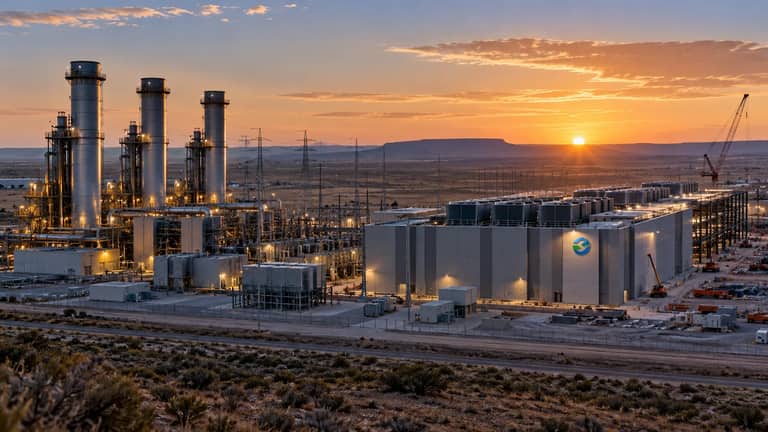
Under the agreement, Luminant will supply a minimum of 200 megawatts and up to 207 megawatts of power for Phase 1 of New Era’s Texas Critical Data Centers project. The electricity is expected to come from Vistra’s 1,180-megawatt natural-gas-fired facility in Odessa, Texas, which sits immediately next to the data-center site.
Power is expected to be available in the third quarter of 2027. The initial contract runs for 20 years, followed by automatic one-year renewal periods.
That timing matters. The agreement does not mean the facility is operating today. It does mean New Era can point to a defined power source for its first development phase instead of relying only on a future power plan.
Why investors are paying attention
New Era describes its Texas Critical Data Centers project as a 493-acre campus in the Permian Basin with anticipated capacity of up to 1.4 gigawatts over time.
The newly announced agreement covers only Phase 1. At the maximum 207-megawatt level, Phase 1 represents roughly 15% of the company’s longer-term capacity target.
That creates both an opportunity and a warning.
The opportunity is that New Era has now made progress on one of the most important pieces of the project. The warning is that most of the larger vision remains ahead. The company will still need to build additional phases, secure more power, attract tenants and obtain the capital required to expand.
In August, New Era said construction permits for the Texas project were in hand. The company also said it had submitted a site plan, received approval to begin grading and was in discussions with potential tenants and joint-venture partners.
The Vistra agreement is the next major step in that sequence.
The stock move is about de-risking, not earnings
Investors should understand what kind of story NUAI represents.
The stock is moving because the market believes the power agreement makes the data-center project more achievable. This is a development milestone, not an earnings announcement.
New Era’s second-quarter results still largely reflected legacy helium and natural-gas assets. Management has said those assets are being evaluated for possible monetization or exit as the company focuses more heavily on digital infrastructure.
The company also reported that, as of June 30, it had $84.8 million in cash, cash equivalents and restricted cash, along with $270 million undrawn under a facility of up to $290 million. Management said it expected Phase 1 equity requirements to be covered by existing cash and that facility.
That may be sufficient for the company’s current plan, but it is not the same as fully financing a 1.4-gigawatt campus. Large data centers require substantial spending on buildings, electrical systems, cooling equipment, networking infrastructure and site work. Costs can also rise before a project produces meaningful revenue.
Vistra adds credibility, but also shares the economics
The agreement gives Vistra a 5% non-voting interest in the portion of the data-center project served by its power after electricity delivery begins.
That arrangement may help align the two companies. Vistra has a financial interest in the project’s success, and New Era gains a major energy partner with direct involvement in the power supply.
However, the arrangement also means New Era will not own all of the economics tied to that portion of the project. Vistra receives an ownership interest, along with rights of first refusal on future opportunities at the Texas site and rights of first offer on certain opportunities involving other New Era projects.
The partnership is a positive credibility signal, but it should not be confused with a signed lease from a hyperscale technology company. The announcement did not identify a data-center tenant or provide a revenue forecast.
What investors should watch next
The next important milestone is evidence that the project is moving from permits and agreements into visible construction.
Investors should watch for site grading, construction financing, equipment orders and the announcement of a customer or lease. They should also look for additional power commitments if New Era intends to move beyond Phase 1.
The company’s ability to make power available in the third quarter of 2027 will be another major test. Delays in construction, financing, equipment delivery or customer commitments could change the timeline.
Bottom line
NUAI is popping because New Era has secured a real, long-term power agreement for the first phase of its Texas data-center project. That is a meaningful improvement over simply owning land and describing a future AI campus.
The agreement reduces one of the biggest risks facing the development plan. It does not eliminate the need for construction, financing, tenants or additional power.
For investors, the key question is no longer whether New Era has a power concept. It now has contracted Phase 1 power. The question is whether management can turn that agreement into a functioning, revenue-producing data-center campus.
That makes NUAI one of the more interesting small-cap AI infrastructure stories in the market this week, but it remains a high-risk development-stage investment rather than an established cash-flow business.