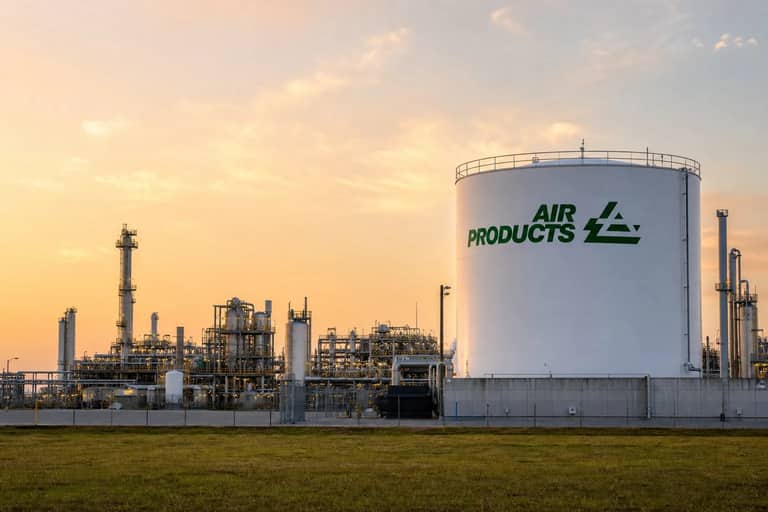
Air Products did something companies rarely do. It admitted a multi-billion-dollar bet was not going to pay off, and it quit.
The company said it will not proceed with its Louisiana Clean Energy Complex, a massive blue-hydrogen project. The decision triggers a pre-tax charge of up to $2.9 billion in its fiscal third quarter to write down the assets and exit contracts. A writedown that size usually sends a stock down. This one sent it up about 8% Tuesday, to around $294, near its 52-week high.
Why a Writedown Made the Stock Go Up
The market was not cheering the loss. It was cheering the discipline.
Under prior leadership, Air Products committed billions to build giant clean-hydrogen plants before locking in enough customers to buy the output. That strategy turned a steady industrial gas company into a speculative energy developer, and investors hated the risk.
Eduardo Menezes took over as CEO in early 2025, after activist investors pushed for change. His job was to stop spending on projects that could not clear the company's return targets. Cancelling Louisiana is the clearest signal yet that he means it. Removing a capital sink is worth more to shareholders than the sunk cost of admitting it.
The company also said it is finalizing a deal with Norway's Yara to market and distribute renewable ammonia from the NEOM project in Saudi Arabia. That matters because it secures a buyer and a distribution channel first, the opposite of the build-it-and-hope approach. Air Products is staying in Louisiana too, where it runs 18 facilities and the world's largest hydrogen pipeline network.
The Core Business Was Never the Problem
Strip out the hydrogen drama and Air Products is a high-quality industrial gas business. It supplies oxygen, nitrogen, and hydrogen to refineries, chemical plants, and chip factories under long contracts.
The fundamentals show it. The company runs an EBITDA margin around 36% and a net margin near 17%. It recently raised its full-year guidance to 8% to 10% adjusted earnings growth. It also won a contract to supply gases to a new Samsung semiconductor plant in South Korea, its largest investment tied to chipmaking, which plugs the company straight into the AI buildout.
Wall Street is warming up. Wells Fargo moved the stock to overweight with a $325 price target, citing better pricing across several product lines.
Valuation is not cheap, which is the trade-off with quality. Shares trade near 31 times trailing earnings and about 18 times enterprise value to EBITDA. The dividend yields about 2.4%, and the company just raised it for the 44th straight year, putting it in a small club of dividend aristocrats. The payout eats roughly three-quarters of earnings, so future dividend growth depends on the earnings growth actually showing up.
The Hydrogen Lesson Sits Right Next Door
The split screen in this sector is stark. Linde, the largest industrial gas company, trades near $522 and close to its own 52-week high, rewarded for steady execution and a premium multiple. Disciplined gas businesses are winning.
Speculative hydrogen is not. Plug Power, a pure-play hydrogen name, trades under $3, down from a 52-week high of $4.58 and a fraction of where it sat a few years ago. The market has spent two years punishing companies that spend ahead of demand in hydrogen. Air Products just made sure it would not be one of them.
Whether the Discipline Holds
The charge clears the deck. Now the question is whether the discipline holds. Watch the next two things: whether management keeps walking away from projects that miss its return bar, and whether the contracted approach, like the Yara deal, actually pulls in paying demand for low-carbon hydrogen. If both hold, the writedown will look like the day the strategy reset. If spending creeps back, the market's applause will fade fast.