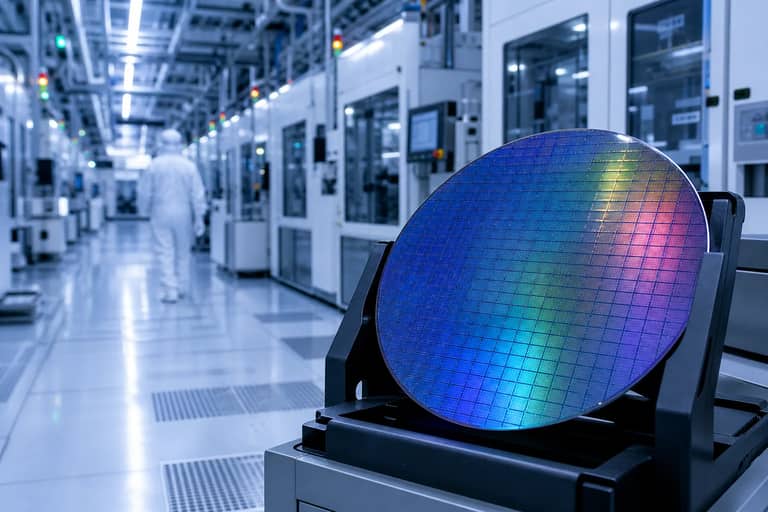
Taiwan Semiconductor posted its fifth straight record quarter overnight. Net profit rose 77% from a year ago to roughly $22 billion. Revenue of $40.2 billion hit the very top of guidance, up 36%. Gross margin reached 67.7%, also above guidance.
Then management raised nearly everything else. Full-year revenue growth guidance moved to more than 40%, up from more than 30%. The 2026 capital budget jumped to $60 billion to $64 billion from $52 billion to $56 billion, an increase of about 15%. The company committed another $100 billion to its US buildout, taking that total to $265 billion. Third-quarter revenue guidance of $44.6 billion to $45.8 billion implies the largest quarter in the company's history.
TSMC is down around 3% at midday.
A year ago, numbers like these gapped chip stocks higher. This week the market is doing the opposite, and it is doing it consistently enough to look like a regime, not a fluke.
Two Days, Four Beats, One Response
ASML raised its full-year revenue forecast to 43 to 45 billion euros on Wednesday, its second raise this year. It closed up about 2% and is giving part of that gain back today.
GE Aerospace beat this morning. Adjusted earnings of $2.02 a share rose 22%, revenue of $13.3 billion grew 21%, and the company lifted its full-year earnings guidance to $7.65 to $7.85 a share from $7.10 to $7.40. The stock is down around 6%.
The selling is not indiscriminate. Abbott beat and is up around 11%. UnitedHealth posted a $1.53-a-share beat, raised its full-year outlook, and is up around 3%.
The market is still paying for good quarters. It has stopped paying for good quarters that come with a bigger factory bill. Nvidia is down around 2% at a $5 trillion market cap, and Broadcom is off around 3%. Micron is down around 6% on top of Wednesday's 8% drop, and the VanEck Semiconductor ETF is off around 3.5% after falling Wednesday too.
The Market Is Repricing Capex, Not Demand
A capex raise used to read as a demand signal. Right now it reads as a cost.
TSMC's own guidance supports that reading. The company guided third-quarter gross margin down to 65% to 67% as its next-generation 2-nanometer production ramps. The buildout's next leg arrives with thinner margins attached.
The cash math explains the anxiety. On trailing numbers, TSMC converts only about 42% of its operating cash flow into free cash flow. The rest goes into fabs and equipment. That is why a stock trading near 33 times trailing earnings trades at roughly 63 times free cash flow. The distance between those two multiples is the factory bill, and it just got 15% bigger.
Management gave the skeptics something too. On the call, executives described cloud customer demand signals as very strong but cautioned that customers are aggressive in their forecasts, and that adding every forecast together would overstate what real demand looks like. When the company selling the shovels hedges the gold rush, the market listens.
Four Reversals in Four Sessions
Two weeks ago we covered the first real chip selloff in six months. What has followed is not a trend in either direction. Chips were routed Monday, unwound further Tuesday, bounced hard Wednesday morning, were liquidated into Wednesday's close, and are now selling off on a record quarter.
Four direction changes in four sessions is not a verdict on AI demand. It is what a crowded trade looks like while it changes hands. Micron, which was down 20% from its high when we covered the momentum unwind Tuesday, has kept falling without any new company-specific news. That is positioning pressure, not a broken thesis.
The honest read: the fundamental news this week has been uniformly good, and the price action has been uniformly bad. One of those two things usually wins within a few weeks. Investors should know which one they are betting on.
The Next Test
Netflix reports after the close, with the Street looking for around $12.6 billion in revenue and $0.79 a share. It has nothing to do with chips, which is exactly why it matters. If a clean Netflix beat gets sold too, the problem is broad positioning into a hot tape. If Netflix gets paid for a beat, the selling is specifically about AI capital intensity, and that is a different problem with a different set of losers.
Two other markers over the next three weeks. First, whether TSMC reclaims its pre-earnings price within a few sessions, which would mark this as profit-taking rather than repricing. Second, the hyperscaler earnings at the end of July, where the companies writing the capex checks either confirm the spending TSMC just guided to or hand the skeptics their proof.
The buildout is not in question. Who gets paid for it is.