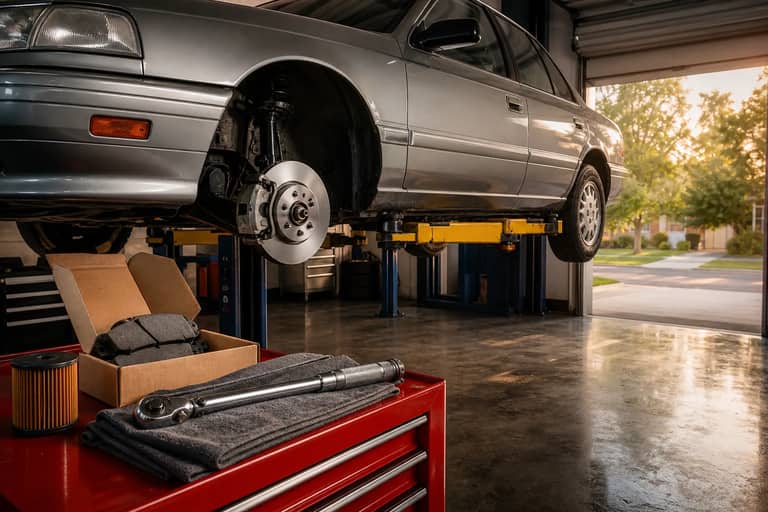
Americans are holding on to their cars longer than ever. The typical vehicle on the road is now close to 13 years old, a record, and the reason is simple: replacing it has become painfully expensive.
That shift is quietly reshaping two parts of the economy at once. For households, it means bigger repair bills and harder choices about when to fix and when to replace. For investors, it has turned the auto parts and repair business into one of the steadier growth stories in retail. Two of the biggest parts suppliers report later this month.
- Edmunds: a record 21.2% of financed new-car buyers took on monthly payments of $1,000 or more in the third quarter, and a record 25.5% signed loans of 84 months or longer.
- Bureau of Labor Statistics: the cost of vehicle maintenance and repair rose 5.2% in the 12 months through August and is up about 56% since August 2019.
- O'Reilly Automotive: sales to professional repair shops grew about 10% on a comparable-store basis in the second quarter, its fourth straight double-digit quarter, while AutoZone's commercial sales rose 8.6% in its latest quarter.
Why people are keeping their cars
S&P Global Mobility measured the average age of U.S. cars and light trucks at a record 12.8 years in its 2025 study, with passenger cars alone averaging 14.5 years. In 2008, the average was closer to 10 years. On O'Reilly's July earnings call, CEO Brad Beckham told analysts the fleet now tops 293 million cars and light trucks, the average age keeps climbing toward 13 years, and Americans drove more than 3.3 trillion miles in 2025.
The math on a new car explains why. Kelley Blue Book, part of Cox Automotive, reported that the average price actually paid for a new vehicle rose to $50,089 in August, the first month above $50,000 this year. Prices peaked at $50,612 last December.
Financing is where the strain really shows. Edmunds reported on Oct. 1 that the average amount financed on a new vehicle hit a record $44,664 in the third quarter. The average monthly payment reached a record $787, up from $756 a year earlier, even though the average interest rate held flat at 7.0%. Buyers are putting less money down, $5,554 on average versus $6,021 a year ago, and stretching loans longer to make the payment fit.
The result is a record $9,938 in total interest over the life of the average new-car loan. "When buyers are already financing nearly $45,000 and taking on another nearly $10,000 in interest, it's critical to think beyond whether the monthly payment works today," said Ivan Drury, Edmunds' director of insights.
The repair bill keeps rising
Keeping an older car is usually the cheaper choice, but it is not cheap. According to the Bureau of Labor Statistics consumer price index, the cost of motor vehicle maintenance and repair rose 5.2% over the year through August. Over the past seven years it has climbed about 56%, far faster than new-car prices (up about 23%) or used-car prices (up about 28%) over the same stretch.
Parts are part of the story. O'Reilly said same-item price inflation on the parts it sells ran about 5.5% in the second quarter, and AutoZone saw mid-single-digit inflation on comparable items in its summer quarter. Labor is the other part. Modern cars carry more sensors, cameras and electronics, and shops say skilled technicians are hard to find, so each shop visit tends to cost more.
There is one piece of relief. Car insurance, which surged after the pandemic, fell 5.1% over the year through August in the same price index, although it is still up roughly 49% since 2019.
Who is winning: the professional repair shop
The most important trend for investors is not just that cars are older, but who is fixing them. Fewer owners are doing their own repairs. More are handing the keys to a professional shop, and the parts chains that supply those shops are taking share.
O'Reilly Automotive grew comparable-store sales 6.0% in the second quarter, on top of 4.1% a year earlier, led by roughly 10% growth with professional customers. Management raised its full-year forecast for comparable sales to 4% to 6%, with total revenue of $18.9 billion to $19.2 billion.
AutoZone, whose fiscal year ended Aug. 29, posted annual sales of $20.3 billion, up 7.4%. The split inside its fourth quarter tells the story. Sales to commercial customers, mostly repair shops, rose 8.6%, while sales to do-it-yourself shoppers slipped 0.6%. Do-it-yourself customers were spending about 5% more per visit, but fewer of them came through the door, which management tied partly to higher gas prices squeezing budgets. AutoZone opened a record 374 stores in its fiscal year and expects commercial sales to grow at a high single-digit to low double-digit pace in the new fiscal year.
Genuine Parts, the owner of the NAPA chain, rounds out the group. Its business leans heavily on independent repair shops, so its results are a good check on whether the professional trend is holding.
What the chatter is saying
On Reddit's personal finance and car repair forums, the same question comes up again and again: pay $2,000 to fix a paid-off car, or take on a new $800 monthly payment? Most replies land on fixing the car if the body and frame are sound. That everyday decision, repeated millions of times, is what shows up in the parts chains' numbers.
On financial Twitter, retail analysts have long called the auto parts group a "needs-based" business, because a broken car has to be fixed whether the economy is strong or weak. The bigger debate now is whether the weak do-it-yourself side is a warning about stretched household budgets or simply a shift toward professional repair.
What investors should watch
Genuine Parts reports third-quarter results before the market opens on Oct. 20. O'Reilly follows after the close on Oct. 28, with its call the next morning. The key numbers are professional sales growth, do-it-yourself traffic and gross margins.
There are real risks. Tariffs on imported parts have raised costs, and AutoZone's latest results included a one-time benefit from tariff refunds that will not repeat. If the do-it-yourself weakness spreads, it would signal deeper consumer strain. Electric vehicles need fewer routine parts over time, though they are still a small share of a fleet that turns over slowly. And these companies are priced as reliable growers, not bargains, so a slowdown in professional sales could weigh on the shares.
What it means for your household
If you are weighing a new car, look at the total cost, not just the payment. An 84-month loan lowers the monthly bill but adds years of interest and raises the risk of owing more than the car is worth. If your current vehicle is reliable, staying on top of maintenance such as oil, brakes, tires and fluids is usually the cheapest way to avoid a forced purchase. Get a second repair estimate for large jobs, and since insurance prices are finally easing, it is a good year to shop your auto policy.
The bottom line is that an aging national fleet is a durable trend, not a one-quarter blip. High prices and record payments keep people in older cars, and older cars need more repair work, which favors the parts suppliers and the shops they serve while stretching family budgets. This article is general information, not personalized financial advice.