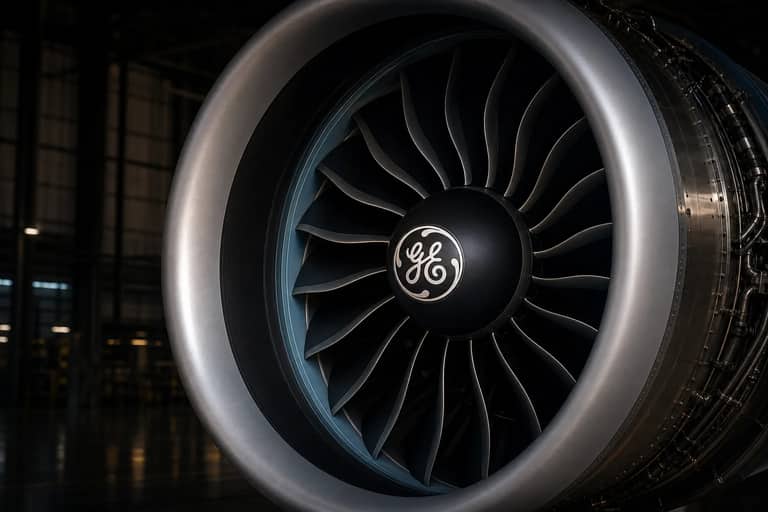
The best aerospace stocks right now are GE Aerospace, RTX, Boeing, Howmet Aerospace, TransDigm, HEICO, and Textron. Together, these seven U.S.-listed companies are worth roughly $1 trillion and cover the aircraft value chain from engines and airframes to parts, repairs, avionics, and business jets.
Aerospace demand is strong, but the stocks are not interchangeable. Engine and parts suppliers can earn recurring revenue long after an aircraft is delivered. Boeing has greater upside from a production recovery, but also carries the most execution risk.
This guide favors companies with durable aftermarket exposure, visible backlogs, strong operating results, and a clear role in commercial or military aviation.
How We Picked These Stocks
The list screens for U.S.-listed companies with meaningful aerospace operations, established aircraft platforms or installed parts bases, and current financial evidence of demand, backlog, margins, or delivery growth. It includes airframe makers, engine suppliers, component makers, and business-aviation companies. The picks are ordered by market capitalization. Airlines, airport operators, private companies, and companies focused mainly on missiles, satellites, or space launches were excluded. Large defense exposure is acceptable only where aviation is also a major business.
The Best Aerospace Stocks
GE Aerospace (NYSE: GE)
Why it made the list: GE Aerospace is the strongest pure aircraft-engine franchise on this list. Its commercial engines and services unit produced $9.7 billion of second-quarter revenue, up 27%, while services revenue rose 26%. The company has more than $210 billion of backlog, including more than $170 billion in commercial services.
The bull case: More shop visits, spare-parts sales, and new engine deliveries can lift profits faster than revenue. GE raised its 2026 outlook after first-half adjusted revenue rose 27% and free cash flow increased 31%.
The risk: The thesis depends on keeping engine output and repair capacity ahead of airline demand. Supply-chain constraints or weaker airline flying activity would slow the high-margin services engine.
Key number: More than $170 billion of commercial-services backlog
RTX (NYSE: RTX)
Why it made the list: RTX combines Pratt & Whitney engines, Collins Aerospace systems, and a large defense business. First-quarter sales rose 9% to $22.1 billion, and company backlog reached $271 billion. Its commercial backlog was $162 billion, giving the company substantial exposure to aircraft production and maintenance.
The bull case: Commercial aftermarket demand and defense orders give RTX two large sources of growth. Management raised its 2026 adjusted sales outlook to $92.5 billion to $93.5 billion after a strong first quarter.
The risk: RTX must convert a very large backlog into revenue without losing margin to supply shortages, tariffs, or program costs. A weaker commercial cycle would pressure both Collins and Pratt & Whitney.
Key number: $271 billion total backlog
Boeing (NYSE: BA)
Why it made the list: Boeing is the highest-risk pick, but it has the most direct exposure to a sustained recovery in large commercial aircraft deliveries. Its total company backlog reached a record $695 billion in the first quarter, including more than 6,100 commercial airplanes. Boeing delivered 171 commercial aircraft in the second quarter and 314 through the first half.
The bull case: If Boeing raises production while improving quality and certification execution, deliveries can drive a major recovery in revenue and cash flow. The backlog gives it years of work once operations stabilize.
The risk: Certification delays, production disruptions, and quality issues remain the central threat. The 737-7 and 737-10 are still expected to be certified in 2026, with first deliveries anticipated in 2027.
Key number: $695 billion company backlog
Howmet Aerospace (NYSE: HWM)
Why it made the list: Howmet makes the forged and cast components used in jet engines, airframes, and industrial gas turbines. Full-year 2025 revenue rose 11% to about $8.3 billion, led by commercial aerospace, defense aerospace, and gas turbines. First-quarter 2026 revenue growth accelerated to 19%, while adjusted EBITDA margin expanded to 32.0%.
The bull case: Higher aircraft build rates and engine output should increase demand for Howmet's specialized parts. Management's 2026 revenue outlook of $9.575 billion to $9.725 billion points to another year of strong growth.
The risk: Howmet is tied to aircraft and engine production rates, where supplier bottlenecks can quickly delay customer orders. Its strong margin outlook also leaves less room for a manufacturing slowdown.
Key number: 32.0% first-quarter adjusted EBITDA margin
TransDigm Group (NYSE: TDG)
Why it made the list: TransDigm owns a wide range of highly engineered aircraft components, many with aftermarket demand that lasts through the life of an aircraft. Second-quarter sales rose 18% to $2.54 billion, while EBITDA as defined reached $1.34 billion. Its 52.6% EBITDA margin is the clearest sign of the pricing power embedded in its portfolio.
The bull case: Commercial aftermarket growth can keep earnings rising even if new-aircraft production is uneven. The company lifted its fiscal 2026 sales outlook to $10.3 billion to $10.42 billion after stronger-than-expected base-business results.
The risk: TransDigm's recent $2.2 billion of acquisitions add financing costs and integration work. Higher interest expense is already expected to limit net-income growth relative to sales growth.
Key number: 52.6% EBITDA margin
HEICO (NYSE: HEI)
Why it made the list: HEICO is a diversified supplier of replacement aircraft parts, repair services, electronics, and defense components. Fiscal second-quarter sales rose 25% to a record $1.38 billion, while operating income climbed 41% to $350.4 million. Its Flight Support segment grew sales 21%, helped by 19% organic growth.
The bull case: HEICO benefits when airlines maintain older fleets and seek lower-cost approved replacement parts. Strong organic growth and a long record of acquisitions give it more than one path to expand.
The risk: Acquisitions are central to HEICO's model, and four deals increased net debt to EBITDA to 1.74 times. Slower organic growth or poor integration would weaken the case for continued premium economics.
Key number: 25% fiscal second-quarter sales growth
Textron (NYSE: TXT)
Why it made the list: Textron brings together Cessna and Beechcraft business aircraft, Bell helicopters, and Textron Systems. Textron Aviation revenue rose 22% in the first quarter to $1.5 billion, helped by higher Citation jet and commercial turboprop volume. Aviation backlog stood at $8.0 billion, while Bell held another $7.6 billion.
The bull case: A planned separation of the Industrial segment could leave a more focused aerospace and defense company. Higher business-jet deliveries and the MV-75 Cheyenne program offer two distinct growth drivers.
The risk: Bell's commercial helicopter revenue fell in the first quarter, and the planned Industrial separation has execution risk. The value case depends on the company completing the split while maintaining momentum in its core aircraft businesses.
Key number: $8.0 billion Textron Aviation backlog
Aerospace Sector Overview
Aerospace is being driven by two linked forces: airlines need more aircraft, and the global fleet needs more maintenance. New aircraft deliveries matter because they create future demand for engines, avionics, landing systems, replacement parts, and repair work. That makes the aftermarket valuable. It is often less cyclical than new-aircraft production because planes already in service must keep flying.
The constraint is supply. Aircraft makers and suppliers are still working through production bottlenecks, certification schedules, labor needs, and component shortages. That favors companies with installed equipment and repair capacity, especially GE Aerospace, RTX, TransDigm, and HEICO. Boeing offers the most direct recovery potential, but it also has the clearest operational burden. Howmet sits earlier in the supply chain, while Textron adds exposure to business aviation and helicopters. The sector's next gains will depend less on orders, which are already strong, and more on whether manufacturers can turn backlog into deliveries and cash.
What to Watch
- RTX second-quarter results on July 23, especially commercial aftermarket growth, Pratt & Whitney execution, and any change to its full-year cash outlook.
- Boeing second-quarter results on July 28, with focus on commercial deliveries, production progress, free cash flow, and certification timing for the 737-7 and 737-10.
- Textron second-quarter results on July 28, including business-jet deliveries, Bell commercial helicopter demand, and details on the planned Industrial separation.
The Bottom Line
This list is built for investors who want aerospace exposure beyond a single bet on Boeing. GE Aerospace, RTX, TransDigm, Howmet, and HEICO offer more aftermarket and parts exposure. Boeing is the turnaround choice. Textron adds business aviation and helicopter exposure. Compare each company's backlog quality, margin path, and production risk before choosing an entry point.
Frequently Asked Questions
What is the best pure-play aerospace stock?
GE Aerospace is the clearest large-cap pure-play aerospace stock on this list. Its engine and services business has more than $210 billion of backlog, with more than $170 billion tied to commercial services.
Is Boeing a good aerospace stock?
Boeing has a record $695 billion company backlog and strong delivery potential if production recovers. It also has more operational and certification risk than the parts, engine, and maintenance-focused companies on this list.
Which aerospace stocks have the strongest aftermarket exposure?
GE Aerospace, RTX, TransDigm, and HEICO have the strongest aftermarket exposure on this list. Their engines, replacement parts, repair work, and aircraft systems can generate revenue long after an aircraft is first delivered.
Why are aerospace aftermarket businesses attractive?
Aftermarket revenue comes from maintaining aircraft already in service. Airlines can delay buying new planes, but they cannot avoid required engine overhauls, replacement parts, and safety-related repairs.
Which aerospace stock is most diversified?
RTX is the most diversified pick here. It combines Pratt & Whitney aircraft engines, Collins Aerospace systems, and a large defense business, with $162 billion of commercial backlog and $109 billion of defense backlog.