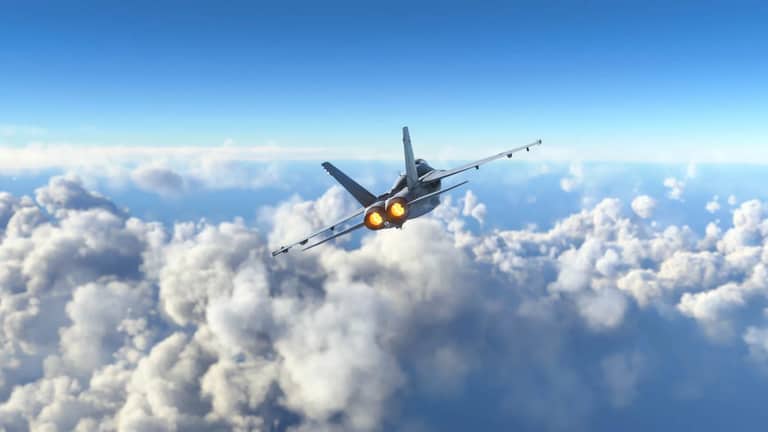
The U.S. defense budget for fiscal year 2026 reached $900.6 billion, the largest in American history, and the White House has requested $1.5 trillion for FY2027. NATO members agreed to spend 5% of GDP on defense by 2035, the alliance's biggest commitment since the Cold War. The 2026 conflict in the Middle East proved that precision missiles, drone systems, and naval power remain essential. For investors looking for companies with visible, multi-year revenue locked in by government contracts, defense stocks offer something rare: backlogs that stretch five to ten years into the future.
We screened all publicly traded U.S. defense companies and narrowed the list to seven based on backlog size relative to annual revenue, free cash flow generation, and direct exposure to Pentagon spending.
How We Picked These Stocks
Every company on this list earns a majority of its revenue from defense and government contracts. We required a market cap above $5 billion, a backlog greater than one year of annual revenue, and positive free cash flow over the trailing twelve months. We excluded foreign defense contractors (even those with U.S. ADRs) and companies where defense revenue is a secondary business line. The result is seven pure-play defense contractors spanning missiles, aircraft, shipbuilding, satellites, and drones.
The List
RTX Corporation (NYSE:RTX)
Why it made the list: RTX is the largest defense company in the world by market cap. Its three segments cover jet engines (Pratt & Whitney), avionics and cabin systems (Collins Aerospace), and missiles and radar (Raytheon). That diversification means RTX collects revenue from nearly every military platform in service today.
The bull case: RTX's backlog hit a record $271 billion at the end of Q1 2026, split between $162 billion in commercial aerospace and $109 billion in defense. Management raised full-year 2026 sales guidance to $92.5 billion to $93.5 billion. A $50 billion, 20-year umbrella contract to build and sustain the Patriot missile defense system locks in one of the largest defense awards on record. Pratt & Whitney's geared turbofan engine is the sole power plant on the Airbus A220 and an option on the A320neo, locking in decades of aftermarket revenue.
The risk: The Pratt & Whitney powder metal contamination issue forced engine inspections across hundreds of aircraft. Remediation costs are largely provisioned, but warranty obligations could extend further than expected.
Key number: $271 billion in total backlog, the largest of any defense company on earth.
Lockheed Martin (NYSE:LMT)
Why it made the list: Lockheed Martin builds the F-35 Lightning II, the most expensive weapons program in history. It also runs the Missiles and Fire Control segment that produces Javelin anti-tank missiles, PAC-3 interceptors, and hypersonic strike weapons. Every major U.S. military branch is a customer.
The bull case: Lockheed's backlog stood at $186.4 billion at the end of Q1 2026. Management reaffirmed full-year guidance calling for roughly 5% sales growth and 25% operating profit growth. The company is moving to triple Patriot interceptor production and quadruple THAAD interceptor output, and international orders from Poland, Germany, and Greece keep adding to the pipeline.
The risk: The F-35 program has faced cost overruns and delivery delays for years. Any further production slowdown would hit both revenue and investor confidence.
Key number: $186.4 billion in backlog, roughly 2.7 times annual revenue.
General Dynamics (NYSE:GD)
Why it made the list: General Dynamics builds nuclear submarines, Abrams tanks, and Gulfstream business jets. Its Marine Systems division is one of only two shipyards in the U.S. capable of building nuclear-powered submarines, giving it a structural advantage that no competitor can replicate quickly. The FY2026 NDAA authorized more than $26 billion for naval shipbuilding.
The bull case: The Columbia-class ballistic missile submarine program is the Navy's top acquisition priority. General Dynamics' Electric Boat division is the prime contractor. Each submarine costs roughly $9 billion, and the Navy plans to build 12 of them. The Gulfstream segment provides a commercial hedge that smooths cyclical defense spending.
The risk: Shipbuilding timelines are stretching due to labor shortages at both major U.S. shipyards. GD has flagged workforce challenges as its biggest constraint on growth.
Key number: Sole-source contractor on the $109 billion Columbia-class submarine program.
Northrop Grumman (NYSE:NOC)
Why it made the list: Northrop Grumman builds the B-21 Raider, the Air Force's next-generation stealth bomber. It is also the prime contractor on the Sentinel intercontinental ballistic missile (ICBM) replacement program and a major supplier of space-based surveillance satellites. These three programs alone provide revenue visibility into the 2040s.
The bull case: Northrop's backlog reached $96 billion with a book-to-bill ratio of 1.10 in 2025, meaning new orders exceeded revenue. The B-21 completed its first flight in late 2023 and is progressing through testing. Full-year 2026 sales guidance sits at $43.5 billion to $44 billion, with free cash flow expected between $3.1 billion and $3.5 billion.
The risk: The Sentinel ICBM program has experienced significant cost growth and schedule delays. The Air Force conducted a Nunn-McCurdy review (a mandatory reassessment triggered when cost overruns exceed 25%) and chose to continue the program, but further overruns would pressure margins.
Key number: $96 billion backlog with a 1.10 book-to-bill ratio, meaning the backlog is still growing.
L3Harris Technologies (NYSE:LHX)
Why it made the list: L3Harris is the leading provider of tactical communications, electronic warfare systems, and intelligence, surveillance, and reconnaissance (ISR) equipment to the U.S. military. If a soldier carries a radio, flies a reconnaissance drone, or jams an enemy signal, L3Harris technology is likely involved.
The bull case: The company completed its integration of Aerojet Rocketdyne in 2023, adding solid rocket motor production to its portfolio. Solid rocket motors are a critical bottleneck in missile production, and L3Harris is now one of only two domestic suppliers. The company's LHX NeXt cost reduction program targets $1 billion in annual savings by 2027.
The risk: L3Harris carries more debt than peers after the Aerojet Rocketdyne acquisition. Net debt stood above $12 billion at the end of 2025, and the company needs steady free cash flow to deleverage on schedule.
Key number: One of only two U.S. companies producing solid rocket motors for military missiles.
Huntington Ingalls Industries (NYSE:HII)
Why it made the list: Huntington Ingalls is America's largest military shipbuilder. It is the sole builder of nuclear-powered aircraft carriers (Ford class) and one of two builders of nuclear-powered submarines (Virginia class). No other company in the world holds this position. The FY2026 NDAA authorized more than $26 billion for naval shipbuilding, and the majority of that spending flows directly to HII's two shipyards.
The bull case: The Navy's shipbuilding plan calls for a fleet of 381 ships, up from roughly 290 today. Reaching that number requires decades of sustained construction at HII's Newport News and Ingalls yards. The company also runs a growing Mission Technologies segment focused on unmanned systems and IT services for government agencies.
The risk: Fixed-price shipbuilding contracts have compressed margins in recent quarters. Labor shortages at the Newport News yard have pushed delivery timelines on both carrier and submarine programs.
Key number: Sole builder of U.S. Navy aircraft carriers, with the next Ford-class carrier (CVN-81) under construction.
AeroVironment (NASDAQ:AVAV)
Why it made the list: AeroVironment is the leading maker of small tactical drones and loitering munitions (also called kamikaze drones). Its Switchblade and Puma systems have been deployed extensively in Ukraine, giving the company a real-world combat record that larger competitors lack. The 2026 Middle East conflict proved that drone warfare has permanently changed how militaries fight, and AeroVironment is the primary U.S. supplier in this category.
The bull case: The Pentagon's Replicator initiative, which aims to field thousands of autonomous drones quickly, plays directly to AeroVironment's strengths. The company secured U.S. Army awards totaling roughly $887 million in 2026 for unmanned aircraft, counter-drone systems, and its new P550 platform. Its Switchblade 600, a larger loitering munition capable of destroying tanks, is in full-rate production.
The risk: AeroVironment is significantly smaller than every other company on this list, with a market cap around $7 billion. The stock has fallen sharply from its 2025 highs, and it competes against well-funded startups and divisions of larger contractors (Kratos, L3Harris, Northrop) in the fast-growing drone market.
Key number: Over 8,000 small drones delivered to the U.S. military and allies, more than any other American manufacturer.
Defense Stocks at a Glance
Sector Overview
The defense sector is in a structural upcycle driven by three forces. First, the U.S. defense budget has grown every year since 2015 and hit a record $900.6 billion in the FY2026 NDAA. Second, NATO allies are rapidly increasing their own spending. Germany committed to a special defense fund of 100 billion euros in 2022 and has since exceeded its 2% of GDP target, and in 2025 NATO members agreed to reach 5% of GDP by 2035, with 3.5% going to core defense. Third, the nature of warfare itself is shifting toward precision munitions, autonomous drones, and space-based assets, all of which require new procurement rather than upgrades to existing systems. The overlap between defense and space is growing, too, with companies like Northrop and Lockheed competing for satellite and launch contracts alongside pure-play space companies.
The 2026 U.S.-Iran conflict accelerated all three trends. Missile inventories were drawn down during naval operations in the Strait of Hormuz. Drone attacks on critical infrastructure (including a strike on the UAE's Barakah nuclear plant) demonstrated vulnerabilities that require new defense systems. Replenishment orders for precision munitions are already flowing to Lockheed, RTX, and Northrop.
Investors should note that defense stocks tend to trade differently from the broader market. Most of these companies have government-contract revenue that does not fluctuate with consumer spending or interest rates. That makes them a natural hedge during economic uncertainty, though it also means they rarely deliver the explosive growth of technology stocks.
What to watch:
- FY2027 defense budget authorization: The White House requested $1.5 trillion for FY2027 in April, the largest request since World War II. Congressional authorization will determine how much of that topline survives and which programs get funded.
- NATO spending follow-through: The July 2026 summit in Ankara comes after members agreed to a 5% of GDP target by 2035, with 3.5% for core defense. National implementation plans will set the pace of orders for U.S. defense exporters, especially Lockheed (F-35) and RTX (Patriot systems).
- Drone procurement acceleration: The Pentagon designated drone dominance a presidential priority and is targeting 300,000 low-cost attack drones by 2027. AeroVironment's roughly $887 million in 2026 Army awards shows how fast this money is moving, and future contract awards will determine which companies capture the category.
Bottom Line
Defense stocks offer multi-year revenue visibility backed by government contracts, record backlogs, and a global rearmament cycle that shows no signs of slowing. The seven companies on this list span the full range of defense spending, from aircraft carriers and stealth bombers to tactical drones and missile defense. Investors looking for steady cash flow, dividend income, and low correlation to the broader economy will find all three here.
Frequently Asked Questions
What are the best defense stocks to buy right now?
The strongest defense stocks for investors right now include RTX, Lockheed Martin, General Dynamics, Northrop Grumman, L3Harris, Huntington Ingalls, and AeroVironment. These seven companies hold a combined $553 billion in order backlog and generate steady free cash flow from long-term government contracts. RTX has the largest backlog at $271 billion.
Are defense stocks a good investment in 2026?
Defense stocks benefit from a structural spending increase that extends well beyond any single year. The FY2026 U.S. defense budget hit $900.6 billion, NATO allies agreed to reach 5% of GDP by 2035, and munition replenishment from the 2026 Middle East conflict is driving new orders. These tailwinds provide multi-year revenue visibility that few other sectors can match.
Do defense stocks pay dividends?
Most large defense contractors pay and grow their dividends consistently. Lockheed Martin, RTX, Northrop Grumman, General Dynamics, L3Harris, and Huntington Ingalls all pay quarterly dividends. AeroVironment is the exception on this list, as the company reinvests cash flow into growth rather than paying a dividend. Defense dividends tend to grow steadily because the underlying revenue from government contracts is predictable.
What is the largest defense company by market cap?
RTX Corporation is the largest publicly traded defense company, with a market cap above $250 billion. It was formed by the 2020 merger of Raytheon and United Technologies and operates three segments: Collins Aerospace (avionics and cabin systems), Pratt & Whitney (jet engines), and Raytheon (missiles and defense systems).
How does the defense budget affect defense stocks?
The annual National Defense Authorization Act (NDAA) sets the spending ceiling for the Pentagon. When the budget grows, it funds new procurement contracts, research programs, and maintenance spending that flow directly to defense contractors. The FY2026 NDAA authorized $162 billion for procurement and $146 billion for research and development. Companies with large backlogs benefit the most because budget increases accelerate delivery timelines on existing orders.