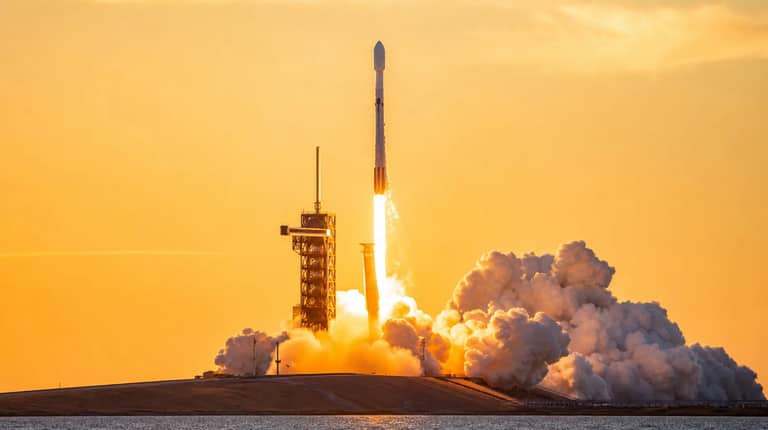
The global space economy was worth about $626 billion in 2025, roughly double its size a decade ago, and Morgan Stanley expects it to reach $1 trillion by 2040. Falling launch costs, the rise of satellite broadband, and a renewed push back to the Moon are pulling private capital into a sector that used to belong to governments alone. The best space stocks to buy right now include SpaceX, Northrop Grumman, Rocket Lab, AST SpaceMobile, Planet Labs, Intuitive Machines, Redwire, and BlackSky, chosen for their position in launch, satellites, lunar landing, and Earth imaging. We screened more than 30 US-listed space companies and narrowed the field to these eight.
How We Picked These Stocks
We started with every space-focused company trading on a US exchange and filtered on four things: a clear primary business in space, a real order book or contract base, a market cap large enough to trade easily, and a credible path to growing revenue. Market cap is the total value of a company's shares. We kept one established defense prime as a steady anchor and added seven pure-plays that give direct exposure to launch, satellites, and lunar missions, including SpaceX, which began trading publicly in June 2026. We left out shell companies, pre-revenue concepts with no signed contracts, and foreign-listed names US investors cannot easily buy.
The List
SpaceX (NASDAQ: SPCX)
Why it made the list: SpaceX is the largest launch company in the world, and as of June 12, 2026 it is finally public. Its offering raised roughly $86 billion after underwriters exercised the full over-allotment, the biggest IPO in stock market history. The stock jumped about 19% on its debut and at one point pushed the company past a $2 trillion market value, but the honeymoon has faded: on July 15 the shares closed below the $135 IPO price for the first time, leaving the company worth roughly $1.7 trillion. Most of its revenue now comes from Starlink, its satellite internet service, rather than from rockets.
The bull case: No other company comes close to its launch volume or its lead in reusable rockets, and Starlink adds a fast-growing subscription business on top. Passive money is a tailwind too, with an estimated $27 billion in index-linked buying following SpaceX into the Nasdaq after the listing. For the first time, everyday investors can own the company that sets the pace for the entire sector.
The risk: The valuation is extreme. Even after the pullback, the stock trades at roughly 90 times sales, far richer than any other name here, and Elon Musk controls about 85% of the voting power through a dual-class structure that public shareholders cannot change. Newly listed stocks with this much attention often swing hard once early investors are free to sell.
Key number: Roughly $86 billion raised, the largest IPO ever recorded.
Northrop Grumman (NYSE: NOC)
Why it made the list: Northrop Grumman runs the largest space business of any pick here. Its Space Systems unit builds satellites, missile-warning sensors, and the booster rockets for NASA's Artemis Moon program. Unlike the pure-plays, it already turns a steady profit and pays a dividend.
The bull case: Defense and space budgets are climbing, and a deep order book gives the company years of visible revenue. That steadiness lets investors own the space theme without betting on a single unproven rocket.
The risk: Space is only a slice of total revenue, so a space boom moves this stock far less than it moves a pure-play. Fixed-price program overruns can also squeeze margins.
Key number: One of only two picks on this list with a market cap above $70 billion.
Rocket Lab (NASDAQ: RKLB)
Why it made the list: Rocket Lab is the most diversified pure-play after SpaceX. Its small Electron rocket is the second-most-launched US vehicle, and its larger reusable Neutron rocket is due to debut later in 2026. First-quarter revenue grew about 64% from a year earlier to a record $200 million.
The bull case: The backlog, meaning signed orders not yet delivered, more than doubled over the past year to roughly $2.2 billion. Customers have already booked several Neutron flights before the rocket has even flown.
The risk: Rocket Lab still loses money, and Neutron's first launch could slip. The stock trades at a rich valuation, so any delay tends to hit it hard.
Key number: Backlog of about $2.2 billion, up roughly 108% over the past year.
AST SpaceMobile (NASDAQ: ASTS)
Why it made the list: AST SpaceMobile is building a satellite network that connects directly to an ordinary smartphone, with no special antenna or hardware. It has signed commercial deals with both AT&T and Verizon to reach US customers from space.
The bull case: Nearly 60 mobile-carrier partners reach more than 3 billion subscribers worldwide, and the company reports over $1.2 billion in contracted revenue commitments. It is targeting roughly 45 satellites in orbit by the end of 2026.
The risk: Revenue today is tiny, and the whole thesis depends on launching dozens more satellites on time and funding them along the way. This is the highest-risk name on the list.
Key number: Carrier partners that reach more than 3 billion mobile subscribers.
Planet Labs (NYSE: PL)
Why it made the list: Planet Labs operates one of the largest fleets of Earth-observation satellites in the world. Its customers include defense agencies, intelligence services, insurers, and farming companies that buy its daily imagery as a subscription.
The bull case: The company is winning larger defense and analytics contracts, and recurring data subscriptions give it more predictable revenue than a launch business. Demand for fresh satellite imagery keeps rising as artificial intelligence tools learn to read it.
The risk: Planet Labs has a long record of losses, and competition in commercial imagery is growing. Government contracts can be slow and lumpy.
Key number: Photographs the entire land surface of Earth roughly every day.
Intuitive Machines (NASDAQ: LUNR)
Why it made the list: Intuitive Machines became the first private company to land a spacecraft on the Moon. It holds NASA contracts to deliver payloads to the lunar surface and to help build a communications and navigation network around the Moon.
The bull case: Its backlog has reached a record near $1.1 billion, and NASA's Artemis program funds a steady stream of lunar missions over the rest of the decade. Few companies have proven they can actually reach the surface.
The risk: Revenue is lumpy and tied to a handful of high-stakes missions. A failed landing can dent both the stock and the contract pipeline.
Key number: Record backlog of about $1.1 billion.
Redwire (NYSE: RDW)
Why it made the list: Redwire supplies the parts that other space companies need, including solar arrays, antennas, navigation sensors, and in-space manufacturing systems. It recently bought drone maker Edge Autonomy to push deeper into defense hardware.
The bull case: Redwire sells the picks and shovels of the space build-out, so it benefits no matter which satellite operator wins. The Edge Autonomy deal roughly doubled its revenue base and added a growing defense business.
The risk: It is a small company still working toward consistent profit while it absorbs a large acquisition. Its balance sheet carries meaningful debt.
Key number: Flight-proven hardware across hundreds of space missions over two decades.
BlackSky (NYSE: BKSY)
Why it made the list: BlackSky sells real-time geospatial intelligence, using satellites that revisit the same spot many times a day. Its main customers are defense and intelligence agencies that pay for fast, frequent imaging.
The bull case: Its newer Gen-3 satellites sharpen image resolution, and multiyear government contracts provide recurring revenue. The company sells analysis, not just raw pictures, which carries higher margins.
The risk: This is the smallest company on the list, and it leans heavily on government budgets and a few large contracts. Any spending freeze would bite quickly.
Key number: Gen-3 satellites can image the same location several times per hour.
Sector Overview
Two forces are driving the space rally. The first is cost. A reusable rocket now puts a kilogram into orbit for a fraction of what it cost ten years ago, which makes large satellite networks affordable for the first time. The second is demand. Satellite broadband, defense imaging, and lunar exploration are all scaling at once, and each needs more launches, more satellites, and more ground hardware.
One giant is still out of reach. Jeff Bezos's Blue Origin is raising its first outside money at a $130 billion valuation while staying private, which leaves the eight names above as the main ways to own the space race through a regular brokerage account.
Defense is the thread that runs through most of these names. Governments want their own eyes in orbit and their own secure communications, which feeds Planet Labs, BlackSky, and the space units inside the big primes. Investors who want the steadier version of this theme can compare these picks with our guide to the best defense stocks.
Artificial intelligence is the other tailwind. AI models are hungry for fresh satellite imagery to train on, and data centers need the kind of secure networks that space companies are building. The same risk-on appetite lifting the best AI stocks and the best semiconductor stocks tends to lift speculative space names alongside them, which cuts both ways when the market turns.
What to Watch
- How SPCX trades from here: SpaceX broke below its $135 IPO price on July 15, barely a month after the largest listing ever, and touched a fresh low the day before Starship's next flight. Whether the stock finds a floor before the post-IPO lockup expires will set the tone for the whole group.
- Starship Flight 13: The July 16 test flight carries the first Starlink V3 satellites, which are built to expand the network's capacity and speeds. A clean flight strengthens the Starlink business that now supplies most of SpaceX's revenue.
- Neutron's first launch: Rocket Lab's larger reusable rocket is due to debut later in 2026, and a clean first flight would open the medium-lift market to a second proven US provider.
- AST SpaceMobile's launch cadence: The next batches of BlueBird satellites will show whether direct-to-phone service can scale on schedule, which is the core of the bull case.
Bottom Line
This list is for investors who want exposure to a fast-growing frontier and can handle sharp swings. The pure-plays sold off hard again in mid-July, and even SpaceX slipped below its IPO price, a reminder that these stocks move on sentiment as much as fundamentals. SpaceX is now the headline name in the group, but its extreme valuation makes it one to size carefully rather than chase. A reasonable approach is to anchor with a profitable name like Northrop Grumman and add one or two pure-plays in small sizes you can afford to hold through the volatility.
Frequently Asked Questions
What are the best space stocks to buy?
The strongest space stocks right now include SpaceX, now public on the Nasdaq as SPCX, for direct exposure to the launch leader, Northrop Grumman for steady exposure, Rocket Lab and AST SpaceMobile for launch and satellite broadband, Planet Labs and BlackSky for Earth imaging, Intuitive Machines for lunar missions, and Redwire for space hardware. They cover different parts of the space economy, from rockets to satellites to the Moon. Pairing one profitable name with a few pure-plays spreads the risk across the sector.
Is Rocket Lab a good stock to buy?
Rocket Lab is the most diversified pure-play space company after SpaceX, with a launch business, a satellite-building arm, and a backlog that more than doubled over the past year to roughly $2.2 billion. The main catalyst is Neutron, a larger reusable rocket due to debut later in 2026. The risk is that the company still loses money and trades at a high valuation, so a launch delay could hit the stock hard.
How can I invest in SpaceX?
SpaceX went public on June 12, 2026 and now trades on the Nasdaq under the ticker SPCX, so retail investors can buy it directly through any standard brokerage account. The IPO priced at $135 a share, and after a sharp early run the stock slipped back below that level in mid-July. Keep in mind that SPCX trades at a very high multiple of sales and carries the price swings typical of a newly listed company, so position size matters more than usual.
Are space stocks a good investment?
Space stocks offer exposure to one of the fastest-growing sectors in the market, with the space economy on track to roughly double by 2040. The trade-off is volatility, because most pure-play space companies still run losses and trade on future expectations rather than current profits. They suit investors with a long horizon who can size positions small and hold through large swings.