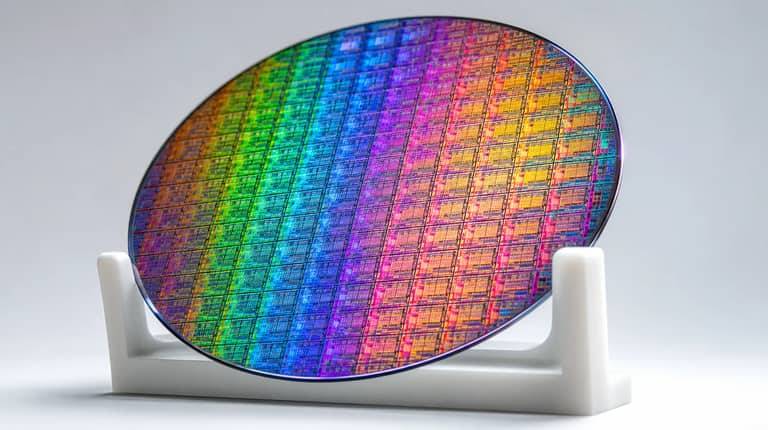
The nine largest cloud companies plan to spend roughly $830 billion building AI data centers this year, and almost every dollar passes through a chip company before it does anything useful. A sharp sell-off that began in early summer has kept many of these names well off their highs, even as the underlying orders keep climbing. For investors who want direct exposure to the buildout rather than an index fund, the real question is which chipmakers sit at the chokepoints. We screened the largest US-listed semiconductor companies and narrowed the list to seven based on market position, revenue growth, and the part of the supply chain each one controls.
How We Picked These Stocks
More than 60 semiconductor companies trade on US exchanges, from tiny penny stocks to the most valuable company on the planet. We filtered for three things: a defensible position in some part of the chip supply chain, revenue growth driven by AI or data center demand, and a market cap above $100 billion that signals real scale. We excluded money-losing startups and names tied to consumer cycles rather than the data center buildout. The result is seven companies that each own a chokepoint, from the machines that print the chips to the memory stacked inside them.
NVIDIA Corporation (NASDAQ:NVDA)
Why it made the list: Nvidia designs the graphics processing units, or GPUs, that train and run nearly every large AI model. The company posted $81.6 billion in revenue last quarter and guided the current quarter to roughly $91 billion. No competitor is close on raw performance or on the software that locks customers in.
The bull case: Its next-generation Vera Rubin systems begin shipping in volume in the back half of the year, and demand still runs ahead of supply. As long as the cloud giants keep raising their capital budgets, Nvidia collects the single largest check in the industry.
The risk: At a market cap near $4.9 trillion, expectations are enormous, and the stock has fallen on four straight earnings beats because the bar keeps rising faster than the results.
Key number: $91 billion in guided revenue for a single quarter.
Taiwan Semiconductor Manufacturing (NYSE:TSM)
Why it made the list: Taiwan Semiconductor is the foundry, the contract factory, that actually manufactures the chips Nvidia, AMD, Apple, and Broadcom design. It builds on the most advanced manufacturing nodes, meaning the smallest transistors, and holds the dominant share of leading-edge production.
The bull case: Every AI accelerator on this list, no matter who designs it, is fabricated by TSMC. That makes it the closest thing to a neutral toll on the entire AI chip race, and its pricing power on the newest nodes keeps climbing.
The risk: Most of its leading-edge capacity sits in Taiwan, a geographic concentration that no balance sheet can fully offset.
Key number: the majority of the world's most advanced chip production runs through its fabs.
Broadcom (NASDAQ:AVGO)
Why it made the list: Broadcom builds custom AI chips, called ASICs (application-specific integrated circuits), plus the networking silicon that ties data center servers together. Its AI revenue doubled to $10.8 billion in the most recent quarter.
The bull case: Major AI labs are designing their own chips with Broadcom to reduce their reliance on Nvidia, including reported multibillion-dollar orders. The networking business grows alongside every new cluster that gets built.
The risk: The stock sold off after its latest report when one guidance figure landed below inflated expectations, a sign of how high the hopes around it have climbed.
Key number: AI revenue doubled to $10.8 billion in one quarter.
Micron Technology (NASDAQ:MU)
Why it made the list: Micron makes the high bandwidth memory, or HBM, that sits stacked next to every AI accelerator and feeds it data fast enough to keep up. It is one of only three companies in the world that produce it, and capacity is sold out through the end of the year.
The bull case: Memory has always been a boom-and-bust business, but AI demand has tightened supply so severely that Micron says it can fill barely half its orders. That scarcity is repricing the entire memory market.
The risk: Memory remains the most cyclical corner of the chip world, and any pause in AI spending tends to hit it first and hit it hardest.
Key number: one of three companies on Earth that makes high bandwidth memory.
Advanced Micro Devices (NASDAQ:AMD)
Why it made the list: AMD is the only company shipping data center GPUs that compete with Nvidia at the high end, alongside a server processor business steadily taking share from Intel. Its MI-series accelerators are winning real cloud deployments.
The bull case: AMD does not need to beat Nvidia to win, it only needs buyers who want a second source. Every cloud giant has a reason to fund an alternative, which keeps the order book growing.
The risk: Nvidia's quarterly profit is larger than AMD's entire quarterly revenue, a gap that shows how far it still has to climb.
Key number: the only credible second source for data center GPUs.
ASML Holding (NASDAQ:ASML)
Why it made the list: ASML builds the extreme ultraviolet, or EUV, lithography machines that print the circuit patterns on every advanced chip. It is the sole maker of these machines on the planet, and each one sells for hundreds of millions of dollars.
The bull case: No EUV machine, no advanced chip, anywhere. As TSMC, Samsung, and Intel race to add leading-edge capacity, they all buy from the same single supplier, and the toolmakers recently hit record highs while the chip designers sold off.
The risk: Its sales are lumpy from quarter to quarter, and export restrictions on selling into China cap part of its market.
Key number: the only company in the world that makes EUV lithography machines.
Marvell Technology (NASDAQ:MRVL)
Why it made the list: Marvell designs custom silicon and the optical interconnects that move data between AI chips at high speed. Nvidia's CEO called it a potential trillion-dollar company at Computex, and the stock surged more than 20% on the comment.
The bull case: As clusters grow, the bottleneck shifts from raw compute to moving data between chips, which is exactly Marvell's specialty. Its custom-silicon pipeline with major cloud customers is filling up.
The risk: It is the smallest company on this list and the most dependent on a handful of large customers staying on plan.
Key number: more than 20% single-session jump on one trillion-dollar comment.
The Sector Right Now
The semiconductor industry is running at two speeds. Chips tied to AI data centers, the GPUs, custom accelerators, high bandwidth memory, and the equipment that makes them, are growing at rates the industry has rarely seen, while chips for phones, cars, and PCs grind along with the broader economy. Every company on this list sits on the AI side of that divide. The buildout behind it is enormous, with the largest cloud providers guiding to well over $700 billion in capital spending this year alone, and much of that money lands in the hands of these seven names. For the broader set of companies riding the same wave, see our guide to the best AI stocks. After notching record gains through the second quarter, the group stumbled on the first trading day of July, a fresh reminder that these stocks do not move in a straight line, much as the whole group sold off together twice in one week in early summer. The structural demand, though, kept building underneath the price action.
What to Watch
- Earnings calendar: Nvidia reports fiscal second-quarter results on August 26, with Broadcom due in early September and Micron in late September, the clearest test of whether AI orders still outrun supply.
- Vera Rubin ramp: Nvidia's next-generation systems begin shipping in volume in the second half of the year, a key check on whether demand still runs ahead of supply.
- Memory pricing: HBM contracts for next year get negotiated over the coming months, and Micron's pricing power will reveal whether the shortage holds.
- Export policy: Any change to US rules on selling advanced chips and equipment into China can move ASML, Nvidia, and AMD on a single headline.
Bottom Line
This list is for investors who want direct exposure to the AI buildout and can stomach sharp swings along the way. The seven names span the entire chain, from the machines that print the chips to the memory stacked inside them. Spreading exposure across several chokepoints lowers the risk of betting everything on a single winner.
Frequently Asked Questions
What is the best semiconductor stock to buy?
Nvidia is the largest and most dominant, controlling the GPUs that train nearly every major AI model, but the best pick depends on what you want. Nvidia offers scale and a deep software moat, AMD offers a cheaper second-source bet, and ASML offers a near-monopoly on the equipment every chipmaker needs. Many investors own several of them rather than picking one.
Why are semiconductor stocks falling?
Chip stocks sold off sharply in June 2026 after Broadcom's quarterly guidance came in below very high expectations, and the group has stayed volatile since as investors weigh stretched valuations against still-rising AI orders. The declines have been driven by positioning and price, not by any drop in actual AI demand.
What is the difference between a chipmaker and a foundry?
A chipmaker like Nvidia or AMD designs the chip but does not manufacture it. A foundry like Taiwan Semiconductor owns the factories, called fabs, that physically produce chips for many different designers. Some companies, such as Intel, do both, while most leading designers outsource production to TSMC.
Are semiconductor stocks a good long-term investment?
Semiconductors are essential to AI, cloud computing, phones, cars, and defense systems, which gives the sector durable long-term demand. They are also among the most cyclical and volatile stocks in the market, with deep drawdowns between booms. The sector has produced strong returns over full cycles historically, though the swings are not for everyone.