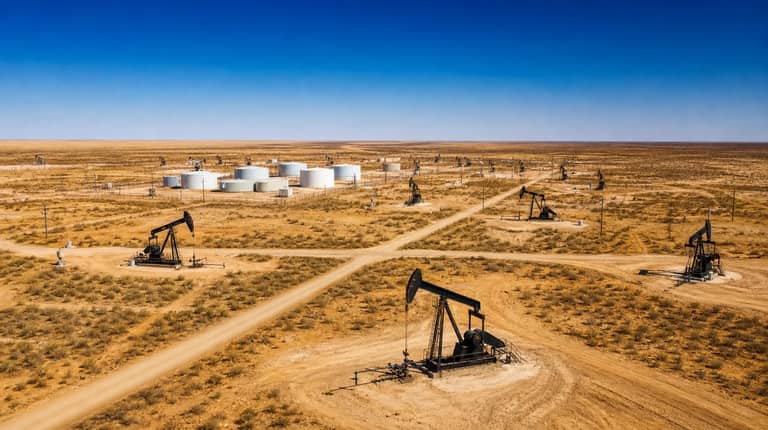
West Texas Intermediate crude, the main US oil benchmark, has traded between $55 and nearly $120 a barrel over the past 12 months. It trades near $71 in mid-July, with Brent around $76, after a fresh round of US and Iranian strikes near the Strait of Hormuz spiked prices in early July before mediators pulled them back. Few sectors have seen this much whiplash in a single year.
That volatility is exactly why stock selection matters more than usual. The companies that win across a $55 to $120 range are the ones with low production costs, strong balance sheets, and the discipline to return cash instead of chasing growth. We screened the US-listed oil and gas universe and narrowed it to seven companies that clear that bar.
How We Picked These Stocks
More than 200 oil and gas companies trade on US exchanges. We filtered for companies that earn the majority of their revenue from oil production or refining, carry a market cap above $50 billion, generate positive free cash flow (the cash left over after operating costs and investment), and return that cash through dividends or buybacks. We excluded pipeline operators and oilfield service firms, which are infrastructure and equipment businesses rather than direct ways to own oil. The result is four producers, two integrated giants, and one refiner.
The 7 Best Oil Stocks
Exxon Mobil (NYSE:XOM)
Why it made the list: Exxon Mobil is the largest US oil company and the most complete way to own the sector. Production keeps climbing in the two lowest-cost basins in its portfolio, the Permian in West Texas and offshore Guyana, while the chemicals and refining arms cushion the swings in crude.
The bull case: Exxon plans roughly $20 billion in share repurchases for 2026 on top of a dividend it has raised for more than 40 consecutive years. If crude holds anywhere near current levels, that cash return program is funded with room to spare.
The risk: Size cuts both ways. A company this large cannot grow production quickly, so the stock is a bet on capital discipline rather than expansion.
Key number: $20 billion in planned share buybacks for 2026.
Chevron (NYSE:CVX)
Why it made the list: Chevron pays the highest dividend yield of the supermajors and has increased that payout for 39 consecutive years. The 2025 close of its Hess acquisition added a 30% stake in Guyana's Stabroek block, one of the biggest oil discoveries of the past decade.
The bull case: Guyana barrels are among the cheapest to produce anywhere outside the Middle East. As that production ramps, Chevron's free cash flow grows even if oil prices stand still.
The risk: Chevron's refining and chemicals segments earn thinner margins than its production arm, and a global slowdown would hit both sides of the business at once.
Key number: 39 consecutive years of dividend increases.
ConocoPhillips (NYSE:COP)
Why it made the list: ConocoPhillips is the largest pure exploration and production company on US exchanges, pumping about 2.3 million barrels of oil equivalent per day in the first quarter of 2026. The 2024 Marathon Oil acquisition deepened its position in every major US shale basin.
The bull case: The Willow project in Alaska adds a new long-life oil source late this decade, and the company's global LNG buildout gives it a second commodity to sell into Asian and European markets.
The risk: With no refining arm, ConocoPhillips is fully exposed to crude prices. It feels downturns faster than Exxon or Chevron.
Key number: 2.3 million barrels of oil equivalent per day produced in Q1 2026.
Valero Energy (NYSE:VLO)
Why it made the list: Valero is the largest independent refiner in the country, with 15 refineries that can process about 3.2 million barrels of crude per day. Disrupted fuel shipments out of the Persian Gulf have tightened global gasoline and diesel supply, and that shortage flows straight to Gulf Coast refining margins.
The bull case: Crack spreads, the gap between what a refiner pays for crude and what it earns selling gasoline and diesel, have widened sharply during the conflict. Valero converts wide spreads into buybacks faster than any peer.
The risk: Refining margins are cyclical and can collapse as quickly as they expand. The stock has already rerated hard and trades near its 52-week high.
Key number: 3.2 million barrels per day of refining capacity.
EOG Resources (NYSE:EOG)
Why it made the list: EOG Resources runs one of the lowest-cost shale operations in the country. Management says it can fund its entire capital program and regular dividend with WTI below $50 a barrel, which means everything above that is surplus cash.
The bull case: The 2025 Encino acquisition added a large position in Ohio's Utica shale at a reasonable price, giving EOG a third core basin alongside the Permian and Eagle Ford. The company carries minimal debt and has a history of paying special dividends when oil runs hot.
The risk: EOG is a pure producer with no downstream cushion, and natural gas, a growing share of its output, has its own volatile price cycle.
Key number: Capital program and dividend funded with WTI under $50.
Occidental Petroleum (NYSE:OXY)
Why it made the list: Occidental controls one of the largest acreage positions in the Permian Basin, and Warren Buffett's Berkshire Hathaway owns roughly 27% of the company. Years of aggressive debt paydown have rebuilt a balance sheet that was stretched after two large acquisitions.
The bull case: Every dollar of debt retired shifts value from bondholders to shareholders. Occidental also operates STRATOS, the largest direct air capture plant in the world, which pulls carbon dioxide from the atmosphere and gives the company a head start if carbon removal becomes a real market.
The risk: Occidental still carries more debt than the other producers on this list, and its dividend yield trails every other name here.
Key number: Berkshire Hathaway owns roughly 27% of the company.
Diamondback Energy (NASDAQ:FANG)
Why it made the list: Diamondback Energy became the largest pure-play Permian producer after its 2024 merger with Endeavor Energy Resources. Management says the base dividend is protected with oil in the low $40s, among the lowest breakeven levels in US shale.
The bull case: Diamondback pays a base dividend plus a variable payout tied to free cash flow. At current crude prices, the variable component turns the stock into one of the highest effective yields in the sector.
The risk: Single-basin concentration. Any Permian-specific problem, from pipeline constraints to well productivity declines, hits Diamondback harder than diversified peers.
Key number: Base dividend protected with oil in the low $40s.
Oil Stocks at a Glance
What Is Driving Oil Prices in 2026
The Iran conflict has dominated the oil market all year. Crude spiked after US and Israeli strikes in late February, crashed through May as deal talk built, with Brent posting its worst month since 2020, then surged past $97 when Iran broke the ceasefire on June 8. Within a day, renewed negotiations had reversed much of that move. Prices flared again in early July when US strikes and Iranian attacks on tankers near the Strait of Hormuz sent Brent back above $80, only for mediation talk to knock crude down and leave Brent near $76 and WTI near $71 by mid-July. Headlines, not fundamentals, are setting the price from week to week.
Underneath the noise, supply is loosening. OPEC+ agreed on July 5 to raise August output by another 188,000 barrels per day, its fourth straight monthly increase, and the UAE left the cartel entirely on May 1, freeing it to pump at will. The OECD has already cut its global growth forecast and blamed the energy shock for most of the damage, which clouds the demand side too.
That mix favors the companies on this list. Low-cost producers stay profitable if a peace deal sends crude back to the $60s, and refiners like Valero benefit from the fuel shortages the conflict has created. Investors who want energy exposure without single-commodity risk can pair these names with our guide to the best nuclear stocks, which monetize a different energy bottleneck.
What to watch:
- The next OPEC+ meeting: The group meets in early August to set September quotas, and a fifth straight increase would pressure crude regardless of the conflict.
- Strait of Hormuz and Iran talks: Mediators are working to keep the July flare-up from tipping into open war. A durable ceasefire sends oil lower fast, and a collapse does the opposite. Position sizing matters more than usual.
- Second-quarter earnings: Valero reports around July 24, with Exxon and Chevron near August 1 and the producers in the first week of August. Watch buyback pacing, since companies still repurchasing aggressively with WTI near $71 are signaling confidence in their cost structure.
Bottom Line
A war premium can make every producer look smart. The seven companies here are the ones that still work if that premium disappears and crude settles back into the $60s. For income-focused investors, Chevron and Exxon anchor the list. For maximum torque to the commodity, EOG and Diamondback offer the lowest breakevens in shale.
Frequently Asked Questions
Are oil stocks a good investment right now?
Oil stocks offer high free cash flow yields and rising dividends, but prices currently carry a war premium from the Iran conflict. The strongest case is for low-cost producers like EOG Resources and Diamondback Energy, which stay profitable even if crude falls back to the $50s. Investors buying today should expect sharp swings tied to ceasefire headlines.
Which oil stock pays the highest dividend?
Among major oil companies, Chevron pays the highest yield of the supermajors and has raised its dividend for 39 consecutive years. Diamondback Energy can deliver a higher total payout in strong years because it adds a variable dividend tied to free cash flow on top of its base dividend.
What happens to oil stocks if oil prices fall?
Producers' earnings fall roughly in line with crude, which is why breakeven costs matter. Companies like EOG, which funds its dividend below $50 WTI, can maintain payouts through a downturn. Refiners like Valero can actually benefit from falling crude because their input costs drop while fuel prices adjust more slowly.
Should I buy oil stocks or an oil ETF?
Individual oil stocks let you target the strongest balance sheets and lowest-cost producers, while an energy ETF spreads exposure across the whole sector, including weaker names. Investors who want income with less single-stock risk can also consider dividend-focused funds, which we cover in our guide to the best dividend stocks.