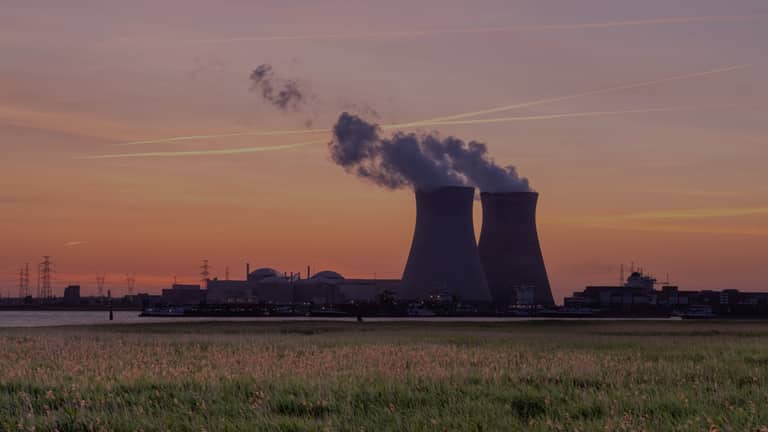
U.S. data center electricity demand is on track to grow from 176 terawatt-hours to as much as 580 terawatt-hours by 2028. Nuclear is the only baseload power source that runs around the clock with zero carbon emissions, and tech companies are paying up for it. Microsoft, Amazon, and Meta have all signed long-term nuclear power purchase agreements.
The best nuclear stocks right now include Constellation Energy, Vistra, Cameco, BWX Technologies, Oklo, Brookfield Renewable Partners, and NuScale Power, selected on contracted revenue, position in the nuclear value chain, and regulatory progress. We screened every publicly traded nuclear company on U.S. exchanges, from fleet operators and uranium miners to small modular reactor developers. The final list of seven spans the full chain: companies generating nuclear power today, the businesses supplying them with fuel and components, and the startups building the next generation of reactors.
How We Picked These Stocks
We filtered for companies where nuclear power, nuclear fuel, or nuclear technology is the primary business driver. Each pick had to trade on a major U.S. exchange with a market cap above $3 billion. We prioritized companies with either proven revenue from nuclear operations or, for pre-revenue developers, regulatory progress with the Nuclear Regulatory Commission (NRC) and enough cash to reach commercialization. We grouped the list into three tiers: operating fleet owners, fuel and component suppliers, and next-generation developers.
The List
Constellation Energy (NASDAQ: CEG)
Why it made the list: Constellation Energy operates the largest nuclear fleet in the United States, part of roughly 32,000 megawatts of total generation capacity it held before completing its acquisition of Calpine in January 2026. That deal pushed combined capacity to roughly 55 gigawatts and made Constellation the nation's largest electricity producer.
The bull case: Constellation has locked in long-term power purchase agreements with Microsoft, Meta, and CyrusOne worth billions in committed revenue. The Microsoft deal is a 20-year agreement tied to the Crane Clean Energy Center nuclear restart, backed by a $1 billion Department of Energy loan guarantee. The company is pursuing 1 gigawatt of nuclear uprates over the next decade, including 135 megawatts at the Braidwood and Byron sites in Illinois, which adds capacity without building new plants. We broke down how Constellation turned 21 reactors into an AI power play in a separate deep dive.
The risk: The stock has pulled back more than 35% from its 52-week high near $413. Integration risk from the Calpine deal is real, and Constellation agreed to sell some PJM generation assets to LS Power to resolve federal regulatory and antitrust review, trimming the combined fleet.
Key number: 1 gigawatt of planned nuclear uprates over the next decade, capacity added without breaking ground on a new plant.
Vistra Corp (NYSE: VST)
Why it made the list: Vistra owns the Comanche Peak Nuclear Power Plant in Texas, a 2,400-megawatt facility cleared by the NRC to operate through 2053. The company signed a 20-year power purchase agreement with Amazon Web Services for up to 1,200 megawatts of carbon-free power from Comanche Peak, with delivery starting in late 2027 and ramping to full capacity by 2032.
The bull case: Vistra widened its contracted nuclear book in January 2026 with 20-year agreements to supply Meta with 2,609 megawatts of power and capacity from its PJM nuclear plants, bringing total long-term nuclear commitments to roughly 3,800 megawatts. The Cogentrix acquisition, expected to close in the second half of 2026, adds about 5,500 megawatts of natural gas capacity. Nuclear baseload plus flexible gas positions Vistra to serve data centers that need both reliability and the ability to ramp.
The risk: More than half of Vistra's total generation capacity still comes from natural gas and coal. A sharp decline in natural gas prices or accelerated coal retirement timelines could pressure earnings from non-nuclear assets. For a broader look at how regulated power names compare, see our guide to the best utility stocks.
Key number: Roughly 3,800 megawatts of long-term nuclear power agreements signed with Amazon and Meta combined.
Cameco Corporation (NYSE: CCJ)
Why it made the list: Cameco is the world's largest publicly traded uranium producer and owns 49% of Westinghouse Electric, the company that builds and services nuclear reactors globally. First quarter revenue reached $845 million, up 7% year over year, while net earnings climbed 87% to $131 million.
The bull case: Spot uranium trades near $85 per pound, well above the $50 to $60 range that prevailed for most of the past decade. Cameco expects uranium demand to outstrip supply by 2030 as reactor construction accelerates, and Kazakhstan, the world's largest producer, has cut output 17%. The Westinghouse stake gives Cameco exposure to reactor servicing and fuel fabrication on top of raw uranium production. Investors who want a purer play on the fuel itself should read our guide to the best uranium stocks.
The risk: Uranium prices are volatile and sensitive to geopolitical events. A slowdown in reactor construction or new supply coming back online could take pressure off spot prices. Cameco also faces production risk at its Canadian mining operations.
Key number: Full-year uranium production guidance of 19.5 to 21.5 million pounds.
BWX Technologies (NYSE: BWXT)
Why it made the list: BWX Technologies manufactures nuclear reactors and fuel for the U.S. Navy and the Department of Energy. The company is the sole supplier of nuclear reactors for American submarines and aircraft carriers, a position it has held for decades. First quarter revenue hit $860 million, up 26% year over year.
The bull case: BWXT booked $1.4 billion in new naval nuclear propulsion contracts and carries a backlog of $8.65 billion. Management raised full-year adjusted EBITDA guidance, a measure of operating profit before interest, taxes, and non-cash charges, to a range of $650 million to $665 million. The company agreed to acquire Precision Components Group for roughly $200 million, and its TRISO fuel enabled the first new reactor criticality under a DOE pilot program in June. Investors looking at defense-adjacent plays should also consider the companies in our best defense stocks guide.
The risk: Revenue concentration with the U.S. government means budget cuts or shifting defense priorities could slow growth. Commercial nuclear and medical isotope segments are growing but still represent a minority of total revenue.
Key number: $8.65 billion backlog, roughly 2.3 times the company's 2026 revenue outlook of $3.75 billion.
Oklo (NYSE: OKLO)
Why it made the list: Oklo is developing the Aurora, a small fast reactor that uses liquid metal coolant and can run on both fresh uranium and recycled nuclear waste. The NRC approved Oklo's Principal Design Criteria for the Aurora, and the first unit is now under construction at Idaho National Laboratory. Co-founder Jacob DeWitte chairs the board after Sam Altman stepped down as chairman in 2025 to clear the way for Oklo to work with more AI customers.
The bull case: The Department of Energy's Idaho office approved Oklo's preliminary documented safety analysis in June, clearing the next regulatory step for the first Aurora powerhouse. Oklo targets initial operations in late 2027 to early 2028. The reactor design uses recycled fuel, which could reduce fuel costs and chip away at the spent fuel problem that has dogged the nuclear industry for decades. Oklo closed the first quarter with $2.5 billion in cash and marketable securities and no debt.
The risk: Oklo has zero revenue, and the Idaho site is not currently authorized to sell power to the grid. Any regulatory delay or technical setback could push commercial operations well past 2028. The cash pile came partly from a $1.2 billion at-the-market equity raise in the first quarter, so existing shareholders absorbed real dilution to fund it. The stock has fallen more than 75% from its 52-week high near $194 and touched a fresh 52-week low in July.
Key number: $2.5 billion in cash and marketable securities against zero revenue.
Brookfield Renewable Partners (NYSE: BEP)
Why it made the list: Brookfield Renewable Partners owns a diversified portfolio of roughly 47,300 megawatts of operating clean energy capacity globally. Brookfield Renewable, together with its institutional partners, holds the 51% interest in Westinghouse that sits opposite Cameco's 49%, giving it exposure to the nuclear servicing and reactor construction cycle.
The bull case: Westinghouse signed an agreement with the U.S. government to deliver new nuclear reactors, which brings decades of fuel and maintenance revenue given reactor lifespans of 80 years or more. Funds from operations, the cash-flow measure infrastructure investors track most closely, reached $375 million in the first quarter, up 19% year over year. The broader hydro, wind, and solar portfolio diversifies risk beyond nuclear, and a development pipeline above 200 gigawatts backs future growth.
The risk: BEP is a limited partnership, which creates tax complexity through K-1 filings. Rising interest rates can compress valuations on yield-oriented infrastructure names, and nuclear is only one slice of a much larger renewable business.
Key number: Roughly 47,300 megawatts of operating capacity, plus a development pipeline above 200 gigawatts.
NuScale Power (NYSE: SMR)
Why it made the list: NuScale Power is the only company in the world with NRC design approval for a small modular reactor. It holds approvals for both a 50-megawatt and an upgraded 77-megawatt design. Its partner ENTRA1 is working with the Tennessee Valley Authority on a deployment program of up to 6 gigawatts.
The bull case: NuScale has regulatory approval that no competitor can match. The RoPower project in Romania cleared its investment decision in February, when Nuclearelectrica shareholders approved the next phase for six NuScale modules at a former coal plant site in Doicesti. The project has moved into geotechnical work, licensing, and pre-construction contract negotiation. NuScale ended the first quarter with about $1 billion in liquidity and essentially no debt.
The risk: First quarter revenue was just $0.6 million, down from $13.4 million a year earlier, as RoPower licensing and engineering work wound down. The net loss widened to $46.7 million. Converting memorandums of understanding into firm, revenue-generating contracts is taking longer than expected, and meaningful reactor revenue probably starts in the early 2030s. The stock has dropped more than 85% from its 52-week high of $57.
Key number: NRC-approved reactor designs and a potential 6-gigawatt pipeline, against $0.6 million in quarterly revenue.
Summary
Sector Overview
The nuclear sector is being repriced by two forces that were not in play five years ago. The first is AI-driven electricity demand. Hyperscaler data centers need power that runs around the clock, and nuclear is the only zero-carbon source that can deliver it at that scale. Microsoft, Amazon, and Meta have all signed long-term nuclear agreements, a level of corporate commitment that did not exist before 2024.
The second force is a structural uranium supply deficit. Kazakhstan cut production 17%, and demand for enriched uranium is projected to more than double by 2040. Spot uranium traded at $85.25 per pound on July 15, and the long-term contract price reached $90 per pound at the end of the first quarter, its highest level since 2008. Nuclear now sits inside a much broader power buildout, which we cover in our guide to the best energy stocks. For context on how a similar supply-and-demand setup plays out in metals, see our guide to the best gold stocks.
Regulatory momentum is building too. The NRC has approved new small modular reactor designs, the DOE is backing reactor deployments through its pilot program, and support for nuclear expansion has been bipartisan. The gap between the sector's story and its share prices has widened this year. Several of these stocks trade far below their 52-week highs even as the contracts and approvals keep landing.
What to watch:
- BWXT second quarter results (August 3): The first look at whether the $8.65 billion backlog is still growing, plus any detail on the Precision Components deal.
- Constellation second quarter results (August 6): The first full quarter with Calpine inside the business, which will show whether the integration is on track.
- RoPower pre-construction phase: NuScale's Romanian project is negotiating long-lead item contracts, and firm orders would be its first real commercial revenue in years.
- Uranium spot prices: Utility spot buying has been muted near $85 per pound. If term contracting keeps prices above $80, miners like Cameco see expanding margins as legacy contracts roll off and reprice.
Bottom Line
Nuclear stocks span the full risk spectrum, from profitable fleet operators generating billions in contracted revenue to pre-revenue startups that may not produce power until the 2030s. Conservative investors can start with Constellation, Vistra, or Cameco, all of which are profitable today and directly tied to data center power demand. Investors willing to bet on next-generation reactor technology can look at Oklo or NuScale, but should size those positions small given the pre-revenue risk.
Frequently Asked Questions
What is the best nuclear stock to buy right now?
Constellation Energy (CEG) is the largest nuclear fleet operator in the U.S. and has signed long-term power purchase agreements with Microsoft, Meta, and CyrusOne. It generates revenue today, pays a dividend, and has a direct link to AI data center power demand. Its acquisition of Calpine made it the largest electricity producer in the country.
Are nuclear stocks a good investment in 2026?
Nuclear stocks are benefiting from two structural tailwinds: AI-driven electricity demand that could push U.S. data center power consumption to as much as 580 terawatt-hours by 2028, and a uranium supply deficit that has held spot prices near $85 per pound. These are long-duration trends rather than short-term trades. The tradeoff is that a lot of that optimism is already priced into the pre-revenue names.
What is a small modular reactor (SMR)?
A small modular reactor is a nuclear reactor designed to generate between 50 and 300 megawatts of electricity, compared to 1,000 megawatts or more for a traditional reactor. SMRs are built in factories and shipped to sites, which reduces construction time and cost. NuScale Power is the only company with NRC design approval for an SMR in the United States.
How does uranium supply affect nuclear stocks?
Uranium is the fuel that powers nuclear reactors. When uranium prices rise, mining companies like Cameco earn higher margins as older, lower-priced contracts expire and reprice. Kazakhstan, which produces roughly 40% of the world's uranium, cut production 17%, tightening supply at the same time demand is growing from new reactor construction and reactor life extensions.
Which companies have signed nuclear power deals with tech giants?
Constellation Energy signed power purchase agreements with Microsoft, Meta, and CyrusOne. Vistra signed a 20-year deal with Amazon Web Services for up to 1,200 megawatts from its Comanche Peak plant in Texas, then added 2,609 megawatts of agreements with Meta across its PJM nuclear plants. These are among the largest corporate nuclear commitments ever made.