1.0%.
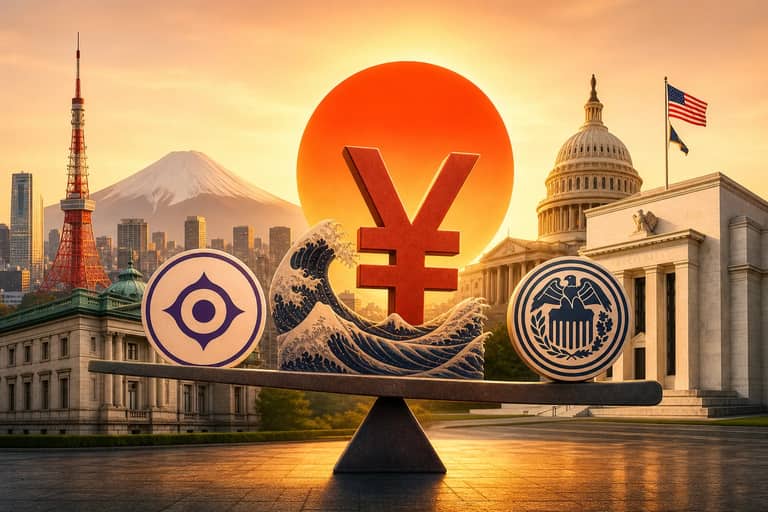
That is the Bank of Japan's benchmark interest rate this morning, after a quarter-point hike overnight. It is the highest borrowing cost in Japan since 1995 and the clearest signal yet that the last major central bank clinging to cheap money has moved on.
The carry trade is more crowded than at any point since 2017
The hike was expected. Over 90% of economists polled anticipated the move. Markets barely flinched. And that calm is the part worth watching.
CFTC data through June 9 shows net short yen positions at roughly 145,800 contracts, a nine-year extreme. Traders are borrowing in yen and deploying into higher-yielding assets faster than the BOJ can tighten. The logic is straightforward: even at 1.0%, the gap between Japanese and U.S. short rates is still roughly 275 basis points. That spread pays.
Until it doesn't.
The last time carry trade positioning reached this kind of extreme, in the summer of 2024, the unwind sent the Nikkei down 12% in a single session. Volatility spilled into U.S. tech within hours. The trigger then was a surprise BOJ hike combined with weak U.S. jobs data that reset rate expectations overnight.
The parallel is not exact. Today's hike was telegraphed. But the crowding is real, and the potential catalyst sits 24 hours away. If Warsh's first dot plot as chair shifts expectations toward a hold through year-end, or if the language signals the oil crash has taken a hike off the table, the rate gap compresses from the U.S. side. That is the scenario where 145,800 short yen contracts become a problem fast.
Japanese financials are the direct beneficiaries of the rate path
Nomura Holdings earned 340 billion yen in its most recent fiscal year, more than double the prior year, on revenue that grew roughly 21%. The expansion in domestic net interest margins from the BOJ's tightening cycle has been the primary driver. NMR trades around $8.70 with a market cap near $25 billion.
Toyota shows the other side. TM is trading near $180, in the lower quarter of its 52-week range of $167 to $249. A stronger yen compresses margins on every vehicle sold outside Japan, and the bulk of Toyota's revenue comes from exports.
The stock rallied roughly 3% Monday on the broader risk-on move, but has been one of the weakest large-cap auto names globally over the past year. For investors who owned TM as a value play near 8 to 9 times forward earnings, the yen trajectory matters more than unit sales.
The iShares MSCI Japan ETF captures both dynamics. EWJ holders carry dual exposure: underlying equity performance plus currency translation. A yen that strengthens modestly rewards the ETF in dollar terms even if local shares are flat.
The second central bank decision arrives tomorrow
The FOMC's two-day meeting begins this morning. The rate decision and updated Summary of Economic Projections land at 2:00 PM Wednesday. Warsh's first press conference follows at 2:30.
Markets are pricing near-certainty the Fed holds at 3.50% to 3.75%. Oil holding in the low $80s, well below the $90 range it traded at last week, changes the inflation picture we covered after the CPI print. If crude stays here, the energy-driven overshoot that pushed headline CPI to 4.2% reverses in next month's data. That shifts the dot plot math: officials who were leaning toward a hike may find less evidence to justify one.
Monday's rally reflected the recalibration. The S&P 500 gained about 1.6% to close around 7,554. The Nasdaq surged roughly 3%. The Dow rose nearly 1% to a record close near 51,671. Futures are holding steady this morning.
Fox announced a $22 billion deal for Roku on Monday and its stock dropped 15% on the news.
Gold is steady near $4,370, caught between falling inflation expectations from cheaper oil and falling real rate expectations from a potentially dovish dot plot.
Two central banks. Forty-eight hours. One is tightening from the bottom of the global rate stack. The other is deciding whether the top needs to move. The carry trade is crowded. The exits are narrow. Positioning matters more than the decisions themselves.