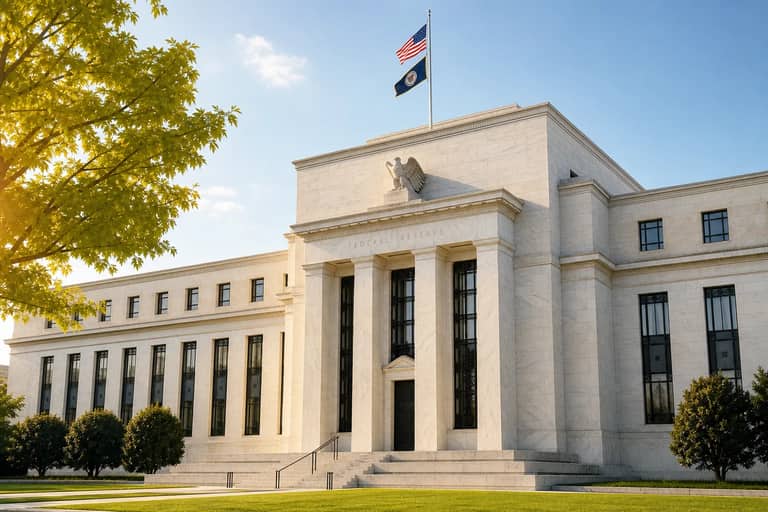
The Fed left rates alone but told the market the next move could be up, not down.
The dot plot did the talking
The Federal Open Market Committee held the fed funds rate at 3.50% to 3.75% in a 12-0 vote. The decision itself was expected. The projections were not.
Nine of the 18 officials now pencil in at least one rate hike before year-end, and six of those see more than one. The median forecast for where rates end the year moved up to 3.8%, from 3.4% back in March. That is a clean reversal. For months the debate was how many cuts were coming. Now the committee's own math points the other way.
The statement also dropped the language that had hinted at easing ahead. Higher energy prices tied to the war in Iran have kept inflation sticky, and the Fed is signaling it would rather hold or hike than cut into that.
The bond market repriced the front end
The reaction landed hardest where Fed policy lives. The two-year Treasury yield, the maturity most tied to rate expectations, jumped 16 basis points to 4.22%, its highest level in more than a year. The 10-year yield rose only about 7 basis points to 4.50%.
That gap is the tell. When the short end moves far more than the long end, it tells you the selloff is about policy, not growth fear. The curve flattened on a repricing of what the Fed will do, not a bet that the economy is rolling over.
Long bonds barely moved as a result. The iShares 20+ Year Treasury Bond ETF TLT finished close to flat near $86, because the action was concentrated in shorter maturities, not the 20-year part of the curve it tracks.
Rate-sensitive corners took the damage
All 11 S&P 500 sectors closed lower. The S&P 500 fell 1.2% to 7,420. The Nasdaq lost 1.3% to 26,022, and the Dow gave up 0.98% to 51,493. The Cboe Volatility Index climbed 12%.
The selling clustered where higher rates bite. Real estate was the worst sector, with the Real Estate Select Sector SPDR ETF XLRE down about 2.5% to $43.97. REITs lean on borrowed money and compete with bond yields for income buyers, so a jump in yields hits them twice.
Small caps slid too. The iShares Russell 2000 ETF IWM fell about 0.75% to $290, still near its 52-week high of $297.91. Smaller companies carry more floating-rate debt than large caps, so a Fed that holds or hikes raises their interest bills directly.
Warsh removed the safety net
This was Kevin Warsh's first meeting as chair, and he made his style clear. He abstained from submitting his own rate projection, and he killed forward guidance outright, telling reporters he cannot say what the Fed will do next because the Fed should not be in that business.
He also announced five task forces to review the Fed's policy operations, communications, data, productivity work, and its read on inflation. The near-term takeaway for investors is simpler than the reorganization. Less hand-holding from the Fed means the market has to price each data point on its own, and that usually means wider swings in both directions.
What it means from here
The cut trade that powered much of this year is on hold. Until inflation cools, the base case is rates that stay where they are or go higher, and the front end of the curve has already moved to reflect it.
That favors balance sheet quality over leverage. Companies that fund themselves with floating-rate debt face higher costs the longer rates hold up, while cash-rich firms keep earning more on their reserves. The next inflation reading now carries more weight than any single Fed speech, because Warsh has told the market it will get no preview.