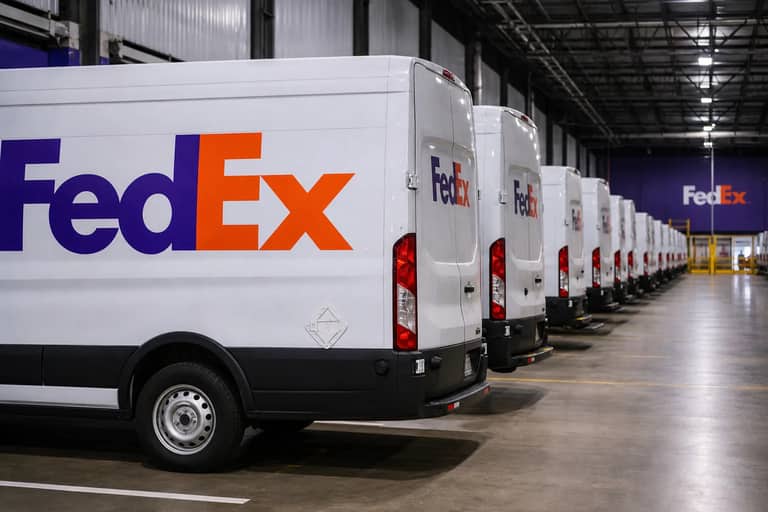
FedEx reports fiscal fourth-quarter results after the close on Tuesday. The shares trade near $331, close to a 52-week high and roughly double the lows they hit a year ago. The market cap sits around $79 billion.
This print is different from every one before it. On June 1, FedEx completed the spin-off of FedEx Freight, its less-than-truckload trucking arm, into a separate public company. So Tuesday is the first earnings report that shows what FedEx looks like without it.
The company is smaller and the math has changed
FedEx distributed 80.1% of FedEx Freight to shareholders and kept a 19.9% stake. The new company trades on the NYSE under FDXF, near $166, with a market value around $21 billion. Investors want to know what FedEx plans to do with the stake it held back, since selling it down would hand the parent a pile of cash to spend or return.
The unit that left was the high-margin part of the business. Less-than-truckload trucking earns fatter operating margins than moving express envelopes and ground parcels. What remains at FedEx is the express and ground network, a lower-margin, higher-volume machine. That makes cost control the main lever on profit, not revenue growth.
Costs are the whole story right now
FedEx has spent three years tearing expense out of its network through a program it calls DRIVE. That effort delivered about $4 billion in cumulative savings from fiscal 2023 through fiscal 2025. A second program, Network 2.0, is merging the separate air and ground operations into one delivery system to cut duplicate routes and facilities. Management has pointed to roughly another $1 billion in structural savings this fiscal year.
Revenue is barely growing. Analysts expect about $24 billion for the quarter, close to flat with a year ago, and adjusted earnings near $5.91 per share. With the top line stuck, the beat or miss comes down to how much cost FedEx can keep stripping out faster than volumes soften.
The demand read matters beyond FedEx
FedEx is a global-trade bellwether. It moves freight for manufacturers, retailers, and small businesses across borders, so its commentary on shipping volumes is a live signal on industrial activity and the effect of tariffs on trade flows. When FedEx says business shipments are slowing, the warning tends to ripple across transports and industrials.
One bright spot is parcel share. FedEx signed a multi-year deal with Amazon to handle large, oversized package delivery. That deal looks better now that UPS is deliberately cutting its Amazon volume to chase higher-margin shipments. UPS trades near $108 with a market cap around $92 billion. FedEx is leaning into Amazon demand exactly where its rival is backing away.
The trade backdrop is the other variable. Tariffs and shifting supply chains have pushed companies to reroute where they make and ship goods, and a chunk of FedEx's express business moves high-value international freight that is sensitive to those flows. A pickup in cross-border activity would help the part of the network with the best margins. A further slowdown in industrial shipping would land on the same place.
Ground volume and pricing carry the quarter
Inside the remaining business, the ground network is the engine. FedEx has been trading away low-margin, lightweight e-commerce packages for heavier, more profitable shipments, a deliberate mix shift that can hold revenue flat while lifting profit per package. The question Tuesday is whether that trade-off is still working, or whether softer volumes are forcing the company to chase parcels it would rather skip. Pricing power into the back half of the year is the tell.
The valuation leaves room, and a reason for caution
FedEx trades around 15 to 17 times forward earnings, below its roughly 18 times five-year average, so the stock is not expensive against its own history. The company raised its dividend 5% this year to $5.80 a share, a yield near 1.8% at the current price. That is a modest payout, backed by a buyback and the cost savings funding it.
The risk is that the stock has already run hard into the print. A name sitting near a 52-week high after doubling off its lows has priced in a lot of good news. A solid quarter that comes with soft forward guidance could still send the shares lower, because the cost story is now well known and the demand story is not improving.
What to Watch From Here
The number that matters is fiscal 2027 guidance, not the fourth quarter itself. Watch whether management frames next year around continued margin expansion from Network 2.0 or hedges on volumes. Listen for any plan to monetize the 19.9% FedEx Freight stake, which would change the capital-return math. And watch the tone on shipping demand into peak season, since that read travels well beyond this one stock.