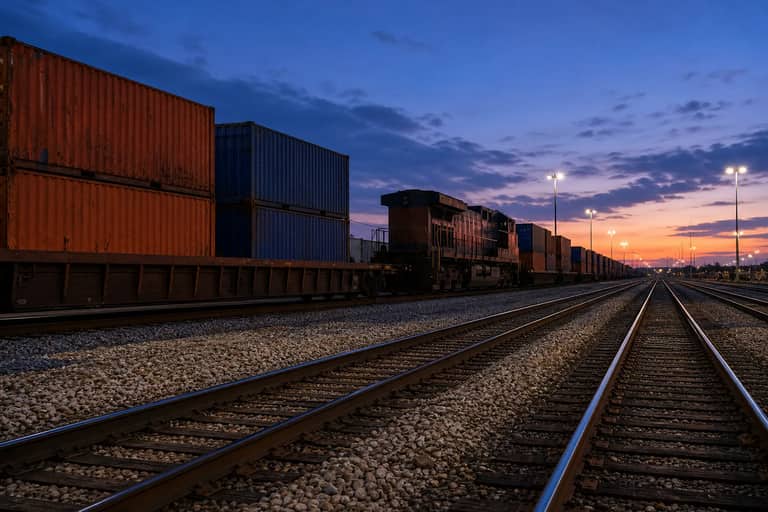
For four years, trucks took freight that used to ride the rails. That is starting to reverse. Higher highway costs and tighter driver supply are pushing containers back onto trains, and the big freight railroads are about to show how far the shift has gone.
U.S. rail intermodal volume is rising faster than commodity carloads, truckload linehaul rates are up double digits from a year ago, and the Cass Freight Index of shipments just posted its first year-over-year gain since early 2023. CSX, Union Pacific and Norfolk Southern report third-quarter results the week of Oct. 19.
- Association of American Railroads: U.S. intermodal volume rose 7.4% in the week ending Oct. 3, and is up 4.2% through the first 39 weeks of 2026.
- Cass Information Systems: the Cass Freight Index of shipments rose 2.1% year over year in August, ending a 42-month downturn, the longest on record.
- Union Pacific: domestic intermodal delivered a fourth straight record quarter in the spring, and intermodal revenue jumped 26%.
The freight recovery is showing up on the rails
The Association of American Railroads reported that total U.S. rail traffic in the week ending Oct. 3 reached 529,712 carloads and intermodal units, up 5.1% from a year earlier. Carloads rose 2.4%. Intermodal containers and trailers rose 7.4% to 299,001.
The year-to-date picture is steadier than one week. Through the first 39 weeks of 2026, U.S. railroads hauled about 8.91 million carloads, up 2.7%, and 11.08 million intermodal units, up 4.2%. Combined traffic is up 3.5%.
That split matters. Intermodal is the part of the railroad that competes most directly with long-haul trucks. When those volumes lead the industry, it usually means shippers are choosing rail for cost, not only for bulk commodities that have few alternatives.
Trucks got expensive again
The Cass Freight Index, which tracks freight invoices paid by large shippers, helps explain why. In August, the shipments component rose to 1.038, up 2.1% from a year earlier. Cass and ACT Research called it the first year-over-year gain since January 2023 and the end of a 42-month downturn, the longest in the index's history.
Spending rose even faster. The expenditures component climbed 18.7% year over year. The Cass Truckload Linehaul Index, which covers both spot and contract truck rates without fuel, rose to 153.9, up 11.3% from a year earlier.
Higher truck costs and a tight driver market make rail intermodal look cheaper on many long-haul lanes. In Logistics Management's October rail roundtable, Citizens Capital Markets analyst Jeff Kauffman said domestic intermodal has been "on fire," largely because of rising trucking costs and solid rail service. He said year-to-date intermodal loads through August were headed for the strongest year since 2018.
Oliver Wyman's Jason Kuehn made the same point: higher fuel prices and tightening truck and driver supply are motivating shippers to move freight back to rail, as long as service holds.
The Class I railroads are already cashing in
Union Pacific's second-quarter results show how the shift lands on the income statement. Operating revenue rose 12% to $6.86 billion. Freight revenue excluding fuel surcharge still grew 4%. Intermodal freight revenue jumped 26% to $1.39 billion, and average revenue per intermodal load rose 21%.
On the July earnings call, marketing chief Kenny Rocker said domestic intermodal delivered its fourth consecutive record quarter in both volume and revenue, with private-asset, rail-asset and parcel shipments all up double digits. International intermodal was still down 14%, so the growth is a domestic story, not an import boom.
CSX told a similar story. Second-quarter revenue rose about 10% to roughly $3.94 billion, its operating ratio improved to 61.7% from 64.1%, and intermodal revenue rose 26% to $620 million on 9% more volume.
Norfolk Southern reported record railway revenue of $3.47 billion, up 11%. Intermodal revenue rose 22% to $908 million on 5% more units. Its operating ratio was still higher than peers, which is one reason investors will watch cost control when it reports the week of Oct. 19.
These companies also matter to income investors. Union Pacific paid a quarterly dividend of $1.38 in the second quarter, up 3% from a year earlier, and generated about $1.8 billion of free cash flow in the first half after capital spending and dividends.
What the chatter is saying
Rail analysts have framed the rebound as a share-shift story, not a broad boom. Anthony Hatch of ABH Consulting told Logistics Management that in ordinary times the domestic intermodal rebound after a four-year slump "would be the story of the year." Kauffman said the carload market is the healthiest it has been in about three years, with nine of 11 commodity groups up in August, even though metals, chemicals and construction materials are only improving gradually.
The caution from the same panel is familiar: railroads have a history of letting service slip when volumes surge. Kuehn noted that several Class I carriers showed slower train velocity or longer dwell in the second quarter even as Union Pacific improved, and that employment is still down year over year despite stronger traffic. Shippers will stick with rail only if on-time performance holds through the fall peak.
On FreightWaves, Norfolk Southern has argued that the old debate over whether rail can beat trucking on cost is the wrong one. The harder job, the railroad says, is making freight easier to buy, track and manage. That customer-experience pitch is aimed squarely at the truck-competitive freight the industry is trying to win back.
What investors should watch the week of Oct. 19
CSX reports after the close on Oct. 21, with a call at 4:30 p.m. Eastern. Union Pacific releases before the open on Oct. 22 and hosts its call at 8:45 a.m. Norfolk Southern reports the same morning ahead of a 10 a.m. call.
The numbers that matter are intermodal volume and revenue, pricing excluding fuel surcharge, and service metrics such as train speed and terminal dwell. If domestic intermodal keeps setting records while operating ratios hold or improve, the truck-to-rail shift is still intact. If fuel costs keep swelling the top line without helping the operating ratio, investors will look through the revenue print.
There is a longer overhang. Union Pacific's proposed purchase of Norfolk Southern is before the Surface Transportation Board, with opening comments due in mid-November and a decision expected in 2027. That deal can move the stocks on headlines, but it is separate from the near-term volume story.
The bottom line is simpler. Tight truck capacity is giving railroads a chance to win freight back, and the August Cass flip plus rising intermodal volumes say the shift is underway. Third-quarter reports will show whether service and pricing can keep up. This article is general information, not personalized financial advice.