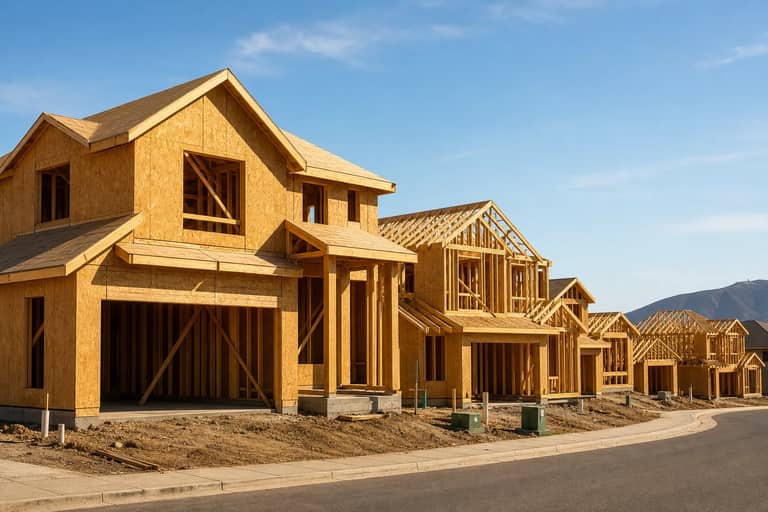
US housing starts fell 15.4% in May to an annualized pace of 1.177 million, the slowest rate of new-home construction since May 2020.
The number badly missed expectations. Forecasters had looked for about 1.43 million. Instead, builders broke ground on the fewest homes in six years, and the data confirmed that high mortgage rates are finally biting into construction activity.
Yet most homebuilder stocks are holding up or trading higher Tuesday. That gap between an ugly data point and a calm tape is the story worth understanding.
The collapse was concentrated in apartments.
The headline drop looks alarming, but the detail softens it. Almost all of the decline came from multifamily construction, where starts collapsed more than 40% on the month, the sharpest drop in years.
Single-family starts, which matter more for the big public builders, fell less than 2% to about 882,000 annualized units. Building permits, a forward-looking gauge of future activity, slipped only 0.7% to roughly 1.413 million. That smaller permit decline is part of why investors are not panicking.
Apartment construction swings hard from month to month because projects are large and lumpy. One delayed development can move the national number. Single-family demand, which drives earnings for D.R. Horton and its peers, is weakening more gradually.
The real driver lands Wednesday.
The Federal Reserve announces its rate decision Wednesday afternoon at the close of a two-day meeting. Markets see almost no chance of a move off the current 3.50% to 3.75% range, so the action is in the new projections and the tone.
Builders live and die by mortgage rates, which still sit near 6.5%. If the Fed's updated dot plot signals that hikes are finished and the next move is down, the math on home affordability improves and demand recovers. If it leaves a year-end hike on the table, the pressure on construction continues.
That is the bet pushing builder stocks higher even on a weak starts print. Investors are looking past one bad month toward a possible turn in rates. The data is backward-looking. The Fed decision is the catalyst.
The group is already priced for trouble.
Homebuilder stocks have spent the year discounting exactly this kind of slowdown, which is why a six-year low in starts is not triggering a selloff.
Lennar trades near $89, in the bottom quarter of its 52-week range of roughly $81 to $144. Its most recent quarter showed the squeeze directly: the company is buying down mortgage rates for buyers to keep sales moving, and those incentives are compressing margins. The stock already reflects that pain.
Toll Brothers sits at the other end of the market. The luxury builder trades around 10 times earnings with a book value near $90 a share, meaning the stock is priced close to the value of its land and homes alone. Its wealthier buyers depend less on financing, which has helped Toll hold up better than the entry-level names.
PulteGroup rounds out the group with a market cap near $24 billion and a stock that has stayed well above its 52-week low even as the data softens. Across the board, these are not expensive stocks. They are cyclical names trading at low multiples because the market already expects a hard patch.
What comes next
Wednesday's Fed decision is the near-term swing factor. A dovish dot plot would hand the builders the rate relief they have been waiting on. A hawkish one would extend the affordability squeeze that just produced a six-year low in starts.
Beyond the Fed, watch whether single-family starts and permits keep sliding in June. Multifamily weakness is noisy, but a sustained drop in single-family activity would hit the public builders where it actually counts.