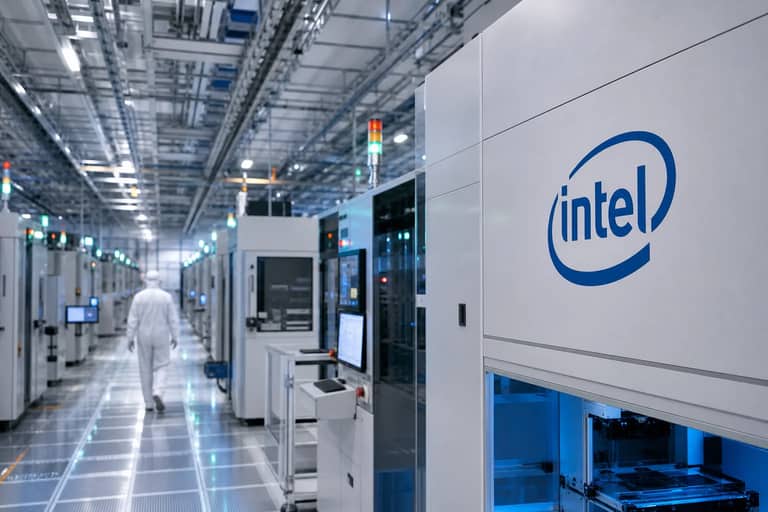
Intel is up about 10% to roughly $133 midday Thursday, a fresh 52-week high, after President Trump said Apple agreed to design and build chips with Intel in the United States. We covered the deal itself this morning. The market has now answered the question that hung over Intel's foundry pivot for years: it found a tier-one customer.
The harder question starts now. The easy money in this stock was made at $19. At $133, you are paying a very different price for the same turnaround.
The number under the headline
Intel's market value sits near $670 billion. Nine months ago it was closer to $100 billion. That is not a rally. That is a re-rating of the entire business, and it happened before Apple shipped a single chip from an Intel fab.
At today's price the stock trades around 12 times its roughly $54 billion in annual sales. For context, that is close to what investors pay for Taiwan Semiconductor, the most profitable contract chipmaker on earth. TSMC trades near 15 times sales and 32 times earnings. The difference is what each company does with a dollar of revenue. TSMC keeps about 47 cents of every sales dollar as profit. Intel keeps nothing right now.
That gap is the whole investment case in one line. The price already assumes Intel grows into TSMC-like economics. It has not shown them yet.
What Apple actually buys
Apple, a company worth about $4.4 trillion that earns a net margin near 27%, spends tens of billions of dollars a year on advanced chips. Almost all of it has gone to TSMC since Apple dropped Intel silicon in 2020. A deal to route even part of that spend through Intel's domestic fabs is real revenue and real validation.
It is also a slow build. The early work points to Intel's 18A and enhanced 18A-P process making lower-volume parts first, the kind used in entry Macs and iPads, before anything approaches the iPhone. Apple does not move its most critical component to an unproven line overnight. The revenue ramps over years, not quarters.
So the deal changes the story without changing this year's numbers much. It gives Intel a named anchor customer with a decade of procurement ahead. It does not, by itself, make Intel profitable in 2026.
Intel still is not a profitable company
Over the past year Intel posted a net loss and burned cash. Free cash flow ran deeply negative, near $12 billion, because the foundry buildout is enormous. Capital spending eats about a quarter of revenue, and research and development takes another quarter on top of that.
That spending is the bet. New fabs and new process nodes cost tens of billions before they earn a cent. The 18A node entered production this week, ahead of schedule, which is the operational proof bulls were waiting for. But a node in production and a node running at high yield for a customer as demanding as Apple are two different milestones.
The turnaround is real. It is also unfinished, and the stock is priced as if it is closer to done than the financials say.
The government is in the cap table
There is one more wrinkle most chipmakers do not carry. The U.S. government holds an equity stake in Intel, which Trump valued at about $60 billion this week, implying roughly a tenth of the company. That backstops the capital plan and ties Intel to domestic-manufacturing policy. It also means a political shareholder sits alongside the public ones. For a company already spending heavily and reporting losses, that support cuts both ways.
What to Watch From Here
The next proof points are specific. Watch for 18A and 18A-P yield data, because a process that works in a demo and a process that works at scale are not the same. Watch whether CEO Lip-Bu Tan lands the additional foundry commitments he has guided toward for the second half of 2026, since one customer is a headline and three is a business. And watch how much of Apple's volume actually moves, and whether iPhone silicon is ever included.
The stock now prices in a lot of that going right. Intel has cleared the demand question that dogged it for years. The profitability question is still open, and at $670 billion the price assumes it gets answered. Anyone deciding whether to chase the move is no longer buying a cheap turnaround. They are paying for one that mostly works.