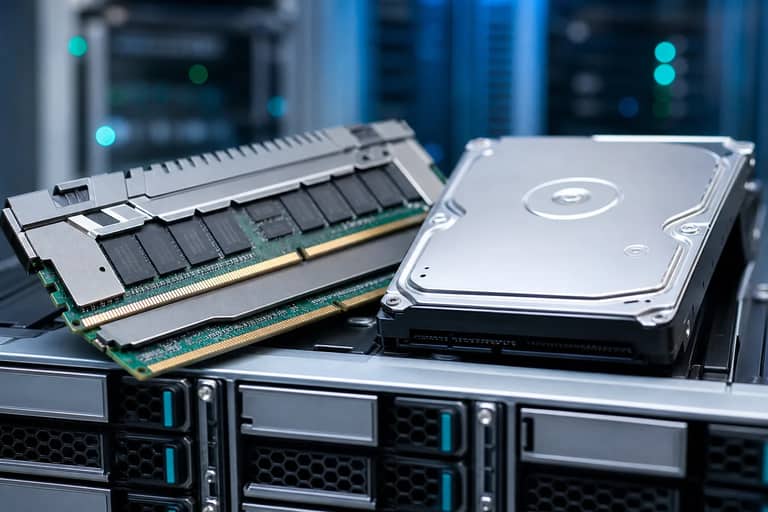
Memory and storage stocks are moving on a single idea this week: the AI buildout has broken the old up-and-down cycle that defined the business for decades.
The trigger is a wall of analyst upgrades. The thesis behind them is that data centers now need more memory and storage than suppliers can produce, and that the shortage runs for years, not quarters.
Western Digital led the move on a bullish hard-drive call.
Western Digital is up sharply Tuesday after Morgan Stanley raised its price target by roughly 33% and laid out an aggressive demand forecast.
The firm projects hard-drive demand growing 40% to 50% a year against supply growth of just 30% to 35% through 2028. That gap, if it holds, keeps pricing firm and lifts margins. Morgan Stanley put 2028 earnings estimates about 70% above the current consensus.
Western Digital was not alone in the upgrade pile. Citi and Mizuho moved targets toward $685, Bank of America to $610, and Wells Fargo to $575. The stock has more than doubled in 2026 and trades near 28 times forward earnings, a premium to its history that reflects how completely the AI-storage story has rerated the name.
Seagate is riding the same wave.
Seagate is also higher Tuesday, extending a run that has made it one of the year's strongest large-cap performers.
The bull case is identical to Western Digital's. AI training and inference generate enormous volumes of data that has to be stored somewhere, and high-capacity hard drives remain the cheapest place to keep it. Seagate trades near 36 times forward earnings, a richer multiple than Western Digital, which tells you the market is already pricing in years of tight supply.
The two companies control the bulk of the global hard-drive market between them. That concentration is part of the thesis. With only two real players left, neither has much incentive to flood the market and crush pricing.
Micron got the loudest call, and it reports next week.
The most dramatic target move belonged to Micron. TD Cowen lifted its price target to $1,500 from $660, a 127% increase, and kept a Buy rating. RBC moved to $1,200 and Aletheia Capital to $1,600.
The argument: memory's role in AI is structural, not cyclical. Micron has said its high-bandwidth memory capacity for the rest of 2026 is already sold out, with AI data centers absorbing the bulk of high-end DRAM supply. The stock has climbed more than 200% this year, yet it still trades around 10 times forward earnings, far below the broad market. That combination of explosive growth and a low multiple is what the bulls keep pointing to.
Micron reports fiscal third-quarter results on June 24. That print is the real test of whether the structural story holds or whether the cycle still has teeth.
Not everything moved together, and that matters.
Tuesday's tape showed a split worth noting. The hard-drive names, Western Digital and Seagate, are leading, while Micron and NAND-flash maker Sandisk are giving back ground after enormous runs.
That divergence is a reminder that these stocks have already traveled a long way. Sandisk trades above $2,000 a share after a move that lifted it off a 52-week low near $40. When names move that far that fast, a single hot analyst note can lift one corner of the group while profit-taking hits another.
The common thread underneath all of it is compute. Every memory chip and every hard drive sold into a data center sits next to Nvidia silicon, and the same AI capital spending that drives chip demand drives the storage that feeds it.
The question heading into Micron's report is whether the "structural, not cyclical" label survives contact with actual guidance. If management confirms multi-year visibility on memory pricing, the upgrade wave gets validated. If it hedges, the names that have run the hardest have the most to give back.