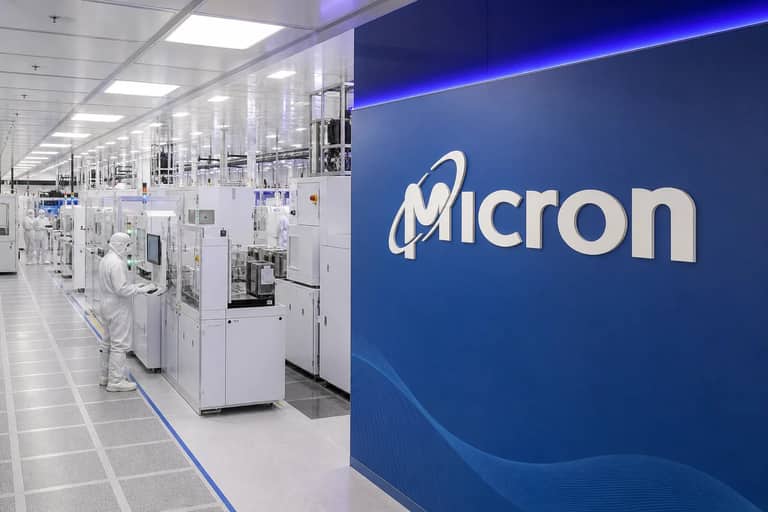
One day after fear over memory chips wiped out trillions across global markets, the company at the center of that fear posted the biggest quarter in its history.
Micron reported fiscal third-quarter revenue of $41.5 billion after the close on Wednesday. That topped the roughly $35.6 billion Wall Street expected and came in 346% above the same quarter a year ago. Adjusted earnings landed at $25.11 per share against an estimate near $20.50.
The stock closed the regular session near $1,048, down a fraction. Then it jumped more than 13% in after-hours trading once the numbers hit.
The Numbers Behind the Print
The headline beat was large, but the mix is what mattered. DRAM revenue hit a record $31.3 billion. NAND flash set its own record at $9.9 billion. Both businesses are riding a supply shortage that has pushed memory prices to levels the industry has not seen in a decade.
Margins tell the same story. Micron carried a gross margin near 85% for the quarter, far above the 30s and 40s that defined memory in normal years. The company runs on almost no debt, with a debt-to-equity ratio near 0.06, so nearly all of that margin drops toward shareholders rather than lenders.
The Guidance Was the Real Shock
A record quarter was largely priced in. The forward guide was not.
Micron told investors to expect fiscal fourth-quarter revenue of about $50 billion, plus or minus $1 billion. Analysts had modeled closer to $43 billion. The company also guided to adjusted earnings near $31 per share and a gross margin around 86%, which would be a record for the business.
That is the line that moved the stock. Memory is a cyclical industry, and the question hanging over the sector was whether prices had peaked. Guidance that calls for revenue to climb another 20% in a single quarter is the company saying the cycle still has room to run.
One Day After the Panic
The timing is hard to ignore. On Tuesday, Korea's KOSPI fell roughly 10% and triggered a circuit breaker as foreign investors dumped chip stocks. The Philadelphia Semiconductor Index lost nearly 8%. The fear was that memory demand tied to artificial intelligence had gotten ahead of itself.
Micron's print pushed back on that fear directly. Chief executive Sanjay Mehrotra said market tightness is locked in to persist beyond calendar 2027, and that demand for memory used in AI systems remains strong. The company added that its next-generation HBM4 chips are ramping twice as fast as the prior generation, with more than $1 billion in HBM4 revenue already booked.
Other memory and AI-chip names climbed in sympathy in late trading. A single earnings report does not end a selloff, but it gives the bulls a concrete number to point at.
What It Means From Here
The stock has had an extraordinary run, trading between $103 and $1,213 over the past year and now carrying a market value near $1.18 trillion. Even after that move, the trailing price-to-earnings ratio sits around 23. For a company guiding to record revenue and record margins, that is not an expensive multiple on its face.
The risk is the same one that has always defined memory. It is a commodity business, and commodity prices turn. The guidance says the turn is not close, but guidance is a forecast, not a guarantee. The earnings call and the read-through to the broader chip complex will set the tone when the market opens Thursday.
For now, the company that scared the market on Tuesday handed it a record on Wednesday. The next move belongs to the buyers who fled the week before.