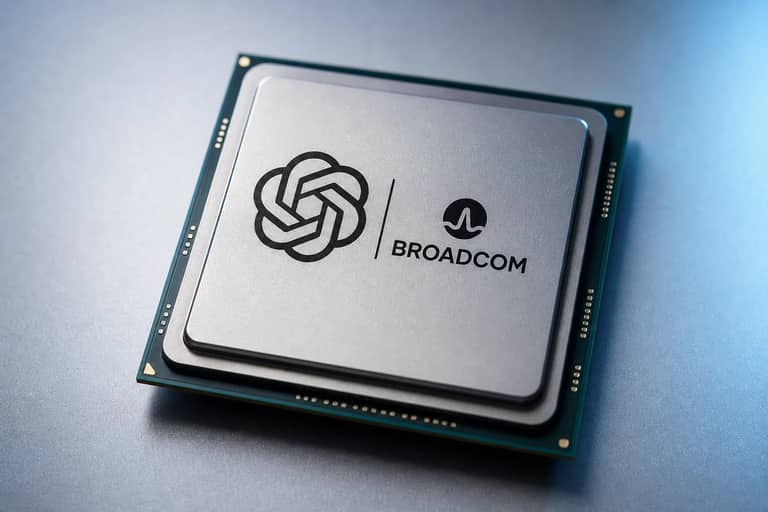
While the chip selloff dominated the tape this week, the most important chip news did not come from a memory maker. It came from a partnership.
Broadcom and OpenAI unveiled Jalapeño on Wednesday, OpenAI's first custom AI accelerator. The two companies say they took it from blank-page design to manufacturing in nine months. That is one of the fastest timelines the industry has seen for a chip this advanced.
The chip is built for one job. It runs large language models. It does not train them.
Why Inference Is the Real Prize
Training a model gets the headlines. Running it pays the bills.
Every time someone types a question into ChatGPT, a chip answers it. That step is called inference, and it happens billions of times a day. As AI moves from research labs into everyday products, inference is the part that scales. It is also the part where cost per answer decides whether the business makes money.
Jalapeño was designed for exactly that. OpenAI built it around the workloads it already runs across ChatGPT, its coding tool, and its developer interface. Broadcom CEO Hock Tan said the chip delivers cost savings of roughly 50% compared with typical AI graphics chips, and better performance per watt in early testing.
That number is the whole story. If a company running the largest AI service on earth can cut its compute bill in half, every other large operator will want the same option.
A Direct Shot at Nvidia
Nvidia sells the general-purpose GPUs that power most AI today. Those chips do everything well, which is why Nvidia carries a market value near $4.8 trillion. The stock trades around $200, down from a 52-week high of $236.
The weakness in a general-purpose chip is that it is general. A custom chip built for one task can beat it on cost and power for that task. That is the bet OpenAI just made.
OpenAI is not alone. Google already designs its own chips. Amazon does too. Now the most prominent AI company in the world has joined them. The message to the market is that the biggest buyers of AI compute want to own more of their own silicon.
Nvidia still sells everything these players cannot make themselves, and demand for its chips remains enormous. But the inference slice of the market, the fastest-growing slice, is the one most exposed to custom competition.
Broadcom Is the Quiet Winner
Broadcom does not make a rival to Nvidia's flagship GPU. It does something more durable. It helps the largest tech companies design their own chips, then manufactures them.
That business is booming. Broadcom carries a net profit margin near 39% and generated roughly $30 billion in free cash flow over the past year on about $75 billion in revenue. The OpenAI partnership builds on an earlier agreement between the two companies to deploy 10 gigawatts of OpenAI-designed accelerators, a figure that signals years of orders, not a one-time sale.
This is the same divide we have flagged for two weeks. The market keeps rewarding the companies that control custom silicon and punishing the ones that sell commodity parts. Jalapeño is the clearest example yet.
The stock reflects the optimism. Broadcom trades near $386, up on the day while the rest of the chip group stayed under pressure. It changes hands at about 62 times trailing earnings and roughly 45 times enterprise value to EBITDA. Those are rich multiples that leave no room for a stumble. Wall Street's consensus price target sits near $498, well above the current price, with a high estimate of $582 and a low of $400.
The other name in this corner of the market is Marvell, the second major custom-silicon designer. Marvell trades near $271 with a market value around $237 billion. It fell about 3% Wednesday, caught in the broad chip selling even though it sits on the same side of the trade as Broadcom.
The AI Trade Just Split in Two
This week showed that "the chip trade" is no longer one thing.
Memory makers got crushed. Korea's market triggered a circuit breaker. Micron reports after the close today into a nervous tape. Those companies sell commodity components whose prices swing with supply.
Custom-silicon designers sit in a different spot. Their revenue comes from long-term design contracts with the richest companies in technology. When OpenAI commits to a custom chip program, it is committing to Broadcom for years.
For investors trying to read the selloff, that split is the edge. Falling memory prices and a custom-chip partnership can happen in the same week because they describe two different businesses wearing the same "AI chip" label.
What to Watch From Here
The first Jalapeño chips are not expected to deploy until the end of 2026, so this is a story about direction, not next quarter's numbers. Watch whether other large AI operators announce custom programs of their own, which would confirm the shift away from buying only off-the-shelf GPUs.
Watch Broadcom's backlog on its next report for the dollar value behind the 10-gigawatt commitment. And watch whether Nvidia responds by competing harder on inference, where the new pressure is building. The training crown is still Nvidia's. The fight has moved to what happens after the model is built.