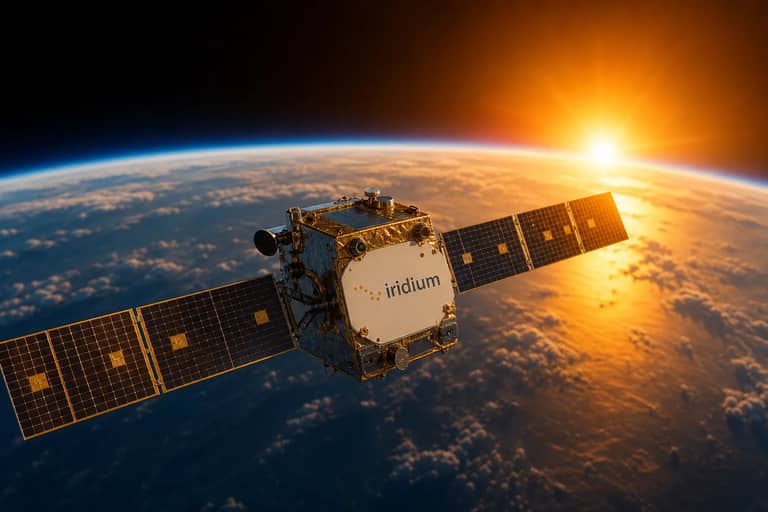
$8 billion.
That is what Rocket Lab just agreed to pay for Iridium Communications, the company that operates the only satellite network covering every square inch of Earth.
Vertical integration is the thesis.
Rocket Lab gets Iridium's 66-satellite low-Earth orbit constellation, globally licensed L-band spectrum, and more than 2.5 million subscribers spanning defense, aviation, maritime, and commercial markets. Each Iridium share is valued at $54, half in cash and half in Rocket Lab stock, a 24% premium to where IRDM last traded. The deal should close by mid-2027.
RKLB surged 17% on Monday. Analysts described the deal as a "bolt from the blue," with Rocket Lab reportedly outbidding multiple suitors. Craig-Hallum raised its price target to $120 from $98 and maintained a Buy rating, implying roughly 42% upside.
This is not a Starlink competitor play. Iridium's L-band spectrum handles low-bandwidth, high-reliability use cases that broadband satellites cannot replace: tactical military communications, real-time aircraft tracking, maritime distress signals, and IoT sensors deployed where no cell tower will ever reach. These are mission-critical services backed by long-term government contracts. The revenue is subscription-based and recurring.
That changes what Rocket Lab is as a business. Before this deal, it was a launch and satellite manufacturing company with revenue tied to contracts and hardware delivery cycles. After the transaction closes, Rocket Lab becomes a recurring-revenue platform with government-grade customer retention. The multiple the market assigns to that kind of revenue profile is meaningfully higher.
Rocket Lab already designs and manufactures satellite components and operates its own launch vehicles. Owning the network those satellites serve closes the value chain. Margins compound across design, manufacturing, launch, and operations instead of bleeding out to separate vendors at each stage.
The risk is execution. $8 billion is a large commitment for a company whose market cap sat near $50 billion before the announcement. The cash portion requires financing. Regulatory approvals span multiple jurisdictions. And integrating a live constellation of 66 satellites into an end-to-end space platform is capital-intensive work on a timeline Rocket Lab does not fully control.
But a 17% rally on a deal this size tells you the market sees the upside outweighing the integration risk. For those watching the space sector, SpaceX dominates launch and broadband. Rocket Lab is carving out a different lane: subscription revenue and vertical integration targeting the markets SpaceX has not prioritized. Iridium's L-band spectrum licenses represent a durable competitive advantage that cannot be easily replicated.
Monday's close and today's calendar.
The Dow finished at 52,182, its first close above 52,000. Alphabet gained 4% on its debut as a Dow component, replacing Verizon and carrying about seven times the index weighting. The S&P 500 rose to 7,440. The Nasdaq surged 2% to 25,820, snapping five straight losing sessions.
The 10-year yield settled near 4.37%. Gold is trading around $4,050 this morning. Oil is steady with WTI near $70 and Brent around $73. Brent is on pace for its steepest quarterly decline since 2020, down roughly 30% as Strait of Hormuz shipping recovered and Iran deal prospects improved.
Nike reports fiscal Q4 after the close with consensus near $0.13 in EPS on $10.85 billion in revenue. Greater China sales are expected to fall around 20%. The stock sits near a decade low. A tariff-refund gain not included in earlier forecasts may distort the quarter, making the forward guide the real signal.
Constellation Brands delivers Q1 fiscal 2027 with analysts expecting roughly $3.20 in EPS. Beer depletions fell 3% last quarter, and tariff exposure adds margin pressure.
JOLTS job openings and Conference Board consumer confidence both land at 10 AM. April JOLTS surprised at 7.6 million openings, well above expectations. May's reading tests whether that labor market strength held.
Futures are up modestly. Today closes Q2. The quarter's signature moves: a semiconductor rout and recovery, Brent crude's steepest drop in five years, and the Dow's first finish above 52,000. The June jobs report lands Thursday before markets close for the holiday Friday.
More tomorrow.