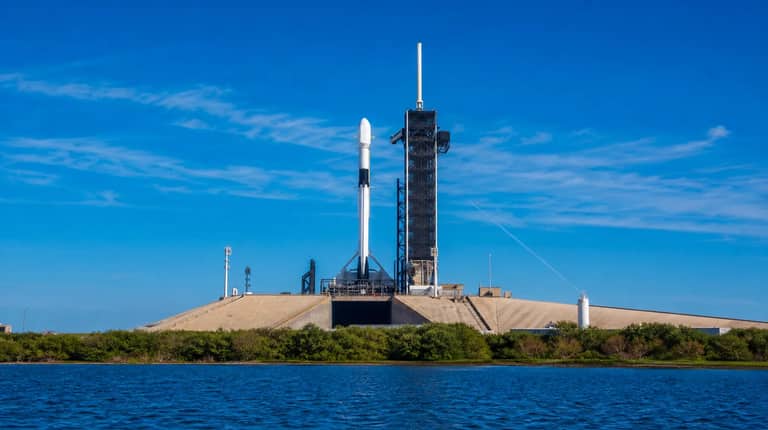
SpaceX opened for trading on the Nasdaq this morning at $150 a share under the ticker SPCX. It is changing hands near $164 around midday, up roughly 22% from the $135 price the company set last night. It touched $168 in the first hour.
The raise is the headline. SpaceX sold about 555 million shares at $135 and pulled in roughly $75 billion. That more than doubles the previous record, Saudi Aramco's $29.4 billion listing in 2019. Underwriters hold an option to buy another 83 million shares.
At the IPO price, SpaceX was valued at $1.77 trillion. That made it the seventh most valuable public company in the country at the open, ahead of Tesla. The pop since then has pushed its market value above $2 trillion.
The price tag is the part worth slowing down on
SpaceX booked $18.7 billion in revenue in 2025. At a market value north of $2 trillion, the stock trades near 115 times sales. For comparison, Tesla, which is now worth less than SpaceX, trades at about 15 times sales. Nvidia, the most valuable company in the market, sits near 20 times.
A number like 115 times sales is not a typo. It means buyers are paying for what SpaceX might earn many years from now, not what it earns today.
And today, it does not earn. The company posted a net loss of $4.9 billion in 2025. So the multiple sits on top of red ink, which is rare for a company this size.
Almost all the good news lives in one division
Starlink, the satellite internet business, is the engine. It generated $11.4 billion of the $18.7 billion total, about 61% of revenue, and grew roughly 50% from the year before.
It is also the only piece that makes money. Starlink produced $7.2 billion in adjusted earnings before interest, taxes, and the rest, a margin near 63%. Its net income came in around $4.4 billion.
The subscriber math is the draw. Starlink ended 2025 with 8.9 million subscribers and reached 10.3 million by the end of March, spread across 155 countries. The service that started as a side project now carries the valuation.
The losses are stacked in the parts people associate with the name
The rocket launch business, the part that lands boosters on drone ships, lost $657 million last year. It is a remarkable operation and a money loser at the segment level.
The bigger drag was the artificial intelligence unit, which ran a deficit of about $6.35 billion. That single division is most of the reason the whole company finished in the red.
Strip it down and the story is simple. Starlink earns. Everything else spends. A buyer at $164 is betting the spending turns into the next Starlink, more than once.
Control does not come with the shares
The stock that trades under SPCX carries one vote each. Insiders hold a separate class of super-voting shares worth ten votes apiece. That structure keeps Elon Musk and a small group in control of the company regardless of how many public shares change hands.
That is common for founder-led tech listings. It also means public shareholders are along for the ride, not steering it. Decisions on spending, new ventures, and capital all sit with the insider class.
What to Watch From Here
The first number to track is the gap between the $135 IPO price and where the stock settles. A debut that holds well above the offer price tells you institutions wanted more than they got. A fade back toward $135 in the coming sessions would say the opposite.
The second is Starlink's growth rate. Subscribers doubled into 2025, but adding the next ten million is harder than adding the first ten million, and the entire valuation leans on that curve staying steep.
The third is the lockup calendar. Early investors and insiders are usually restricted from selling for months after a listing. When those restrictions lift, the supply of shares for sale jumps, and that date will matter more than any single trading day this week.