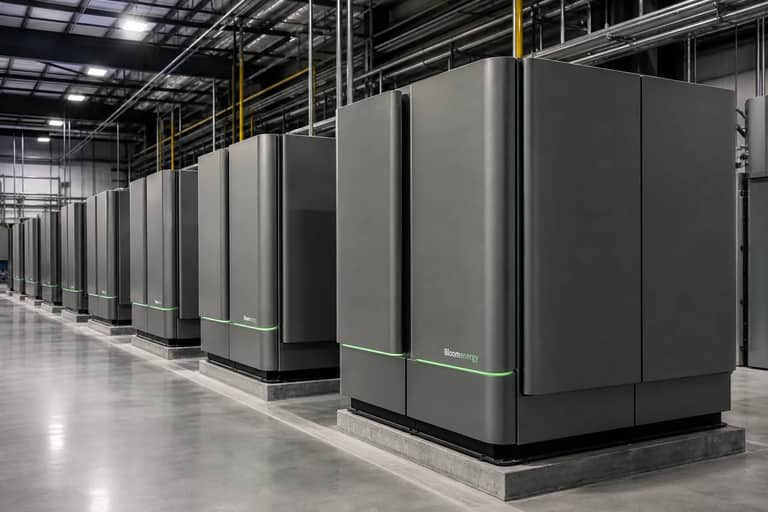
On Thursday, Industrial Development Funding and Oaktree announced a $1.7 billion project investment to deploy Bloom Energy's fuel cells for AI data centers, including dedicated electricity for Nebius' AI cloud buildout.
Bloom's stock fell almost 14% that day, closing near $207, its lowest level since April 2025. By Friday midday it was up around 6%, one of the few green names in a falling tape. The market sold the confirmation first and started reconsidering a day later.
Why the structure matters more than the number
This is not a customer order, and it is not Bloom raising money. IDF is developing the project with minority equity from Oaktree, senior debt from MUFG Bank, and tax equity placed by Morgan Stanley. The structure points to Bloom supplying hardware and service while outside capital carries the buildout, so the spending never lands on Bloom's own balance sheet.
That distinction matters for a company whose debt already runs about three times equity. If outside project capital keeps funding deployments, Bloom's growth stops being constrained by what Bloom can afford.
The behind-the-meter piece is the other half. Power generated on site skips the interconnection queue, and those queues, not chips, have become the binding constraint on new data center capacity. Dedicated fuel cells are one of the few ways to add compute without waiting years for a grid hookup.
The wipeout that set the stage
The deal landed on a stock that had already been taken apart. Bloom has shed close to $40 billion in market value since its record high above $350 a share, and even after the slide it trades around 25 times trailing sales with a net margin barely above breakeven. Gross margin runs about 31% on roughly $2.5 billion in trailing revenue, and the balance sheet holds around $2.5 billion in cash.
In other words, the selloff was a valuation argument, not a demand argument. Thursday's reaction extended the pattern we flagged this week: the market has stopped paying up when AI infrastructure spending gets confirmed. A $1.7 billion vote of confidence produced a 14% drawdown.
The read-through
Nebius was up about 4% at midday Friday at a $43 billion market cap, still down about 40% from its high. For the neocloud group, third-party-funded power is a template: someone else pays for the electrons, the cloud provider keeps its capital for GPUs.
The rest of the on-site power cohort traded the same direction against a red tape. Vistra was up more than 2% at midday and Constellation Energy edged higher, though the two still sit roughly 29% and 39% below their 52-week highs after the group's long slide.
Watch whether the model repeats. Every hyperscaler and neocloud faces the same queue problem, and there is far more infrastructure capital looking for contracted power returns than there are shovel-ready projects.
What to watch from here
Bloom's next earnings report is the test of whether project-financed deals convert into reported revenue and improving margins rather than just announcements. Until then, the split verdict stands: infrastructure investors committed $1.7 billion at exactly the level where public investors were dumping the stock. One of those two groups is wrong about what AI power demand is worth, and this deployment will start settling the question within a few quarters.