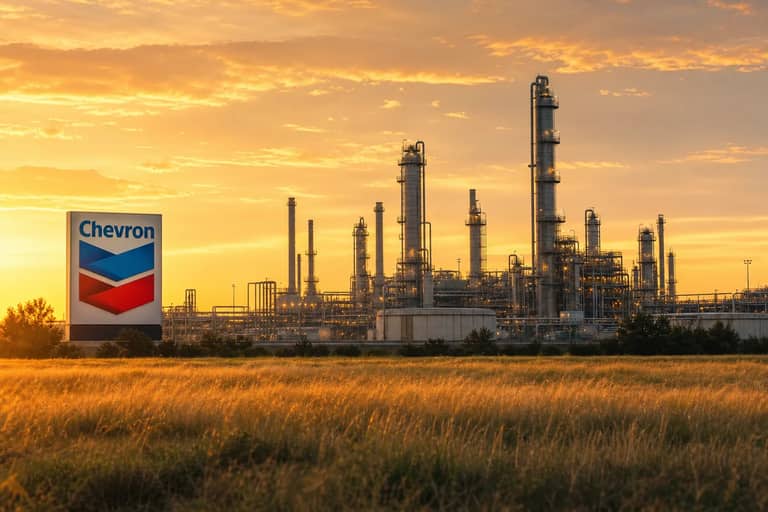
Wall Street usually chases oil stocks higher when crude is rising. Wolfe Research just did the opposite.
The firm's analyst Doug Leggate raised Chevron to Outperform from Peer Perform on July 2, with a $210 price target. That is roughly 25% above where the stock trades near $168. The call landed as oil was sliding and Chevron was falling, not rising, and crude has kept dropping since.
An Upgrade Into Weakness
Chevron has been a laggard. The stock sits well under its 52-week high near $215 and below both its 50-day and 200-day average prices. Buying it here is a bet against the tape, which is exactly what makes an upgrade now stand out.
The oil backdrop is soft. OPEC+ agreed on Sunday to raise output by another 188,000 barrels a day in August, the fifth straight monthly increase. Oil is trading around $68 a barrel and Brent near $72, both slipping again on the news. Falling crude is why the group has lagged the broader market this year.
Wolfe's argument is that the bad news is already in the price. When an integrated major trades this far below its highs on a weak-oil view everyone already holds, the setup can favor the contrarian.
The Case for the Dividend Major
Chevron is a $334 billion company, and its appeal to income investors is the payout. It pays $1.78 a share each quarter, a yield near 4.2%, backed by decades of increases. That yield is the reason many hold the stock through oil's swings.
The valuation is less obvious. Chevron trades around 34 times earnings, a high multiple that reflects depressed profits at low crude prices rather than an expensive business. If oil stabilizes and earnings recover, that multiple compresses on its own.
The bigger lever is Guyana. Chevron closed its acquisition of Hess in 2025, adding a stake in one of the lowest-cost offshore oil fields in the world and targeting about $1 billion in annual cost savings. Those barrels are what let the company defend its dividend even with crude in the high $60s.
How It Stacks Up
Chevron's larger rival, Exxon Mobil, is worth about $566 billion and trades near $137, roughly 23% below its own 52-week high. The two majors move together, and both have been pressured by the same slide in crude. We compared their payouts in detail in Exxon or Chevron: Whose Dividend Holds Up Better.
For now, one analyst is calling the bottom on the smaller of the two.
What to Watch From Here
The next test is second-quarter earnings and what management says about the dividend and buyback at these oil prices. As long as Guyana keeps costs low, the payout looks safe. If crude keeps sliding toward the low $60s, the market will start asking how long the buyback can hold.