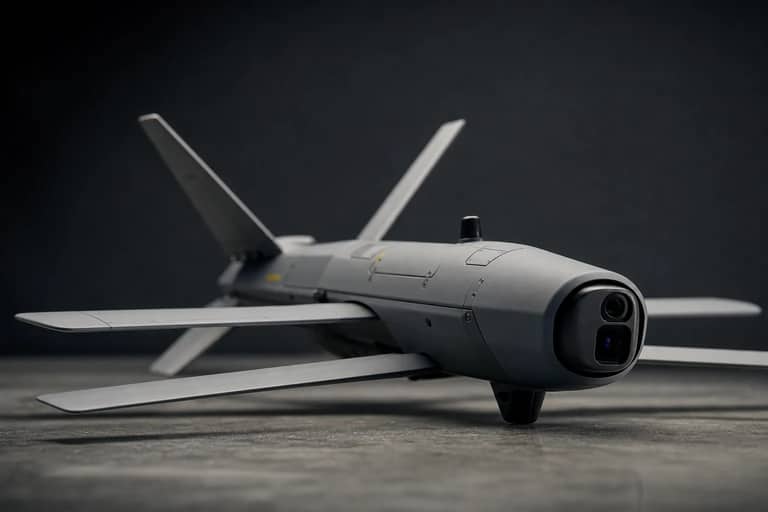
AeroVironment reported its fiscal fourth quarter after Monday's close, and the numbers were big. Revenue came in at a record $641.6 million. Adjusted earnings were $1.84 a share against a $1.46 estimate. The stock jumped about 15% to 20% in Tuesday trading, putting it back near $160.
That is the headline. The real story is what this company has become.
A Drone Maker That Outgrew the Label
For years AeroVironment was known for two things: small reconnaissance drones and the Switchblade, a backpack-sized loitering munition that a soldier can launch and fly into a target. Useful, but a niche.
On May 1, 2025, the company closed the largest acquisition in its history, buying defense technology firm BlueHalo. In March 2026 it added Empirical Systems Aerospace. Those deals pushed AeroVironment into counter-drone systems, space, cyber, and directed energy.
The scale shift is the point. Full-year revenue reached nearly $2 billion, up from $820 million the prior fiscal year. Most of that jump came from folding BlueHalo in, but even stripping the acquisitions out, fourth-quarter revenue grew about 31% on its own. The company is bigger and still growing the base.
The Autonomy Mix Is Doing the Heavy Lifting
The Autonomous Systems segment delivered $492 million in the quarter, about 76% of total revenue. That is Switchblade loitering munitions, the Red Dragon one-way attack drone, and Titan counter-drone gear.
This mix matters because it carries better margins. Fourth-quarter adjusted EBITDA was $140 million, a 22% margin, up sharply as higher-value munitions and autonomy work replaced lower-margin contract revenue. For the full year, adjusted EBITDA was $286 million.
Modern conflict has made these products front-line essentials. Cheap, attritable drones now do work that used to require expensive crewed aircraft, and every military that watched the war in Ukraine wants a deep magazine of them. AeroVironment sells exactly that.
Bookings Tell You About Next Year, Not Last Year
A record quarter is nice. The order book is what tells you whether it repeats.
Full-year bookings reached $2.7 billion, a book-to-bill ratio of 1.4. That means the company booked $1.40 in new orders for every dollar it shipped. Funded backlog ended at a record $1.2 billion. Demand is running ahead of deliveries.
Management guided fiscal 2027 revenue to $2.125 billion to $2.225 billion, roughly 10% growth at the midpoint, with adjusted EBITDA of $305 million to $325 million and non-GAAP EPS of $3.02 to $3.34. That is a clean step up, not a one-quarter pop.
The Catch Sits in the Fine Print
Here is the honest part. On a GAAP basis, AeroVironment lost money this year. Reported full-year results showed a net loss of about $5.40 a share, driven by acquisition costs and the amortization that comes with a deal this size. The $1.84 figure that beat estimates is adjusted, which strips those items out.
That gap is normal right after a large merger, but it is real. Investors are paying for the autonomy business and the backlog, not for current reported profit.
Valuation reflects that optimism. Enterprise value sits near 4 times trailing sales. On next year's non-GAAP earnings guide, the stock trades around 50 times forward earnings. That is a growth multiple on a defense name, and it leaves little room for a stumble. The balance sheet does help: AeroVironment holds more cash than debt and ended the year with a current ratio above 4, so it has room to integrate without strain.
Worth noting where the stock has been. Even after Tuesday's pop, shares sit roughly 60% below their 52-week high near $418. The market got very excited about this story a year ago, repriced it lower, and is now reacting to results that actually showed up.
The Sector Moved With It
AeroVironment did not move alone. Kratos Defense rose about 5% in sympathy Tuesday, and it too trades far below its 52-week high of $134, near $49 now with a market cap around $9 billion. The drone and autonomy names trade as a basket on days like this.
The larger primes were quieter. Lockheed Martin and RTX each gained less than 1%. They are slower-growth, dividend-paying giants, not pure plays on the autonomy wave. Palantir, the software layer many of these systems run on, added about 2%.
The policy backdrop is the tailwind under all of it. We covered how the Pentagon set a target of hundreds of thousands of drones and made domestic drone supply a stated priority, a story that repriced a whole group of suppliers. For a wider look at the field, see our defense stock breakdown.
The Three Tests Ahead
Three things decide whether this quarter was an inflection or a peak.
First, integration. A company that just doubled in size has to prove it can run the combined business without margin slippage. The 22% Q4 EBITDA margin is the number to track next quarter.
Second, order timing. Government contracts are lumpy. The 1.4 book-to-bill is strong, but a single delayed program can swing a quarter. Watch whether bookings hold above shipments.
Third, the GAAP line. At some point the adjusted-versus-reported gap has to narrow for the valuation to make sense. The faster amortization and deal costs roll off, the sooner the stock stands on actual profit instead of the promise of it.