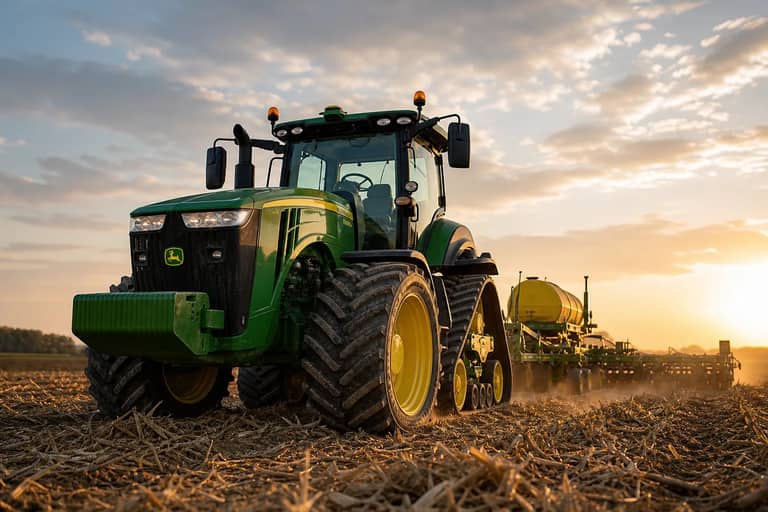
Fertilizer prices jumped more than 20% early this year after trade restrictions tightened global supply, and the USDA expects grocery prices to rise 3.6% this year, well above the Fed's 2% target. The best agriculture stocks to buy right now include Deere, Corteva, Archer-Daniels-Midland, Nutrien, Bunge, CF Industries, and AGCO. Together they cover every link in the food chain, from the tractor to the seed to the grain elevator.
Farmers are getting squeezed, but the companies that equip, supply, and process for them keep getting paid. We screened more than 40 US-listed agriculture companies and narrowed the list to these seven based on market position, cash generation, and balance sheet strength.
How We Picked These Stocks
We started with every US-listed company that earns most of its revenue from agriculture: equipment, seeds, crop protection, fertilizer, and crop processing. We filtered for a market cap above $5 billion, positive operating cash flow over the last 12 months, and a leading position in at least one product line.
We excluded food companies that mostly process meat or packaged goods, stocks below $2 billion in market value, and companies with deteriorating fundamentals. Mosaic missed the cut because phosphate weakness has dragged its shares near a one-year low while peers recover. The result is seven companies that dominate their corner of the farm economy.
The List
Deere & Company (NYSE:DE)
Why it made the list: Deere is the largest farm equipment maker in the world. Its precision agriculture push is working: 80% of new combine orders now include the company's highest-tier automation package.
The bull case: Equipment demand is turning after a two-year slump, and shares have climbed roughly 30% over the past 12 months. Automation subscriptions add recurring software revenue on top of every machine sold. Farmers who adopt self-driving and precision spraying rarely go back.
The risk: Row-crop prices still sit below most farmers' break-even costs, so a stalled farm recovery would delay big-ticket purchases. The stock also trades at a premium earnings multiple because profits are still near a cyclical trough.
Key number: 80% of new combine orders include Deere's top automation package.
Corteva (NYSE:CTVA)
Why it made the list: Corteva is one of the world's largest seed and crop protection suppliers. The company is splitting in two, with its advanced seed and genetics business, named Vylor, on track to separate in the fourth quarter of 2026.
The bull case: The split gives investors a focused seed genetics company and a leaner crop protection business, and spinoffs of this size often surface value that a conglomerate structure hides. Corteva also carries very little debt, which gives both new companies clean balance sheets. Seed pricing power has held up even while farm incomes sagged.
The risk: Separations bring one-time costs and management distraction. Generic competition keeps pressuring prices in crop chemicals.
Key number: A 47% gross margin, the richest of any input maker on this list. Gross margin is what remains of each sales dollar after the direct cost of making the product.
Archer-Daniels-Midland (NYSE:ADM)
Why it made the list: Archer-Daniels-Midland is one of the world's largest crop processors and traders, moving corn, soybeans, and wheat from farm gates to food and fuel makers on every continent. It has paid a dividend without interruption for more than a century.
The bull case: The company raised its payout again this year, its 53rd consecutive annual increase. The stock trades below half its annual sales, a valuation that assumes little goes right. Growing demand for soybean oil as a renewable fuel feedstock gives its crushing plants, the facilities that press beans into oil and meal, a long runway.
The risk: Processing margins are razor thin, so small commodity swings move earnings a lot. The payout consumed most of trailing earnings during this margin trough, which leaves less room for error until profits recover.
Key number: 53 consecutive years of dividend increases, with 378 straight quarterly payments.
Nutrien (NYSE:NTR)
Why it made the list: Nutrien is the world's largest potash producer and runs the biggest network of farm retail stores in North America. When fertilizer prices surge the way they have this year, the gains flow straight to its mining margins.
The bull case: Fertilizer demand recovered last year and pricing has followed, lifting results across potash and nitrogen. The retail division smooths out the commodity cycle by selling seed, chemicals, and services in every season. Investors collect a dividend yield above 3% while the cycle plays out.
The risk: Potash is a commodity, and new global supply could cap prices even as demand grows.
Key number: Adjusted EBITDA rose 13% to $6.04 billion last year. EBITDA measures earnings before interest, taxes, depreciation, and amortization, a common gauge of core profitability for capital-heavy companies.
Bunge Global (NYSE:BG)
Why it made the list: Bunge completed its merger with grain handler Viterra last year, creating one of the largest crop trading and processing networks on earth. The combined company connects farmers to buyers across six continents.
The bull case: Merger synergies are still ahead of it, and the stock trades near 1.3 times book value, the accounting value of assets minus liabilities. A dividend yield above 2.5% pays investors to wait while integration finishes. Scale matters in crop trading, and few rivals can match Bunge's new footprint.
The risk: Integration costs are consuming cash flow right now, and compressed trading margins have kept the shares well below their high from last year.
Key number: Roughly $80 billion in trailing 12-month revenue, the most of any company on this list.
CF Industries (NYSE:CF)
Why it made the list: CF Industries is North America's largest nitrogen fertilizer producer. Its plants run on cheap US natural gas while overseas competitors pay far more for the same feedstock, a structural cost advantage that shows up in its margins every quarter.
The bull case: Nitrogen is the one fertilizer farmers cannot skip, because crops consume it every season. The company converted that steady demand into a roughly 50% EBITDA margin over the past year while buying back stock. Its low-carbon ammonia project on the Gulf Coast opens new markets in shipping fuel and power generation.
The risk: A spike in US natural gas prices would squeeze the margin advantage, and nitrogen prices track global energy markets.
Key number: A 24% net profit margin over the last 12 months, the best on this list.
AGCO (NYSE:AGCO)
Why it made the list: AGCO is a pure-play farm equipment maker behind the Fendt and Massey Ferguson brands. It is the value pick of the group, trading near 11 times trailing earnings, a fraction of Deere's multiple.
The bull case: Its precision agriculture retrofit business upgrades existing tractors of any brand, which grows even when new equipment sales stall. European farm demand, where AGCO earns most of its revenue, has held steadier than the US market. The company carries almost no long-term debt.
The risk: AGCO's dealer network is thinner than Deere's, and mid-tier equipment makers feel downturns harder than the market leader.
Key number: About 11 times trailing earnings, the cheapest equipment stock in the sector. The price-to-earnings ratio divides a stock's price by 12 months of profit per share, so a lower number means a cheaper stock.
Agriculture Stocks at a Glance
What Is Driving Agriculture Stocks Now
The farm economy is squeezed from both sides. The USDA forecasts net farm income of $153.4 billion this year, slightly below last year, while break-even costs on corn and soybeans still sit above market prices for many growers. That pressure hurts equipment demand in the short run but rewards the suppliers farmers cannot cut: seed, crop protection, and nitrogen fertilizer.
At the same time, input costs are climbing. Fertilizer prices surged after trade restrictions hit global supply, a windfall for producers like Nutrien and CF Industries. Natural gas is the main cost of making nitrogen fertilizer, and US producers enjoy some of the cheapest gas in the world. Our guide to the best natural gas stocks covers the companies behind that supply.
Agriculture also offers something most sectors cannot: demand that does not shrink in a recession. People eat in every economy. That defensive quality puts these names in the same family as the picks in our best water stocks guide, and income investors will find familiar logic in our list of the best dividend stocks.
What to watch:
- Second-quarter earnings: ADM, Bunge, Corteva, Nutrien, and CF all report in late July and early August, the first full read on how fertilizer and crop prices are flowing through.
- Monthly USDA supply reports: The next WASDE crop report lands in mid-July and sets the tone for corn and soybean prices into harvest.
- Corteva's Vylor separation: Progress toward the planned fourth-quarter split, including the exchange ratio and listing details, could move the stock.
Bottom Line
This list suits investors who want exposure to food demand without betting on any single crop. Deere and AGCO ride the equipment cycle, Corteva and Nutrien sell what farmers must buy every season, and ADM, Bunge, and CF turn crops and gas into steady cash. Buy the links in the chain, not the harvest.
Frequently Asked Questions
What are the best agriculture stocks to buy?
The best agriculture stocks right now include Deere, Corteva, Archer-Daniels-Midland, Nutrien, Bunge, CF Industries, and AGCO, based on market position, cash generation, and balance sheet strength. Together they span farm equipment, seeds, crop protection, fertilizer, and crop processing.
Are agriculture stocks a good investment?
Agriculture stocks offer defensive demand because food consumption holds up in every economy. They are still cyclical: equipment sales, fertilizer prices, and processing margins all swing with crop prices and farm income. Owning several links in the chain, rather than one, smooths those swings.
Do agriculture stocks pay dividends?
Most large agriculture stocks pay dividends. Archer-Daniels-Midland has raised its payout for 53 consecutive years, and Nutrien yields more than 3%. Equipment makers like Deere and AGCO pay smaller dividends and return additional cash through buybacks.
What is the largest agriculture stock?
Deere is the largest US-listed pure-play agriculture stock, with a market value well above $150 billion. Bunge generates the most revenue on our list, at roughly $80 billion over the past 12 months, thanks to its merger with Viterra.
How can I invest in agriculture without buying farmland?
The simplest route is owning shares of the companies that supply farms: equipment makers like Deere and AGCO, input suppliers like Corteva, Nutrien, and CF Industries, and processors like ADM and Bunge. These stocks trade daily on the NYSE, pay dividends, and require no land, storage, or crop expertise.