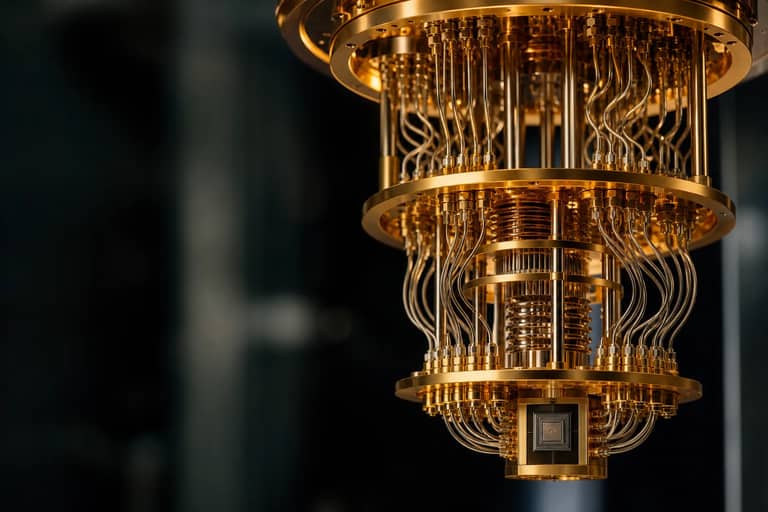
Quantum computing stocks have given back most of their spring rally. President Trump signed two executive orders on June 22 ordering a national push to build a quantum computer powerful enough for scientific research by 2028, and the Energy Department launched the program a day later. The pure plays spiked, then reversed. IonQ, D-Wave Quantum, and Rigetti Computing now all trade well below their 50-day averages. The best quantum computing stocks right now include Nvidia, Alphabet, IBM, Honeywell, IonQ, D-Wave Quantum, and Rigetti Computing, based on revenue growth, cash reserves, and technical progress.
Washington is still the biggest force in the sector. The Commerce Department committed more than $2 billion in CHIPS Act funding to nine quantum companies in exchange for direct government equity stakes, with $1 billion of that going to IBM alone. We screened more than 20 publicly traded companies and narrowed the field to these seven.
How We Picked These Stocks
More than 20 US-listed companies sell quantum hardware, software, or both. For the large caps, we required a working quantum program with published results and a core business strong enough to fund it indefinitely. For the pure plays, we required real product revenue, at least $500 million in cash, and a US listing.
We excluded development-stage names that fund themselves through heavy dilution. (Dilution happens when a company issues new shares to raise money, shrinking each existing investor's stake.) The result is four profitable giants and three pure plays holding a combined $4.3 billion in cash.
The Seven Best Quantum Computing Stocks
Nvidia (NASDAQ:NVDA)
Why it made the list: Nvidia sells the classical computing power that every quantum lab depends on. Its CUDA-Q software platform connects quantum processors to GPU supercomputers, and the company opened a dedicated quantum research center in Boston with partners including Harvard and MIT.
The bull case: Quantum computers need enormous conventional computing power for error correction, the process of catching and fixing the mistakes fragile qubits make. Nvidia gets paid whichever hardware approach wins, and its AI business keeps funding the effort.
The risk: Quantum is a rounding error in Nvidia's revenue today. You are buying the AI chip business with a quantum option attached.
Key number: The five largest cloud companies have committed roughly $660 billion to $690 billion in capital spending this year, and much of it flows to Nvidia hardware.
Alphabet (NASDAQ:GOOGL)
Why it made the list: Alphabet's Willow chip was the first to show that error rates fall as you add more qubits, a result published in the journal Nature. A qubit is the basic unit of quantum information, and keeping error rates down while scaling up is the central problem in the field.
The bull case: Google has run a quantum lab since 2013, prints cash from search and cloud, and can fund the program for decades. Its custom chip experience with TPUs transfers directly to quantum hardware design.
The risk: Quantum will not move the needle on a company this size for years. Antitrust pressure and AI competition matter far more to the stock price.
Key number: Willow packs 105 qubits with error correction that improves as the system grows.
IBM (NYSE:IBM)
Why it made the list: IBM is the $1 billion anchor of the government's quantum funding push, the largest single award among the nine recipients. Its Nighthawk processor runs 120 qubits linked by 218 tunable couplers, and IBM expects it to handle 7,500-gate circuits this year.
The bull case: IBM has the most detailed public roadmap in the industry and expects the first verified examples of quantum advantage to be confirmed by the wider research community by the end of this year. Quantum advantage is the point where a quantum machine beats classical computers on a useful problem. Hundreds of enterprise clients already pay to access its systems over the cloud.
The risk: IBM shares fell more than 25% on July 14, the worst day in the stock's history, after preliminary second quarter revenue of $17.2 billion landed below the $17.9 billion analysts expected. Customers shifted spending to servers and memory instead of mainframes, and CEO Arvind Krishna admitted in a letter to investors that the company was slow to adapt. The quantum program is not what broke, but the stock now carries a credibility discount and full results land July 22.
Key number: $1 billion in CHIPS Act funding, the largest quantum award in the program.
Honeywell (NASDAQ:HON)
Why it made the list: Honeywell holds just under half of Quantinuum, which raised $1.68 billion in its June IPO and trades on the Nasdaq as QNT. Quantinuum's Helios system runs 48 logical qubits, which are error-corrected groups of physical qubits stable enough for real calculations.
The bull case: Honeywell finished its three-way breakup on June 29, distributing shares of Honeywell Aerospace after separating Solstice Advanced Materials last October. What remains is an automation business plus the Quantinuum stake, so quantum is a far bigger share of the story than it was inside the old conglomerate.
The risk: Now that Quantinuum trades on its own, anyone who wants the quantum exposure can buy QNT directly, which weakens the reason to own it through Honeywell. QNT has already fallen well below its post-IPO high.
Key number: 99.921% two-qubit gate fidelity on Helios, a measure of how accurately the machine performs quantum operations.
IonQ (NYSE:IONQ)
Why it made the list: IonQ posted $64.7 million in first quarter revenue, more than eight times the year-ago figure and the most of any pure play. The company holds $3.1 billion in cash, the deepest reserve in the group.
The bull case: IonQ's contracted future revenue, called remaining performance obligations, reached $470 million, up 554% in a year. Its trapped-ion approach produces high-quality qubits, and it has begun selling its 256-qubit Tempo system to commercial customers. In February it was added to the Missile Defense Agency's $151 billion SHIELD framework, which lets it bid on Golden Dome work.
The risk: Short seller Wolfpack Research alleges that up to 86% of IonQ's 2022 to 2024 revenue came from Pentagon earmarks Congress no longer funds, leaving what it calls a $54.6 million hole. IonQ disputes the claims, but the stock has fallen roughly a third in a month and Morgan Stanley cut its stake. Washington also left IonQ off the list of nine CHIPS Act equity recipients even as D-Wave and Rigetti made the cut. IonQ still loses money every quarter and trades at a large multiple of sales.
Key number: $470 million in contracted future revenue, up 554% year over year.
D-Wave Quantum (NYSE:QBTS)
Why it made the list: D-Wave booked $33.4 million in new orders in the first quarter, roughly 20 times the year-ago total. The haul included a $20 million system sale to Florida Atlantic University and a $10 million cloud deal with a Fortune 100 company.
The bull case: D-Wave's annealing machines, a specialized quantum design built for optimization problems like routing and scheduling, are solving commercial workloads today. The company holds $588 million in cash, is one of the nine CHIPS Act equity recipients, and is expanding into the gate-model systems its rivals build.
The risk: Recognized revenue was just $2.9 million last quarter because large system sales land unevenly. The company has also leaned on share sales to raise cash.
Key number: $33.4 million in first quarter bookings, up 1,994% from a year earlier.
Rigetti Computing (NASDAQ:RGTI)
Why it made the list: Rigetti launched Cepheus-1-108Q, the industry's largest modular quantum computer, now available through Amazon Braket and Microsoft Azure. The company holds $569 million in cash with no debt and signed a CHIPS Act letter of intent worth up to $100 million in federal funding.
The bull case: Cepheus is built from 12 small interconnected chips, validating a modular path toward machines with more than 1,000 qubits. Modular designs scale by linking proven pieces instead of building one giant fragile chip.
The risk: Revenue was $4.4 million last quarter, the least commercial traction of the three pure plays on this list. Rigetti is a technology bet, not a business bet, for now.
Key number: 99.1% median two-qubit gate fidelity on its new 108-qubit system.
Quantum Stocks at a Glance
What Is Driving Quantum Stocks
Government money changed the sector's math this spring. The Commerce Department's letters of intent would hand nine quantum companies more than $2 billion in CHIPS Act funding in exchange for equity stakes, a structure we broke down when the deal was announced and again when we looked at what the government actually gets. Four companies tied to this guide made the list: IBM, D-Wave, Rigetti, and Quantinuum, the firm behind Honeywell's quantum stake. The rest are GlobalFoundries, Atom Computing, Diraq, Infleqtion, and PsiQuantum. IonQ, the largest pure play by revenue, is the notable absence. Federal backing lowers the odds that the funded pure plays run out of cash before their technology matures.
The federal push widened in June. Two executive orders signed on June 22 directed a national effort to build a quantum computer for scientific research by 2028 and to move government systems to post-quantum cryptography. The Energy Department launched that program, called QC-ADDS, the next day. The pure plays jumped on the news and then gave it all back. IonQ has fallen roughly a third over the past month, and D-Wave and Rigetti trade well below where they did in June. A risk-off tape, renewed doubt about AI valuations, and a short seller's attack on IonQ's revenue quality did the damage, not any change in federal policy.
The customer base is still changing in the right direction. Universities, national labs, and Fortune 100 companies are signing eight-figure contracts for systems and cloud access. That shift from grant-funded research to commercial orders is why bookings at IonQ, D-Wave, and Rigetti are growing faster than the broader chip sector we covered in our guide to the best semiconductor stocks.
Quantum also rides the same infrastructure wave lifting the best AI stocks, which cuts both ways. Every serious quantum system pairs with racks of GPUs for error correction and simulation, so when the AI trade wobbles, the quantum pure plays fall harder.
What to watch:
- IBM's full second quarter report on July 22: Management has to explain the revenue miss and say whether the shift in customer spending is a timing problem or a lasting one.
- IonQ's second quarter results on August 5: Analysts model about $65 million in revenue, and the report is IonQ's chance to answer the short seller with numbers.
- Final CHIPS agreement terms: The $2 billion in letters of intent must still convert to binding deals, and the equity terms will determine how much existing shareholders at IBM, D-Wave, and Rigetti get diluted.
- The DOE's QC-ADDS specifications: The program launched in June with a 2028 target, and the technical requirements will signal which qubit approach the government is betting on.
- Quantinuum's first full quarter as a public company: QNT now gives the market a direct read on the most advanced trapped-ion program, and its results will reprice Honeywell's stake.
Bottom Line
Investors who want quantum exposure without the volatility should start with Alphabet or Nvidia, where enormous core businesses fund the research and the quantum program is a free option. IBM belongs on the list on quantum merit, but its July revenue warning means you are buying a repair job alongside the roadmap. The pure plays belong in small position sizes. IonQ has the revenue and cash lead and the loudest bear case, D-Wave has the commercial bookings plus federal backing, and Rigetti has the cheapest entry into the superconducting race.
Frequently Asked Questions
What is the best quantum computing stock to buy?
IonQ is the strongest pure play, with $64.7 million in quarterly revenue, $3.1 billion in cash, and $470 million in contracted future orders, though a short seller has challenged the quality of that revenue. For lower-risk exposure, Alphabet pairs a leading research program with a business that throws off enough cash to fund quantum for decades.
Is IonQ stock a buy right now?
IonQ grew revenue more than eight times year over year last quarter and holds more cash than any other quantum pure play. It is also down roughly a third in a month, still unprofitable, and facing a short-seller report claiming most of its historical revenue came from Pentagon earmarks that Congress stopped funding. IonQ disputes that. Position sizing matters more than timing here.
What quantum computing company does Honeywell own?
Honeywell holds just under half of Quantinuum, which went public on the Nasdaq under the ticker QNT after raising $1.68 billion. Honeywell completed its three-way breakup on June 29, spinning off Honeywell Aerospace as HONA, so the remaining company is automation plus that Quantinuum stake. Investors can now also buy QNT directly.
Does Nvidia make quantum computers?
No. Nvidia sells the GPUs and software that quantum computers depend on for error correction and simulation. Its CUDA-Q platform connects quantum processors to classical supercomputers, which lets Nvidia profit no matter which quantum hardware approach wins.
Which quantum companies is the US government investing in?
The Commerce Department signed letters of intent to take equity stakes in nine companies: IBM, GlobalFoundries, Quantinuum, D-Wave, Rigetti, PsiQuantum, Atom Computing, Infleqtion, and Diraq. IBM's $1 billion award is the largest. IonQ is not on the list.
Are quantum computing companies profitable?
No pure-play quantum company earns a durable profit today. IonQ, D-Wave, and Rigetti all spend more than they bring in while they scale their systems. The profitable ways to own the sector are diversified giants like Nvidia, Alphabet, IBM, and Honeywell.