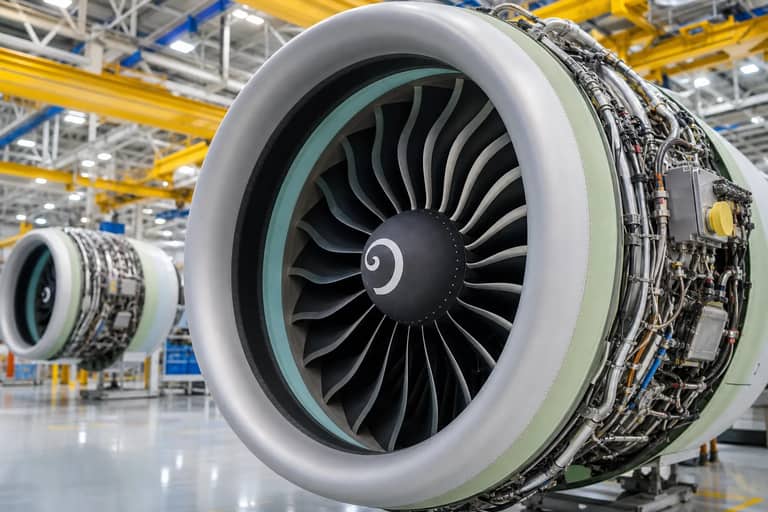
The best aerospace stocks right now include GE Aerospace, RTX, Boeing, Lockheed Martin, Howmet Aerospace, TransDigm, HEICO, and Textron, chosen for backlog depth, margins, and their position in the aviation supply chain. Commercial aviation is running through a fleet-replacement super-cycle. GE Aerospace ended its most recent quarter with an order backlog above $210 billion, more than $170 billion of it in high-margin commercial service contracts. A record 72 million Americans traveled over the July 4 week, and every one of those flights runs on engines, parts, and airframes these companies build. We screened the largest US-listed aerospace names and narrowed the field to eight.
How We Picked These Stocks
Dozens of companies touch aerospace, from raw-material suppliers to avionics startups. We filtered for four things: a US listing, aerospace or aviation as a primary revenue source, an order backlog that covers more than a year of sales, and positive free cash flow (the cash left after a company pays for its operations and equipment). We excluded foreign-listed manufacturers and thinly traded small caps. The result is eight companies that sit at the center of both commercial and defense aviation, ordered here by market value.
The Best Aerospace Stocks Right Now
GE Aerospace (NYSE: GE)
Why it made the list: GE Aerospace is the largest maker of commercial jet engines in the world. Its LEAP engines, built through a joint venture with France's Safran, power most new Boeing 737 MAX and Airbus A320neo jets. That installed base drives decades of parts and maintenance revenue.
The bull case: Aftermarket services, meaning spare parts and engine overhauls, carry fatter margins than selling a new engine. Every engine flying today feeds that stream for 20 years or more, and the fleet keeps growing.
The risk: Aftermarket growth could cool as fresh deliveries replace older, higher-maintenance engines.
Key number: More than $170 billion of its backlog sits in high-margin commercial services.
RTX (NYSE: RTX)
Why it made the list: RTX owns Pratt & Whitney, which builds the geared turbofan engine on the A320neo, and Collins Aerospace, which supplies cabins, avionics, and landing gear. A third arm, Raytheon, makes missiles and radars. Organic sales grew 10% last quarter.
The bull case: Collins commercial aftermarket demand rose 7% year over year, and the defense side adds a steady government-funded backlog on top of the commercial recovery.
The risk: A powder-metal inspection issue on the Pratt geared turbofan has been a costly, multi-year headwind.
Key number: Commercial aftermarket demand rose 7% year over year at Collins Aerospace.
Boeing (NYSE: BA)
Why it made the list: Boeing is one of only two companies that build large commercial jets at scale. After years of safety and production setbacks, it is steadily lifting output of the 737 MAX and 787.
The bull case: Boeing and Airbus form a duopoly, and Boeing's order book stretches years into the future. Free cash flow improves with every extra jet it delivers.
The risk: Execution, factory quality, and regulatory scrutiny have repeatedly pushed back the recovery.
Key number: Total backlog of roughly half a trillion dollars, the largest in the industry.
Lockheed Martin (NYSE: LMT)
Why it made the list: Lockheed Martin builds the F-35 fighter, the backbone of allied air power, plus missiles and space systems. Its aeronautics unit is the largest of its four segments.
The bull case: F-35 sustainment, the long-term maintenance and upgrade work, compounds for decades. Rising defense budgets across NATO add fresh orders.
The risk: Heavy reliance on a single program and on US defense budget cycles.
Key number: A backlog near $170 billion, more than two years of sales locked in.
Howmet Aerospace (NYSE: HWM)
Why it made the list: Howmet Aerospace makes engine components, fasteners, and titanium structures that go into nearly every commercial jet and many military ones. It supplies both Boeing and Airbus platforms.
The bull case: Demand for engine spares has pushed margins to record levels, and content on new, more efficient engines keeps rising.
The risk: Results track aircraft build rates closely, so a production slowdown hits Howmet directly.
Key number: Engine products are the company's fastest-growing and highest-margin business.
TransDigm Group (NYSE: TDG)
Why it made the list: TransDigm supplies highly engineered aircraft parts, most of them sole-source, meaning it is the only approved supplier. That gives it strong pricing power, and roughly 90% of sales come from proprietary products.
The bull case: Aftermarket parts fund enormous margins. Its EBITDA margin, a measure of cash profit before interest, taxes, and accounting charges, runs near 50%, among the highest in aerospace.
The risk: An acquisitive, debt-heavy model and periodic scrutiny of its aftermarket pricing.
Key number: EBITDA margins around 50%, near the top of the entire sector.
HEICO Corporation (NYSE: HEI)
Why it made the list: HEICO makes FAA-approved replacement parts that cost airlines less than the original manufacturer's version, plus niche electronics for defense and space. It grows through steady, disciplined acquisitions.
The bull case: Airlines under cost pressure keep shifting to cheaper approved parts, and HEICO's flight support segment posts consistent double-digit organic growth.
The risk: A rich valuation leaves little room for a disappointing quarter.
Key number: Consistent double-digit organic revenue growth in its flight support business.
Textron (NYSE: TXT)
Why it made the list: Textron owns Cessna and Beechcraft, the business-jet and turboprop brands, along with Bell, a major helicopter maker. It is the smallest name here but the most exposed to private aviation.
The bull case: Business aviation demand has held up, and Bell won the US Army's Future Long-Range Assault Aircraft program, a multi-decade rotorcraft contract.
The risk: Business-jet demand is cyclical and tracks corporate profits closely.
Key number: Bell's FLRAA win anchors decades of future military rotorcraft revenue.
Where Aerospace Stands Now
Two forces are driving the sector at once. Airlines are replacing aging fleets with quieter, more fuel-efficient jets, and they are doing it faster because cheaper jet fuel has lifted margins going into peak travel season. Our recent look at cheaper oil handing airlines a summer tailwind covers that shift, and the record July 4 travel week shows how strong demand has become.
The second force is defense. Rising military budgets across the US and NATO are funding new aircraft, engines, and missiles, which is why several of these names blur the line between commercial and defense aerospace. For the pure government-contract side, see our guide to the best defense stocks.
The catch is the supply chain. Engine makers and parts suppliers have struggled to hire and produce fast enough, which has capped how quickly Boeing and Airbus can deliver. That bottleneck is a headwind for aircraft builders but a tailwind for the parts and spares companies that keep older jets flying longer.
What to Watch
- Q2 earnings, late July: GE Aerospace, RTX, and Boeing all report within weeks. Watch backlog growth and free cash flow guidance.
- Boeing production rates: Any regulatory decision on lifting the 737 MAX build rate would reset Boeing's cash-flow math for the year.
- Defense budgets: New US and NATO spending plans could add multi-year orders for Lockheed, RTX, and Textron's Bell unit.
The Bottom Line
Aerospace is a long-cycle sector, and these eight companies span the whole chain, from finished jets to the single-source parts inside them. Investors who want steady, backlog-backed exposure tend to favor the engine and parts suppliers, while those willing to bet on a turnaround lean toward Boeing.
Frequently Asked Questions
What are the best aerospace stocks to buy?
The largest and most established US aerospace stocks include GE Aerospace, RTX, Boeing, Lockheed Martin, Howmet Aerospace, TransDigm, HEICO, and Textron. They cover engines, parts, and finished aircraft across both commercial and defense aviation. Engine and parts suppliers such as GE Aerospace and TransDigm offer the steadiest margins, while Boeing is the main turnaround play.
Is aerospace a good sector to invest in right now?
Aerospace is supported by a commercial fleet-replacement super-cycle and rising global defense budgets. Order backlogs stretch years into the future, which gives these companies unusually clear revenue visibility compared with most industries. The main risk is a supply-chain bottleneck that limits how fast new aircraft can be built and delivered.
What is the difference between aerospace and defense stocks?
Aerospace companies build aircraft, engines, and related parts, serving both airlines and militaries. Defense companies earn most of their revenue from government contracts for weapons, systems, and services. Many names overlap: Lockheed Martin and RTX are both aerospace and defense, while GE Aerospace and Textron lean more commercial.
Which aerospace stock has the highest margins?
TransDigm runs some of the highest margins in aerospace, with an EBITDA margin near 50%, because roughly 90% of its sales come from proprietary, sole-source parts. HEICO also posts strong margins in its aftermarket parts business. High-margin aftermarket revenue is a key reason parts suppliers often outperform aircraft builders over time.
Are aerospace stocks a good long-term investment?
Aerospace tends to reward long-term investors because aircraft stay in service for decades, generating parts and maintenance revenue the whole time. That recurring aftermarket income smooths out the cyclical swings in new-aircraft orders. The sector still carries risk from production delays, defense budget shifts, and the health of the airline industry.