Battery-grade lithium carbonate has slid to about $21,000 a ton, its lowest level in nearly four months, as mothballed mines restart. CATL's Jianxiawo mine cleared permits to resume, Mineral Resources is reopening Bald Hill after an 18-month halt, and Core Lithium has restarted Finniss. The supply deficit the market spent early 2026 pricing in has been pushed out to 2027 and beyond, and the stocks have sold off with it. The best lithium stocks to buy now are SQM, Albemarle, Sigma Lithium, Lithium Americas, and Standard Lithium, chosen for production scale, cost position, and balance sheet strength. We screened the US-listed lithium space and kept the five companies built to survive a longer wait.
How We Picked These Stocks
The investable lithium universe shrank in 2025 after Rio Tinto bought Arcadium, the largest pure-play producer, for $6.7 billion and delisted it. That left a short list of US-listed names. We filtered for companies whose primary revenue or development plan is lithium, a market value (the total value of all shares) above $1 billion, and either current production or a financed, permitted path to it. We made two exceptions below the $1 billion line, both US projects carrying federal funding, because the selloff has dragged several names under that mark. We excluded early exploration plays with no feasibility study and no clear route to revenue. We also looked at the debt-to-equity ratio, a measure of how much a company borrows against the money shareholders have put in, because the names that survived the crash with clean balance sheets are best placed to fund growth into the recovery. The result is a list that runs from two profitable global producers down to two early-stage US developers.
The List
SQM (NYSE: SQM)
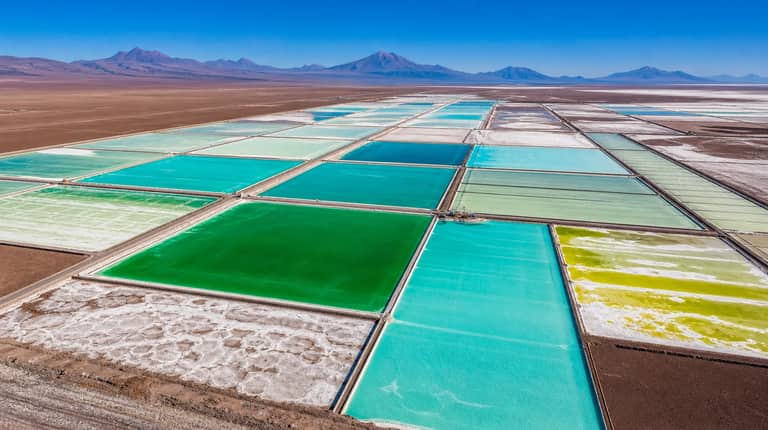
Why it made the list: SQM pulls lithium from brine, the lithium-rich saltwater under Chile's Atacama Desert, which is the lowest-cost lithium source on earth. That cost edge kept the company profitable even when prices collapsed. Lithium sits alongside iodine and specialty fertilizer, so SQM is not betting everything on one product.
The bull case: Low costs mean SQM can keep producing at prices that force higher-cost rivals to idle mines, and they widen into fat margins whenever prices recover. SQM pays a dividend, rare in this group. Its Atacama venture has budgeted $3 billion to deploy new extraction technology at the salar, and it filed for environmental approval of that expansion in July.
The risk: SQM has folded its Atacama operations into NovaAndino Litio, a venture with Chile's state miner Codelco that holds exclusive rights to the salar through 2060. SQM manages it until 2030, then Codelco takes over, and profits are shared throughout.
Key number: Atacama is forecast to supply 12% of the world's mined lithium this year.
Albemarle (NYSE: ALB)
Why it made the list: Albemarle, based in Charlotte, North Carolina, is the largest Western lithium producer and the closest thing the sector has to a blue chip. Two other segments, bromine and specialty catalysts, generate steady cash that cushions lithium's swings.
The bull case: Management cut costs and capital spending hard during the downturn, so higher prices drop quickly to the bottom line. First-quarter net income reached $319 million against $41 million a year earlier, as energy storage volumes rose 14% and prices rose 51%. The company guides to lithium demand growing at a 10% to 20% annual rate through 2030, with grid storage now a second driver alongside electric vehicles.
The risk: Albemarle's earnings are the most exposed to the lithium price among the large-caps, so the same swing that lifts the stock can pull it down fast. It also carries more debt than SQM, which raises the stakes if the recovery keeps sliding.
Key number: First-quarter net income of $319 million, up from $41 million a year earlier.
Sigma Lithium (NASDAQ: SGML)
Why it made the list: Sigma Lithium runs the Grota do Cirilo mine in Brazil, one of the lowest-cost greenfield (newly built) lithium operations in the world. It already produces and ships concentrate, so this is a real producer, not a promise.
The bull case: Low costs and an expansion plan let Sigma grow output into the recovery. Second-quarter production hit 35,000 tons of concentrate, roughly 6% above its own guidance. Its single, focused asset keeps the story simple.
The risk: Everything depends on one mine in one country, so any operational or political setback in Brazil hits hard. Sigma is also working through a strategic review, holding proposals from global energy, auto, and battery companies, with a majority-of-minority shareholder vote set to decide the outcome.
Key number: 35,000 tons of concentrate produced in the second quarter, about 6% above guidance.
Lithium Americas (NYSE: LAC)
Why it made the list: Lithium Americas owns Thacker Pass in Nevada, the largest known lithium resource in the United States. General Motors holds a 38% stake in the project, and the US Department of Energy backed it with a $2.23 billion loan.
The bull case: Construction is well underway, with more than 1,300 workers on site as of May and headcount expected to top 2,000 at peak. The company held roughly $1.2 billion in total cash at the end of the first quarter, so the build is funded. Phase 1 is designed for 40,000 tons a year of battery-quality lithium carbonate, making Thacker Pass a cornerstone of domestic supply at a time when Washington wants lithium made at home.
The risk: The company has no lithium revenue yet. Mechanical completion is targeted for late 2027, and a commissioning ramp of six to twelve months pushes full production into 2028, which is a long wait. It has also been raising cash by selling shares, which dilutes existing holders.
Key number: $2.23 billion US Department of Energy loan backing Thacker Pass.
Standard Lithium (NYSE American: SLI)
Why it made the list: Standard Lithium is the smallest name here, and it earns a spot on federal backing and a US location. Its South West Arkansas project uses direct lithium extraction (DLE), a faster method that pulls lithium straight from brine without large evaporation ponds.
The bull case: The project is a joint venture with Norway's Equinor, which owns 45%, and it won a $225 million US Department of Energy grant. The Department of Energy closed its environmental review in May 2026 with no added mitigation measures, and the partners have since awarded the last major construction contract ahead of a final investment decision.
The risk: Standard Lithium has no revenue, first commercial production is not expected until 2029, and DLE at full commercial scale is still unproven. The shares have given back much of their 2025 run as the sector cooled.
Key number: $225 million federal grant plus a deep-pocketed Equinor partner.
Sector Overview
Lithium went through a full boom and bust. Prices spiked above $80,000 a ton in 2022, then crashed below $14,000 by late 2025 as a wave of new supply met slower electric-vehicle growth. That crash forced miners to cut output and shelve projects, which drove a rebound that peaked near $25,000 a ton in April.
The rebound is now working against itself. Higher prices pulled idled supply straight back online, and carbonate has fallen about 11% in a month to roughly $21,000 a ton, its lowest level in nearly four months. UBS downgraded the sector on a view that oversupply runs through the year, and the deficit most analysts once penciled in for 2026 has slid toward 2027 and 2028.
Demand is not the weak link. One major Chinese producer expects global lithium demand to grow 30% to 40% this year, and Chinese battery makers are raising production schedules to defend market share even as EV orders there cool. Grid storage has become a second engine alongside cars, as utilities and data-center operators install large battery banks to firm up wind and solar power. Our guide to the best battery stocks covers that chain from raw lithium through to finished cells, and the best EV stocks guide covers the demand side. The trouble is that supply restarts faster than it gets built, which caps how quickly prices climb.
The 2025 sale of Arcadium to Rio Tinto removed the largest pure-play producer from the market, which is part of why the US-listed list is so short. It also signals that big mining companies see value in lithium near the bottom of the cycle.
Lithium is one piece of a wider critical-minerals push. The same forces driving it, electrification and a scramble for domestic supply, also lift other metals. See our guides to the best copper stocks, best rare earth stocks, and best uranium stocks for the rest of the cluster.
What to Watch
- Lithium price: Whether carbonate finds a floor near $21,000 a ton as restarted supply from Jianxiawo, Bald Hill, and Finniss works through the market.
- Albemarle earnings: Second-quarter results land August 5, the clearest read on whether cost cuts are protecting margins while prices slide.
- Sigma Lithium: Full second-quarter results are due in mid-August, along with any word on the strategic review and the shareholder vote that settles it.
- Chile: NovaAndino Litio filed in July for environmental approval of its $3 billion Atacama expansion, the first big milestone for the SQM-Codelco venture.
- Arkansas: A final investment decision (FID), the formal go-ahead to build, from Standard Lithium and Equinor, expected this year now that the last major construction contract is awarded.
Bottom Line
For investors who want lithium exposure through individual stocks, SQM and Albemarle offer scale and lower risk, Sigma Lithium adds a low-cost producer, and Lithium Americas and Standard Lithium are higher-risk bets on US supply. The deficit has been delayed, not canceled, so this is a patience trade. Match the pick to how much volatility you can stomach.
Frequently Asked Questions
What is the best lithium stock to buy right now?
SQM and Albemarle are the two safest large-cap lithium stocks because of their low production costs and revenue beyond lithium. SQM mines the lowest-cost brine in Chile and pays a dividend, while Albemarle is the largest Western producer with two non-lithium segments that steady its cash flow.
Is lithium a good investment in 2026?
Lithium carbonate trades near $21,000 a ton, well off its late-2025 lows but sliding again as idled mines restart. UBS and others now expect oversupply to last through the year, with the supply deficit pushed toward 2027 and 2028. That backdrop favors low-cost producers that can afford to wait, but the sector stays volatile, so position sizes should reflect the risk.
What is the largest lithium producer in the United States?
Albemarle is the largest US-based lithium company and the biggest Western producer. For future domestic mine supply, Lithium Americas' Thacker Pass project in Nevada holds the largest known US lithium resource and is backed by General Motors and a Department of Energy loan.
Are there any pure US lithium stocks?
Pure US plays are limited. Lithium Americas (Nevada) and Standard Lithium (Arkansas) are the clearest domestic development stories, both pre-revenue and both carrying federal funding. Albemarle is US-based but produces around the world.
Why did lithium stocks crash?
A surge of new mine supply arrived just as electric-vehicle sales growth slowed in 2023 and 2024, pushing lithium prices down more than 80% from their 2022 peak. Producers cut output in response, which drove a rebound into early 2026. Prices have since slipped again as those idled mines come back.