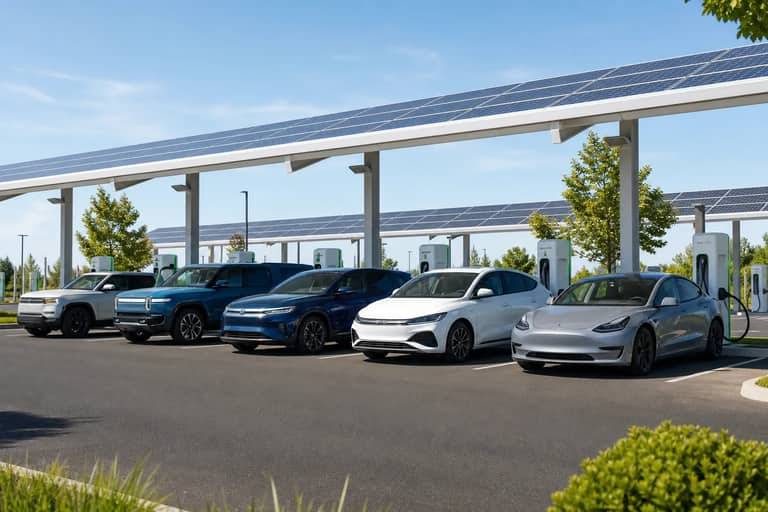
The best EV stocks right now include Tesla, BYD, General Motors, Ford, Rivian, Li Auto, and NIO, chosen for their scale, delivery growth, and position in a market that is finally separating winners from also-rans. The signal this year is clear. Tesla delivered 480,126 vehicles in the second quarter, up 25 percent from a year earlier and its first year-over-year delivery growth after a rough stretch. BYD now outsells every other electric and plug-in hybrid brand on earth. Legacy makers like GM and Ford are scaling real EV volume, while pure plays like Rivian and NIO chase the same milestones. We screened the largest US-listed EV names and narrowed the field to seven, ordered here by market value.
How We Picked These Stocks
Dozens of companies claim a piece of the electric vehicle market, but most are too small, too speculative, or too dependent on a single unproven model to belong on a serious list. We filtered for four things: a US listing, electric vehicles as a core business, enough size and trading volume to matter, and a credible record of or path to profitability. We excluded micro-cap startups with no meaningful deliveries. The result is seven names that split into two clear groups. Tesla, BYD, GM, Ford, and Li Auto have all posted profits. Rivian and NIO are still burning cash as they scale. Know which group a stock sits in before you buy.
The Best EV Stocks Right Now
Tesla (NASDAQ: TSLA)
Why it made the list: Tesla is the benchmark every other name gets measured against. It is the largest pure EV maker in the West and the most profitable, and it just returned to growth after a bruising year. It delivered 480,126 vehicles in the second quarter, up 25 percent from a year earlier and roughly 74,000 above Wall Street estimates.
The bull case: Beyond cars, Tesla is building large businesses in energy storage and betting heavily on autonomy and robotaxis, areas that could reprice the stock if they scale. Our look at whether Tesla can spend its way to autonomy digs into that push.
The risk: The stock trades at a valuation far above any other automaker, so it needs the autonomy and energy stories to deliver, not just the cars.
Key number: 480,126 vehicles delivered in the second quarter, up 25 percent year over year.
BYD (OTC: BYDDY)
Why it made the list: BYD is the Chinese giant that passed Tesla to become the world's top seller of electric and plug-in hybrid vehicles. It makes its own batteries, chips, and cars, a level of vertical integration no Western rival matches.
The bull case: BYD sells millions of vehicles a year and is expanding aggressively into Europe, Southeast Asia, and Latin America, giving it a global growth runway most EV makers can only envy.
The risk: US tariffs effectively lock BYD out of the American market, and its US-listed shares (an ADR, a foreign stock that trades on American markets) change hands over the counter, which brings less liquidity and disclosure than a major exchange listing.
Key number: BYD is the world's largest maker of electric and plug-in hybrid vehicles by volume.
General Motors (NYSE: GM)
Why it made the list: General Motors has become the clearest legacy-automaker EV story in the US. It is now the number two seller of electric vehicles in the country behind Tesla, and its lineup, built on its Ultium battery platform, is finally reaching real scale.
The bull case: GM's EV portfolio spans the Chevrolet, Cadillac, and GMC brands, and management has said the EV business is approaching break-even, a milestone most rivals are still far from.
The risk: GM still earns the bulk of its profit from gas-powered trucks and SUVs, and a slowdown in EV adoption or a renewed price war would pressure the transition.
Key number: GM ranks as the second-largest EV seller in the United States.
Ford (NYSE: F)
Why it made the list: Ford takes a different path, pairing electric models like the F-150 Lightning and Mustang Mach-E with a fast-growing hybrid business. It reports its EV unit, called Model e, separately so investors can see the economics clearly.
The bull case: Ford's commercial arm, Ford Pro, sells electric vans and trucks to businesses with service contracts attached, a steadier and more profitable slice of the EV market than consumer sales.
The risk: Ford's Model e division loses billions of dollars a year, and the company has delayed and rescaled EV projects as buyer demand shifted toward hybrids.
Key number: Ford's Model e unit remains deeply unprofitable even as its hybrid sales climb.
Rivian (NASDAQ: RIVN)
Why it made the list: Rivian is the leading US EV pure play after Tesla, known for its R1T truck, R1S SUV, and a large commercial van deal with Amazon. Its newer, cheaper R2 SUV started reaching customers this year and is the key to hitting a mass-market price.
The bull case: A joint venture with Volkswagen worth up to $5.8 billion gives Rivian both cash and a partner for software and electrical architecture, and the company raised its full-year delivery outlook after early R2 demand.
The risk: Rivian still loses money on a full-cost basis and depends on the R2 ramp going smoothly to reach sustained profitability.
Key number: The Volkswagen joint venture is worth up to $5.8 billion to Rivian.
Li Auto (NASDAQ: LI)
Why it made the list: Li Auto is one of the few Chinese EV makers to string together profitable quarters, built on extended-range electric SUVs, vehicles that carry a small gas engine used only to recharge the battery and erase range anxiety.
The bull case: Its extended-range models sell well with Chinese families, and the company is expanding into pure battery-electric vehicles and building out its own fast-charging network.
The risk: China's brutal EV price war is squeezing margins across the industry, and Li Auto's stock has fallen hard from its highs as growth has slowed.
Key number: Li Auto has been among the most consistently profitable of China's EV startups.
NIO (NYSE: NIO)
Why it made the list: NIO is a premium Chinese EV maker best known for its battery-swap stations, which let drivers exchange a depleted battery for a full one in minutes instead of waiting to charge.
The bull case: NIO is launching lower-priced sub-brands to reach a wider market and has built a loyal customer base and a swapping network that is hard to copy.
The risk: NIO loses substantial money each quarter and has repeatedly needed outside funding, so its progress depends on cutting those losses as it scales.
Key number: NIO remains lossmaking and trades well below its historic highs.
Where the EV Market Stands Now
The electric vehicle market has entered a harder, more honest phase. The early years rewarded almost any company with an EV story, and valuations soared on promises. Now the market pays for delivered vehicles, real margins, and a credible path to profit. That shift explains why Tesla, BYD, GM, and Ford sit at the top of this list while a wave of smaller startups has stalled or vanished.
Two forces shape the sector today. The first is price. A global price war, led by Chinese makers, has pushed EV prices down and squeezed margins for everyone, which is why even strong operators like Li Auto have watched their stocks fall. The second is policy. Tariffs, tax credits, and emissions rules differ sharply by country and shift with each election, and they can make or break a company's access to a market almost overnight.
Underneath the cars sits the supply chain that feeds them. The same demand that drives EV sales pulls on batteries and raw materials, which is why our guides to the best battery stocks and best lithium stocks pair naturally with this one. The wider move toward electrification also ties into the best energy stocks powering the grid these vehicles plug into.
What to Watch
What to watch:
- Quarterly delivery numbers: Each maker reports vehicle deliveries every quarter, and those figures move these stocks more than almost anything else.
- China's price war: Any easing or worsening of the discounting battle in China would ripple through Li Auto, NIO, and BYD.
- US policy and tariffs: Changes to EV tax credits and import tariffs could reshape which companies can compete in the American market.
The Bottom Line
Electric vehicles have moved from a speculative theme to a real industry with clear leaders. Tesla, BYD, GM, and Ford offer scale and profits, while Rivian, Li Auto, and NIO offer faster potential growth with more risk. Investors who want stability lean toward the profitable giants, while those willing to accept volatility can add a smaller position in the growth names.
Frequently Asked Questions
What are the best EV stocks to buy?
The largest and most established EV stocks include Tesla, BYD, General Motors, and Ford, all of which are profitable and sell vehicles at scale. Rivian, Li Auto, and NIO are higher-growth, higher-risk names tied to newer models and expanding markets. A balanced approach often mixes one or two profitable leaders with a smaller position in the growth names.
Is Tesla still the best EV stock?
Tesla remains the largest and most profitable pure EV maker in the West, and it returned to delivery growth in the second quarter with 480,126 vehicles. It also carries the highest valuation of any automaker, which means much of its future growth in energy storage and autonomy is already priced into the stock. Whether it is the single best pick depends on how much an investor believes in those newer businesses.
Are Chinese EV stocks like BYD and NIO worth buying?
Chinese makers such as BYD, Li Auto, and NIO sell large and growing volumes, and BYD is the world's top EV seller by volume. The risks include a fierce domestic price war, US tariffs that limit access to the American market, and the thinner disclosure of over-the-counter shares. They can offer strong growth but come with political and currency risk that US-listed makers do not.
Which EV companies are actually profitable?
Among the names on this list, Tesla, BYD, General Motors, and Ford post company-wide profits, though Ford's dedicated EV unit still loses money. Li Auto has been one of the few consistently profitable Chinese EV startups. Rivian and NIO are still burning cash as they scale toward profitability.
What is an extended-range electric vehicle?
An extended-range electric vehicle runs on an electric motor and battery but carries a small gasoline engine that acts only as a generator to recharge the battery, never driving the wheels directly. The design removes the worry of running out of charge on a long trip. Li Auto built its business on these vehicles, which have proven popular with Chinese families.