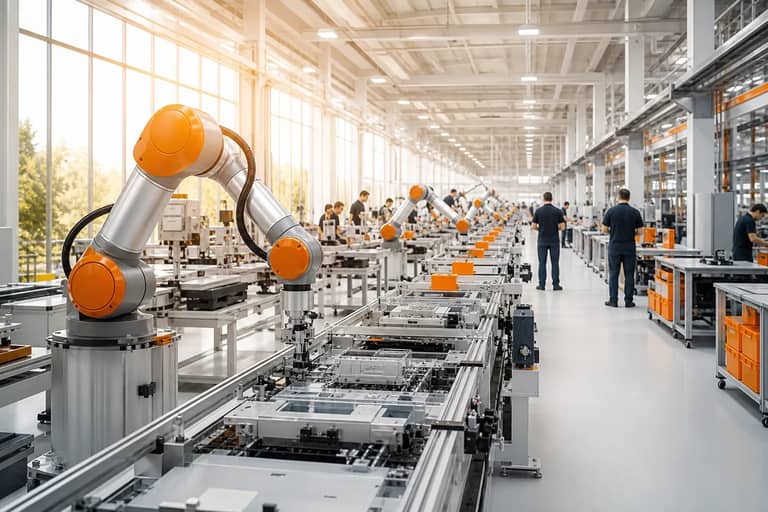
Robotics revenue is growing at double-digit rates across medical, industrial, and warehouse applications. Symbotic's contracted backlog hit a record $22.4 billion in its latest quarter, and Nvidia's data center revenue grew 92% year-over-year to $75.2 billion in fiscal Q1 2027 as AI moves off the screen and into machines. Structural labor shortages in manufacturing, healthcare, and logistics are pushing companies to automate faster than at any point in the last decade. AI is accelerating the shift by giving robots the ability to see, adapt, and work alongside humans without safety cages.
We screened over 40 publicly traded robotics and automation companies on US exchanges and narrowed the list to six. The criteria: revenue growth above 10% year-over-year, direct exposure to physical robotics or the enabling technology behind it, market capitalization above $10 billion, and a clear competitive moat in their sub-sector.
How We Picked These Stocks
More than 40 robotics-related companies trade on US exchanges, from pure-play robot makers to chip designers powering autonomous systems. We filtered for revenue growth above 10%, market cap above $10 billion, positive or rapidly improving margins, and a dominant position in at least one robotics sub-sector. We excluded companies where robotics is a minor revenue line or where the business is undergoing restructuring. The result is six companies that each own a defensible piece of the robotics value chain.
The List
Nvidia (NASDAQ: NVDA)
Why it made the list: Nvidia builds the GPU and AI platforms that power modern robotics. Its Isaac robotics platform provides simulation, perception, and manipulation software for autonomous machines, while the Jetson edge computing modules run inside physical robots from warehouse AMRs to surgical assistants. Nvidia's Project GR00T foundation model, designed specifically for humanoid robots, positions the company at the center of the next wave of embodied AI. It recently launched Halos for Robotics, a full-stack safety architecture that extends its autonomous-vehicle safety work to humanoids and industrial robots.
The bull case: Every major robotics company, from Universal Robots to Symbotic, runs on Nvidia silicon. As robots move from pre-programmed tasks to adaptive, AI-driven behavior, the computational requirements per robot increase dramatically. Nvidia's data center revenue reached $75.2 billion in fiscal Q1 2027, up 92% year-over-year, reflecting this demand across both cloud training and edge inference.
The risk: Nvidia trades at a premium valuation. Any slowdown in AI capital spending or a competitive breakthrough in custom AI chips from hyperscalers could compress the multiple.
Key number: $75.2 billion in data center revenue in fiscal Q1 2027, up 92% year-over-year.
Intuitive Surgical (NASDAQ: ISRG)
Why it made the list: Intuitive Surgical is the dominant force in surgical robotics. Its da Vinci systems performed over 2.4 million procedures in 2025, and the installed base continues to expand globally. Q1 2026 revenue hit $2.77 billion, up 23% year-over-year, driven by the rollout of the da Vinci 5 platform and 39% growth in Ion lung biopsy procedures.
The bull case: The da Vinci 5 system is driving a hardware upgrade cycle across hospitals that already own older models. The company placed 232 da Vinci 5 systems in Q1 2026 alone, up from 147 a year earlier. Management raised full-year procedure growth guidance to 13.5%-15.5%, signaling confidence in adoption.
The risk: At a market cap above $140 billion, Intuitive trades at a steep premium. Hospital capital budgets are cyclical, and any pullback in healthcare spending could slow system placements.
Key number: 431 da Vinci system placements in Q1 2026, with 232 of the newest da Vinci 5 model.
Teradyne (NASDAQ: TER)
Why it made the list: Teradyne owns Universal Robots, the global leader in collaborative robots (cobots), and Mobile Industrial Robots (MiR), which makes autonomous mobile robots for logistics. Cobots are the fastest-growing segment of industrial robotics because they work alongside humans without safety cages, making automation accessible to small and mid-sized manufacturers. The Robotics segment generated $91 million in Q1 2026 revenue.
The bull case: Universal Robots is opening a new US manufacturing hub in Wixom, Michigan, positioning for reshoring demand as manufacturers bring production back to North America. Teradyne's semiconductor test business also benefits from AI chip demand, with AI-related work now around 70% of total sales, giving the company dual exposure to two structural growth themes. The stock was added to the Nasdaq-100 in late June.
The risk: The Robotics segment remains a small fraction of total Teradyne revenue. The company's stock price is heavily influenced by semiconductor test cycles, which can be volatile. Shares fell more than 13% in a single early-July session as a memory-glut scare swept the chip sector.
Key number: $91 million in Q1 2026 Robotics revenue from Universal Robots and MiR combined.
Rockwell Automation (NYSE: ROK)
Why it made the list: Rockwell Automation is the largest pure-play industrial automation company in North America. It provides the controllers, sensors, drives, and software that connect robotic systems to factory floors. Q2 fiscal 2026 revenue reached $2.24 billion, up 12% year-over-year, with the Intelligent Devices segment posting $1 billion in quarterly sales for the first time.
The bull case: Rockwell is seeing strong demand in warehouse automation, data centers, semiconductor fabs, and energy infrastructure. The company raised its full-year guidance to $9.3-$9.7 billion in revenue and $12.50-$13.10 in EPS. Its autonomous mobile robot deployments are expanding across automotive, food and beverage, and logistics customers.
The risk: Rockwell's revenue is tied to industrial capital spending cycles. A manufacturing recession or pullback in factory construction would slow orders.
Key number: $1 billion in Intelligent Devices segment revenue in Q2 FY2026, up 13% year-over-year.
Symbotic (NASDAQ: SYM)
Why it made the list: Symbotic builds AI-powered robotic systems that automate warehouse operations for major retailers and wholesalers. Its Q2 fiscal 2026 revenue reached $676 million, up 23% year-over-year, with adjusted EBITDA of $78 million. The company holds a record $22.4 billion contracted backlog, providing multi-year revenue visibility that few robotics companies can match.
The bull case: Walmart, Symbotic's largest customer, is deploying the system across its distribution network. The company reached GAAP profitability with $9 million in net income in Q2 fiscal 2026 and sits on roughly $2 billion in cash. It closed its acquisition of Arms Innovations in early July, extending its systems into micro-fulfillment and complex inbound logistics, after buying Fox Robotics earlier for trailer unloading. Guidance calls for $700 million to $720 million in Q3 revenue and adjusted EBITDA of $80 million to $85 million.
The risk: Customer concentration is the primary concern. Symbotic relies heavily on a small number of large retail clients. Execution risk also rises as the company scales deployments across dozens of warehouse locations simultaneously.
Key number: $22.4 billion in contracted backlog with roughly $2 billion in cash on the balance sheet.
Cognex (NASDAQ: CGNX)
Why it made the list: Cognex makes machine vision systems, the cameras and AI software that give robots the ability to see. Every robot that inspects, sorts, or assembles products needs machine vision, making Cognex a picks-and-shovels play on the entire robotics sector. Q1 2026 revenue grew 24% year-over-year to $268 million, with adjusted EBITDA margin expanding more than 10 percentage points.
The bull case: Cognex launched two new embedded AI vision systems (In-Sight 6900 and In-Sight 3900) that expand its addressable market into edge-to-cloud industrial automation. The company has posted seven consecutive quarters of margin improvement. As robotics adoption accelerates in automotive, electronics, food, and logistics, demand for machine vision grows in lockstep.
The risk: Cognex is smaller than the other names on this list at roughly $11 billion in market cap. The machine vision market is competitive, with players like Keyence and Basler pushing into overlapping segments.
Key number: Seven consecutive quarters of adjusted EBITDA margin improvement, reaching 26.9% in Q1 2026.
Sector Overview
Robotics is no longer a futuristic bet. It is an operational necessity. Structural labor shortages across manufacturing, healthcare, and warehousing are forcing companies to automate tasks that were previously done by hand. The International Federation of Robotics put the global market value of industrial robot installations at an all-time high of $16.7 billion, with annual installations topping 500,000 units for a fourth straight year. US installations returned to double-digit growth in 2025, rising 11% to 38,000 units, and 2026 is tracking higher.
The integration of AI into physical robots is the catalyst accelerating this cycle. Traditional industrial robots followed pre-programmed instructions. Modern systems from companies like Symbotic, Universal Robots, and Cognex use computer vision, reinforcement learning, and foundation models to adapt in real time. Nvidia's Isaac and GR00T platforms are making this AI layer accessible to a broader range of manufacturers. Humanoid robots dominated the conversation at Automate 2026, with cage-free dual-arm machines and full-rate humanoid production lines moving from demos toward commercial deployment. We covered the broader AI infrastructure boom and its implications for hardware companies earlier this year.
The reshoring trend is adding fuel. Government incentives for domestic manufacturing, tariff-driven supply chain shifts, and new semiconductor fab construction are all driving demand for industrial automation. The same buildout pushed chip equipment makers to record highs in June. Defense contractors are also increasing their use of autonomous systems, creating crossover demand for robotics technology.
What to watch:
- Intuitive Surgical earnings on July 16: Wall Street expects around $2.40 in EPS. Da Vinci 5 placement pace and any change to procedure growth guidance are the numbers that will move the stock.
- Teradyne earnings on July 29: After a sharp early-July selloff tied to chip-sector memory-glut fears, the report will test whether AI-driven test demand, now around 70% of sales, can keep momentum going.
- Symbotic earnings on August 5: With a record $22.4 billion backlog, Q3 guidance of $700 million to $720 million in revenue, and the Arms Innovations deal now closed, investors will watch deployment pace and how fast the acquisition integrates into revenue.
- Nvidia earnings on August 26: Chip stocks sold off in early July on questions about how long cloud platforms will keep spending on AI infrastructure. Nvidia's fiscal Q2 2027 report, now confirmed for August 26, is the sector's next major read on data center and robotics-chip demand, and Teradyne trades with the same cycle.
Bottom Line
Robotics exposure spans multiple price points and risk profiles. Nvidia and Intuitive Surgical offer large-cap stability with premium valuations. Teradyne and Rockwell provide diversified industrial exposure with robotics upside. Symbotic and Cognex are more concentrated bets on warehouse automation and machine vision, respectively. Investors looking to build robotics exposure can mix across these sub-sectors based on their risk tolerance.
Frequently Asked Questions
What are the best robotics stocks to buy right now?
The strongest robotics stocks for 2026 include Nvidia (NVDA) for AI-powered robotics platforms, Intuitive Surgical (ISRG) for medical robotics, Teradyne (TER) for collaborative robots through its Universal Robots division, Rockwell Automation (ROK) for industrial automation, Symbotic (SYM) for warehouse robotics, and Cognex (CGNX) for machine vision systems. Each company holds a dominant position in its sub-sector with double-digit revenue growth.
Is robotics a good investment in 2026?
The robotics sector is growing at double-digit rates driven by three structural forces: chronic labor shortages in manufacturing and logistics, falling hardware costs, and the integration of AI into physical automation systems. Companies with strong backlogs and recurring revenue, like Symbotic and Rockwell, offer more visibility than early-stage robotics startups with no revenue.
What is the difference between industrial robots and collaborative robots?
Industrial robots are large, high-speed machines that operate behind safety cages in factories, handling heavy tasks like welding and painting. Collaborative robots (cobots), pioneered by Universal Robots (owned by Teradyne), are smaller, lighter, and designed to work safely alongside humans without barriers. Cobots are the fastest-growing segment because they cost less to deploy and are accessible to small manufacturers that could not justify traditional industrial automation.
How does AI change the robotics investment thesis?
AI transforms robots from pre-programmed machines into adaptive systems that can see, learn, and respond to changing environments. Nvidia provides the GPU platforms and simulation tools. Cognex provides the AI-powered vision systems. Symbotic uses AI to coordinate thousands of robots in a single warehouse. The automotive sector is also pushing toward autonomy, as we explored in our analysis of Tesla's spending on self-driving technology. Companies at the intersection of AI and physical automation are seeing the fastest revenue growth in the sector.
What ETFs focus on robotics stocks?
The three largest robotics ETFs are the Global X Robotics and Artificial Intelligence ETF (BOTZ), the ROBO Global Robotics and Automation Index ETF (ROBO), and the First Trust Nasdaq AI and Robotics ETF (ROBT). All three hold some combination of the stocks on this list. For investors who prefer diversified exposure over individual stock picks, these ETFs provide broad robotics coverage in a single position.