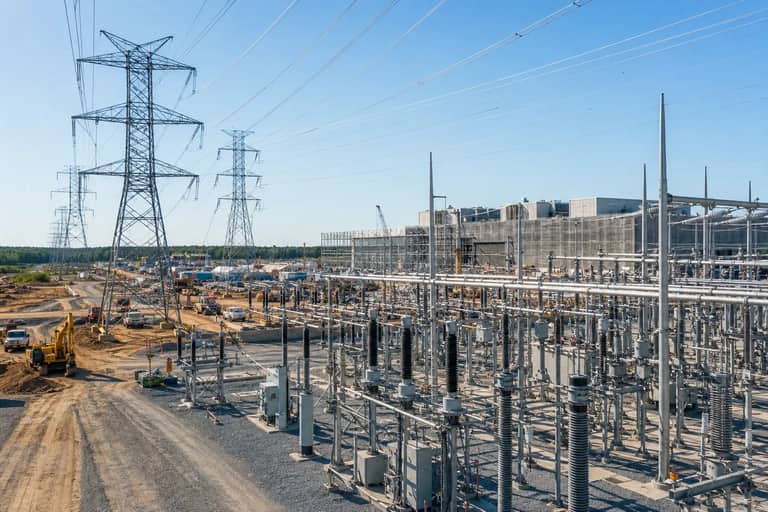
The biggest infrastructure story right now is not roads or bridges. It is power. US data center electricity demand is on track to rise from about 31 gigawatts in 2025 to roughly 41 gigawatts in 2026, and worldwide data center spending is set to pass $1 trillion this year. That wave of construction needs transformers, switchgear, aggregates, rail capacity, and rented equipment on every job site.
The best infrastructure stocks to buy right now are the companies that supply the physical backbone: heavy equipment makers, electrical grid suppliers, materials producers, railroads, and the contractors who wire it all together. These are not speculative names. Most are decades old, profitable, and sitting on growing order books.
Below are seven infrastructure stocks that fit the moment, screened on scale, backlog strength, and pricing power. Live figures update on every page load, so the numbers you see are current.
How We Picked These Stocks
We started with companies whose core revenue comes from building or supplying physical infrastructure, then applied three filters. First, scale: a market cap large enough to win national projects and absorb a slow quarter, generally above $10 billion, with one smaller pure play included for growth exposure. Second, demand visibility: a rising backlog, long-term contracts, or a structural tailwind like grid spending or reshoring. Third, financial durability: real free cash flow and a balance sheet that can fund equipment and acquisitions without stress.
We deliberately spread the list across the value chain. Owning one equipment maker, one grid supplier, one materials producer, one railroad, and one contractor gives broader exposure than stacking five names that rise and fall together.
The 7 Best Infrastructure Stocks
Caterpillar (NYSE: CAT)
Why it made the list: Caterpillar is the default name in heavy construction and mining equipment, and its Energy and Transportation segment sells the reciprocating engines, turbines, and generator sets that power data centers directly. When a hyperscaler needs backup power or a contractor needs an excavator, Caterpillar is usually on the short list.
The bull case: Three demand streams pull in the same direction: construction, mining for the metals the buildout needs, and power generation for data centers. That diversification smooths the cycle that used to whip the stock around.
The risk: Equipment sales are still tied to construction activity, and higher interest rates or a building slowdown would hit new orders first.
Key number: Caterpillar has raised its dividend for more than 30 straight years, one of the longest streaks in industrials.
Union Pacific (NYSE: UNP)
Why it made the list: Union Pacific runs one of the two dominant freight rail networks in the western United States, moving the coal, chemicals, construction products, and finished goods that physical infrastructure runs on. Railroads are close to impossible to replicate, which is why the network itself is the moat.
The bull case: Rail is the cheapest way to move heavy freight over land, and reshoring of manufacturing adds volume without adding a single mile of new track. Pricing power tends to hold even when volumes wobble.
The risk: Freight volumes track the industrial economy, so a manufacturing recession would pressure carloads and revenue.
Key number: Union Pacific operates more than 32,000 route miles connecting Pacific and Gulf Coast ports to the Midwest.
Eaton (NYSE: ETN)
Why it made the list: Eaton is a power management company that makes the electrical gear, switchgear, and distribution equipment sitting between the grid and the building. Every data center, factory, and grid upgrade needs its products, which puts Eaton at the center of the electricity demand surge. Our best AI stocks guide covers the chip side of that same buildout.
The bull case: The electrical segments now drive the bulk of profit, and the order backlog has grown sharply as utilities and hyperscalers race to add capacity. Electrification is a decade-long tailwind, not a one-year trade.
The risk: Expectations are high, and the valuation leaves little room for a slip in electrical orders.
Key number: Eaton's electrical backlog has expanded to record levels over the past three years.
Quanta Services (NYSE: PWR)
Why it made the list: Quanta Services is the largest specialty contractor for electric power infrastructure, the crews that build and upgrade transmission lines, substations, and smart grid systems. If the grid gets rebuilt for AI and electrification, Quanta does much of the physical work. Its renewable and pipeline segments broaden the base, and it ties directly to demand from the best energy stocks.
The bull case: Grid modernization is a structural need, not a choice, and Quanta's skilled labor force is a genuine bottleneck that competitors cannot quickly copy.
The risk: As a contractor, margins depend on project execution, and a few troubled jobs can dent a quarter.
Key number: Quanta's total backlog has climbed to record levels, giving multiple years of visible work.
United Rentals (NYSE: URI)
Why it made the list: United Rentals is the largest equipment rental company in North America, and rental is how most infrastructure and data center projects now get their machines. Renting instead of buying lets contractors scale up fast, and United Rentals owns the biggest fleet and branch network to serve them.
The bull case: Large projects favor the biggest renter with the deepest fleet, and the specialty segment (power, climate control, trench safety) carries higher margins and recurring demand.
The risk: Rental demand is cyclical and moves with construction starts, so a downturn would cut utilization and rates at the same time.
Key number: United Rentals runs more than 1,300 rental locations across North America and beyond.
Vulcan Materials (NYSE: VMC)
Why it made the list: Vulcan Materials is the largest US producer of construction aggregates, the crushed stone, sand, and gravel under every road, foundation, and data center pad. Aggregates are heavy and cheap to make but expensive to ship, so local quarries act like regional monopolies with real pricing power.
The bull case: Federal infrastructure funding and private construction both consume aggregates, and Vulcan has raised prices consistently through cycles. You cannot pour a foundation without its product.
The risk: Volumes depend on construction activity and public funding, and a housing or public spending slowdown would soften demand.
Key number: Vulcan is the number one aggregates producer in the country, supplying materials across about 20 states.
Sterling Infrastructure (NASDAQ: STRL)
Why it made the list: Sterling Infrastructure is the pure play growth name on this list. Its e-infrastructure segment does site development for data centers, e-commerce, and warehouse clients, exactly the projects driving today's construction boom, alongside transportation and building work.
The bull case: E-infrastructure is the fastest growing segment, tied directly to hyperscaler site work, and the smaller size means each large win moves the needle more than it would for a mega cap.
The risk: Higher beta and project concentration make the stock more volatile, and it pays no dividend, so the return case rests entirely on growth.
Key number: Sterling's e-infrastructure segment now anchors its highest margin work and blue chip data center clients.
Infrastructure Stocks at a Glance
Why Infrastructure Is a Story Right Now
For two decades US electricity demand was essentially flat. That era is over. AI data centers, factory reshoring, and the electrification of transport are pulling demand higher at the same time, and the physical systems to meet it, power plants, transmission lines, substations, and the roads and rail that serve them, are being built or rebuilt at once.
The money behind this is unusually visible. Data center construction alone is a multiyear commitment, and the grid upgrades required to feed those sites stretch out over a decade. That gives the contractors, equipment makers, and materials producers on this list longer order books than they have carried in years. The same power demand that lifts the best nuclear stocks and utilities flows straight to the companies that pour the concrete and string the wire.
There is a second engine underneath it. Federal infrastructure funding for roads, bridges, water systems, and ports is still being spent, and reshoring of manufacturing is adding factory construction that did not exist five years ago. A robot on a new factory floor needs a building, power, and rail access first, which is why the best robotics stocks and infrastructure names ultimately draw on the same wave.
What to Watch
- Quarterly backlog updates. For Eaton, Quanta, and Sterling, the order backlog is the clearest read on future revenue. A rising backlog confirms the buildout is still accelerating.
- Interest rates and construction starts. Higher rates slow new projects and pressure the equipment and rental names first. Watch construction spending data and rate decisions.
- Data center announcements. Each new hyperscaler campus pulls power, materials, and site work with it. Large project announcements are a leading signal for the whole group.
Bottom Line
The best infrastructure stocks to buy right now are the companies that supply the picks and shovels of the power and construction boom, not the headline tech names on top of it. Caterpillar, Union Pacific, Eaton, Quanta, United Rentals, and Vulcan give large, profitable exposure across equipment, rail, grid, and materials, while Sterling adds a higher growth, higher risk pure play. Spreading a position across the value chain captures the buildout without betting the outcome on any single project.
Frequently Asked Questions
What are infrastructure stocks? Infrastructure stocks are companies that build, supply, or operate the physical systems an economy runs on: roads, bridges, power grids, railroads, water systems, and the equipment and materials that go into them. Examples include heavy equipment makers, electrical suppliers, aggregates producers, railroads, and construction contractors.
Are infrastructure stocks a good investment right now? They are tied to a rare combination of tailwinds: surging electricity demand from data centers, federal infrastructure funding, and manufacturing reshoring. That gives many infrastructure companies growing, multiyear order books. Like any equity, they still carry cyclical risk if construction activity slows, so position sizing matters.
Do infrastructure stocks pay dividends? Some do and some do not. Established names like Caterpillar, Union Pacific, and Eaton pay dividends, and Caterpillar has raised its payout for over 30 years. Growth focused contractors such as Sterling Infrastructure often reinvest all cash into expansion and pay nothing, so check each company individually.
How is investing in infrastructure stocks different from an infrastructure ETF? Buying individual stocks lets you target the specific parts of the value chain you believe in, such as grid equipment over materials. An infrastructure ETF spreads risk across dozens of names in one purchase but dilutes your exposure to any single winner. Many investors hold a core ETF and add a few individual names on top.
Which infrastructure stock has the most exposure to data centers? Eaton and Quanta Services have the most direct grid and power exposure to data centers, while Sterling Infrastructure does the physical site development for data center campuses. Caterpillar supplies the backup power and generators. Each touches the same trend from a different angle.